
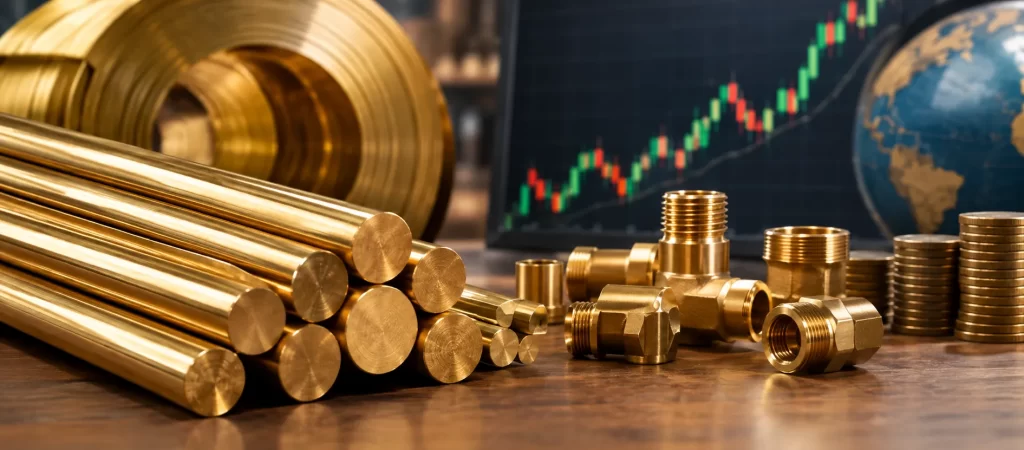
Why does the brass rate change every day? Why does a 50-gram brass fitting cost more than 50 grams of brass? This
guide from Anand Brass Components explains how brass is priced, from copper and zinc on the exchanges to the
finished, machined part.
⚡ Quick Answer
What decides the brass price per kg?
The brass price per kg follows copper and zinc prices, which trade daily on the London Metal
Exchange (LME) and, in India, on MCX. Brass is roughly 60–70% copper, so copper drives most of the
price. On top of the metal value, the price depends on the form you buy. Scrap trades
at a discount to metal value. Rod and bar add extrusion cost. Finished parts add
machining, finishing, inspection, packing and freight, which together often cost more than the metal itself.
Indicative Jamnagar brass scrap rates on 9 October 2026 were around ₹426 per kg (base), but rates change daily, so
always check a live quote.
“What’s the brass rate today?” is one of the most common questions in the metals trade, from scrap dealers in
Jamnagar to procurement managers in Chicago. The honest answer is that there isn’t one brass price. There’s a
metal value that moves every trading day, and then there are the prices of scrap, rod, castings and finished
components, each built on top of that metal value differently.
At Anand Brass Components we buy brass, extrude it into rod
in-house and machine it into finished parts for buyers in 30+ countries. So we see every layer of the price,
from the melt to the shipping carton. This guide explains each layer so you can read a quotation with confidence
and understand why it moves.
🎯 Key takeaways
- Copper is the main driver. At around
60–70% of brass by weight, and far pricier than zinc, it sets most of the metal value. - Prices change daily with the LME and
MCX, currency rates and local scrap supply. - Form matters. Scrap is cheapest, rod
costs more, and machined parts cost the most per kg. - For finished parts, metal is often under half
the cost. Machining time, finish and quantity frequently matter more. - Swarf has value. Machining chips are
recycled, and good suppliers credit that value in their price. - Metal-linked contracts protect both
buyer and supplier when copper prices swing.
How brass is priced: the three layers
Think of any brass price as three stacked layers:
- Metal value. This is the value of the copper and zinc in the alloy, based on exchange
prices. It moves every day. - Conversion cost. This is the cost to turn metal into a usable form: melting, casting,
extrusion or forging. It is fairly stable and depends on energy, labor and equipment. - Value added. This covers machining, finishing, inspection, certification, packing,
logistics and margin. It is specific to each part, and for complex components it is often the largest layer.
Scrap prices are essentially layer 1 minus a discount for sorting and remelting losses. Rod prices are layer 1
plus layer 2. Component prices include all three.
The metal-value formula (with a worked example)
You can estimate the metal value of any brass grade from its composition:
Metal value per kg ≈ (Cu% × copper price per kg) + (Zn% × zinc price per kg) + (other elements ×
their prices)
Worked example (illustrative prices only): Take free-cutting brass with about 61% copper, 36%
zinc and 3% lead. Assume copper at ₹900/kg, zinc at ₹280/kg and lead at ₹190/kg.
| Element | Share | Assumed price / kg | Contribution / kg of brass |
|---|---|---|---|
| Copper | 61% | ₹900 | ₹549.00 |
| Zinc | 36% | ₹280 | ₹100.80 |
| Lead | 3% | ₹190 | ₹5.70 |
| Metal value | 100% | — | ≈ ₹655.50 |
The prices here are assumptions chosen to show the arithmetic, not today’s rates. Plug in live LME or MCX
prices for a real estimate. Copper contributes about 84% of the metal value in this example.
Two things follow from this. First, a 10% move in copper shifts brass value by roughly 8%,
while a 10% move in zinc shifts it by only about 1.5%. Second, higher-copper brasses cost more:
70/30 cartridge brass carries more copper value per kg than 60/40 forging brass.
8 factors that move brass prices
| Factor | Effect on brass price | How fast it changes |
|---|---|---|
| 1. Copper price (LME / MCX) | Largest single driver | Daily |
| 2. Zinc price | Smaller effect | Daily |
| 3. Currency (USD/INR) | Metals are priced in USD globally; a weaker rupee raises Indian brass prices | Daily |
| 4. Scrap supply | Most brass is made from recycled scrap; tight scrap supply raises premiums | Weekly / seasonal |
| 5. Import duties & trade policy | Duties on scrap or metal change local cost; export tariffs change landed cost | Policy-driven |
| 6. Energy & labor | Affect conversion cost (melting, extrusion) | Monthly / yearly |
| 7. Grade & special additions | Lead-free (silicon, bismuth) and DZR grades cost more than standard free-cutting brass | Stable |
| 8. Demand cycles | Construction, plumbing and electrical demand shift premiums | Seasonal |
For buyers in the USA, import tariffs can add far more to landed cost than metal price swings. In 2026, many
brass articles face a 50% Section 232 copper tariff. See US Tariffs on Brass
Components from India (2026).
Price by form: scrap vs ingot vs rod vs finished parts
| Form | Typical price vs metal value | What’s included |
|---|---|---|
| Mixed / dirty scrap | Below metal value | Discount for sorting, contamination, melt loss |
| Sorted, clean scrap (e.g. “Honey”) | Closer to metal value | Less processing needed |
| Ingots / billets | Around metal value plus melting cost | Melting, refining, casting |
| Extruded rod & profiles | Metal value plus conversion premium | Extrusion, drawing, straightening, cutting |
| Forgings | Higher, per kg | Dies, hot forging, trimming |
| Machined components | Highest per kg, often several times metal value | Machining, finishing, inspection, packing |
For a full guide to scrap grades and how they’re sorted, read Brass Scrap Explained. For buying
rod,
see How to Choose a Brass Rod
Manufacturer
and our brass extruded rods page.
What a brass component really costs: a cost breakdown
Buyers are often surprised that a small brass fitting can cost two or three times its metal value. Here’s where
the
money goes on a typical CNC-turned brass part:
| Cost element | What drives it | Typical influence |
|---|---|---|
| Raw material (gross weight) | Bar size, part weight, metal price | High for simple, heavy parts |
| Scrap credit (swarf) | Material removed during machining is sold back | Reduces cost; larger on parts with heavy machining |
| Machining time | Cycle time, number of operations, tolerances | Often the largest element for complex parts |
| Tooling & setup | Special tools, fixtures, forging dies | High for small batches; spread over volume |
| Secondary operations | Knurling, threading, drilling, deburring | Medium |
| Surface finish | Nickel, chrome, tin plating, polishing, lacquer | Medium to high |
| Inspection & certification | CMM checks, MTCs, NSF or other approvals | Low to medium |
| Packing & logistics | Export packing, freight, insurance | Depends on Incoterm |
Gross weight vs net weight. A part weighing 50 g may be machined from a 90 g piece of rod. You
pay
for the 90 g of material, minus the scrap value of the 40 g of chips. That’s why near-net-shape forging can be cheaper than turning from bar
for
some shapes: less metal is cut away. To estimate gross weight from bar dimensions, use our Copper-Brass Weight Calculator.
Get a transparent, metal-linked quote
Anand Brass Components shows material, machining and finish separately, so you can see exactly what you’re
paying for. Quotation within 24 hours.
Worked example: building up the price of a 50 g brass fitting
To show how the layers stack, here’s an illustrative build-up for a simple CNC-turned brass adapter. It has a
50 g finished weight, is turned from 90 g of free-cutting brass rod, is nickel-plated, and is ordered in a batch
of 10,000. All figures are illustrative, using the assumed metal value of ₹655.50/kg from the formula section,
and are not a quotation.
| Line | Basis | Per piece (₹) | Share |
|---|---|---|---|
| Metal value of rod (90 g) | 0.090 kg × ₹655.50 | 59.00 | — |
| Extrusion / rod conversion premium | Illustrative ₹60/kg × 0.090 kg | 5.40 | — |
| Less scrap credit on 40 g chips | 0.040 kg × ₹655.50 × 85% | −22.29 | — |
| Net material | 42.11 | ~47% | |
| CNC machining | Cycle time × machine-hour rate | 22.00 | ~25% |
| Tooling & setup (spread over 10,000 pcs) | Amortized | 1.50 | ~2% |
| Nickel plating | Per piece | 9.00 | ~10% |
| Inspection, packing | Per piece | 4.00 | ~5% |
| Overheads & margin | Illustrative | 10.50 | ~12% |
| Ex-works price | ≈ 89.11 | 100% |
Illustrative numbers to show structure only. Real costs depend on the part, machine, volume, finish and current
metal prices.
Three lessons fall out of this example:
- The finished part costs about ₹1,780 per
kg (₹89 ÷ 0.05 kg), roughly 2.7 times the metal value per kg, without anyone overcharging. - Material is under half the price. A 10%
copper rise moves this part’s price by only about 4%. - Machining and finish are where design changes
save money. Shorter cycle times, fewer operations and the right finish matter as much as metal
price.
How to read a brass parts quotation
A good quotation for brass components should let you see these items clearly. If any are missing, ask:
| Item | Why it matters |
|---|---|
| Alloy grade and standard | Lead-free, DZR and free-cutting grades are priced differently |
| Metal price reference and date | Lets you compare quotes made on different days |
| Gross and net weight per part | Shows how much material you’re paying for |
| Scrap credit treatment | Confirms chip value is deducted |
| Tooling or die cost (one-time) | Separates setup from unit price |
| Finish and plating thickness | Plating spec drives cost and durability |
| Tolerances and inspection level | Tighter specs cost more to make and check |
| MOQ and price breaks | Shows how volume changes unit price |
| Incoterm, packing and currency | FOB vs CIF, export packing, USD vs INR |
| Validity period | Metal-sensitive quotes often hold only for days or weeks |
Why copper, and therefore brass, is so volatile
Copper is one of the most actively traded industrial metals, and its price reacts to global news quickly. The
main forces are:
- Electrification demand. Power grids,
renewable energy, electric vehicles and data centres all use large amounts of copper. - Mine supply. New mines take many years
to develop, and disruptions at major producers move prices sharply. - Trade policy. Tariffs on copper and
copper products, such as the 2025–2026 US Section 232 copper tariffs, change regional prices and trade flows. - Interest rates and the US dollar. A
stronger dollar usually weighs on dollar-priced metals. - Inventories and speculation. Exchange
stock levels and investor positioning amplify short-term moves.
For brass buyers, the practical response is not to forecast copper but to manage exposure. Use
metal-linked pricing, agree quote validity periods, and time large orders sensibly.
Brass prices in India vs global markets
Indian brass prices follow international copper and zinc but are shaped by local factors:
- MCX and LME. Indian traders watch both.
Domestic copper and zinc futures on MCX broadly track LME prices converted to rupees, plus local premiums. - Jamnagar scrap markets. As India’s
largest brass hub, Jamnagar publishes widely followed daily scrap rates. Sorted grades and red brass command a
premium over mixed yellow brass. Indicative rates on 9 October 2026 showed a base of around ₹426/kg, with
graded lots higher. - Import duty on scrap. Much of India’s
brass scrap is imported, so customs duty and freight on scrap feed into local prices. - GST. Domestic prices are usually quoted
before GST. Check whether a quote is inclusive or exclusive. - Export pricing. Export quotations are
usually in USD on FOB or CIF terms and exclude Indian GST. Read How to Import Brass Components from
India.
The scale of the Jamnagar cluster also keeps conversion costs competitive. That is one reason Indian brass
parts often land cheaper than alternatives, as we showed in India vs China for Brass
Components.
How buyers can lower the cost of brass parts
-
Reduce gross weight
Design hollow sections, reduce wall thickness where pressure allows, and choose bar sizes close to the
finished diameter. -
Pick the right process
Forging or hollow extrusions can save material on complex shapes, and turning suits small precision parts.
-
Choose the right grade
Use free-cutting brass where possible, since it machines fastest. Specify lead-free or DZR only where
regulations or water conditions require it. See Brass Alloy for CNC Machining. -
Relax non-critical tolerances
Tight tolerances add cycle time and inspection. Keep them only on functional features.
-
Order in economic batches
Setup and tooling costs are spread over volume. Blanket orders with scheduled releases often get better
pricing. -
Match finish to need
Plating adds cost. Natural or lacquered brass may be enough for indoor parts. See Brass Surface Finishes Explained.
Metal-linked pricing: protecting both sides of a contract
Because copper can move significantly within weeks, many long-running brass supply contracts use a
metal price adjustment clause:
- The quote separates the metal component
from the conversion and machining component. - The metal component is tied to an agreed reference, for
example the monthly average LME copper price, and adjusted at each order or quarterly. - The conversion component stays fixed for the contract
term.
This avoids suppliers padding prices for risk, and avoids buyers paying yesterday’s high prices when copper
falls. Anand Brass Components can quote on a metal-linked basis for repeat programs.
Brass price vs other metals
People often ask whether brass is “expensive”. The answer depends on what you compare it with. This table shows
relative raw-metal cost and, more importantly, the cost of turning each metal into a finished machined part.
| Metal | Raw material cost per kg | Machining cost | Overall for small precision parts |
|---|---|---|---|
| Copper | Highest of these | High (gummy, slow) | Expensive |
| Bronze | High (tin is costly) | Medium–high | Expensive |
| Brass | Medium–high | Lowest (fastest to machine) | Often the most economical copper alloy |
| Stainless steel | Medium | High (hard, tool wear) | Medium–high |
| Aluminium | Low | Low | Low, but lacks brass’s corrosion and sealing properties |
| Carbon steel | Lowest | Medium | Low, but needs coating to prevent rust |
This is why brass remains the default for threaded fittings, valves and terminals despite a higher metal price
than steel or aluminium: its machinability, corrosion resistance and sealing performance lower the total cost of
the finished part. For a materials comparison, see Brass
vs Stainless Steel vs Copper and Brass vs Bronze.
Brass pricing glossary
- LME: London Metal Exchange, the global
reference market for copper and zinc prices. - MCX: Multi Commodity Exchange of India,
where domestic copper and zinc futures trade in rupees. - Cash / 3-month price: LME prices for
immediate and three-month delivery. Contracts state which one they use. - Premium: the amount over the exchange
price paid for metal in a specific form, location or quality. - Metal value: the value of the copper,
zinc and other elements contained in the brass. - Conversion cost: the cost of turning
metal into rod, forgings or castings. - Gross weight: the weight of raw
material used per part, before machining. - Net (finished) weight: the weight of
the finished part. - Swarf / scrap credit: machining chips
and the value credited for them. - MOQ: minimum order quantity.
- FOB / CIF: Incoterms defining whether
the price includes ocean freight and insurance. - Metal adjustment clause: a contract
term linking the metal part of a price to an agreed index.
Common brass pricing mistakes
- Comparing part prices by kg. A complex part should cost more per kg than a simple one.
Compare like for like. - Ignoring gross weight. Two suppliers may machine from very different bar sizes.
- Forgetting the scrap credit. Ask whether swarf value has been deducted.
- Mixing up grades. Lead-free and DZR brass legitimately cost more than standard free-cutting
brass. - Comparing quotes from different dates. Copper may have moved, so normalize to the same
metal reference. - Overlooking landed cost. Duties, freight and tariffs can exceed the metal-price difference
between suppliers.
Talk to a brass manufacturer with in-house extrusion
Anand Brass Components controls metal from melt to finished part, which keeps conversion cost low and pricing
transparent.
Frequently Asked Questions
the LME and MCX, along with currency rates and local scrap supply.
adjusted for form — a discount for scrap, a premium for rod, and much more for finished parts.
sorted and red brass grades higher. Check a live market report or dealer quote.
inspection, packing and freight, which together often exceed the metal value.
by transparent suppliers.
free-cutting brass.
batches and match the finish to the real requirement.
example monthly LME average) while keeping machining cost fixed.
before GST.
Calculator.
Related guides from Anand Brass Components
Written by the Anand Brass Components Commercial Team. Anand Brass Components is a brass parts
manufacturer and exporter at Plot 4110-4111, H-Road, GIDC Phase-III, Jamnagar, Gujarat 361004, India. Founded in
1991,
ISO 9001 certified, with in-house extrusion at 2 tons/day. Contact: info@anandbrass.com · +91 78743 05684.
Disclaimer: Metal prices change daily. All prices in this article are illustrative or dated
indicative figures and are not offers. For current pricing, check live LME or MCX quotes or request a quotation.
References: London Metal Exchange; Multi Commodity Exchange of India; indicative Jamnagar brass
scrap
rates published 9 October 2026; Anand Brass Components commercial practice.