
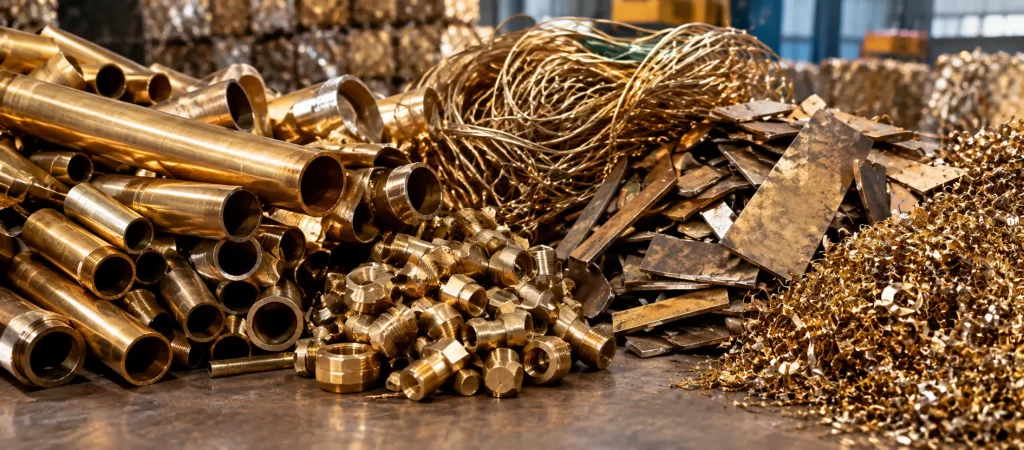
Brass scrap is the raw material behind most new brass. This guide from Anand Brass Components, a manufacturer in Jamnagar, India’s brass recycling capital, explains what “Honey”, “Ebony” and “Ocean” mean, how to tell brass from copper and bronze scrap, and what decides its value.
⚡ Quick Answer
What is brass scrap and how is it graded?
Brass scrap is used or waste brass, such as old taps, valves, fittings, keys, shell cases, machining chips and offcuts, collected for remelting into new brass. It is graded mainly by alloy type (yellow brass at about 60–70% copper, red brass at about 85% copper), by form (solids, turnings, clippings, castings) and by cleanliness (free of iron, plastic and other contamination). Internationally, grades use ISRI code words. “Honey” is yellow brass scrap, “Ebony” is red brass composition scrap, “Night” is yellow brass rod turnings, “Lake” is clean fired 70/30 shell cases and “Ocean” is mixed unsweated auto radiators. Clean, sorted, higher-copper scrap earns the best price.
Every brass tap, valve, fitting and machined part eventually becomes scrap, and nearly all of it is melted back into new brass. That loop makes brass one of the most recycled engineering materials in the world. It also makes scrap grading a serious business: a few percent of copper or a handful of steel screws can change the value of a lot considerably.
At Anand Brass Components we work in Jamnagar, India’s largest brass manufacturing hub, where much of the world’s brass scrap is sorted, melted and turned into new rods and components. This guide explains brass scrap the way the trade sees it, for scrap sellers, traders, recyclers and buyers who want to understand where their brass comes from.
🎯 Key takeaways
- Brass scrap is graded by alloy, form and cleanliness. Higher copper and cleaner material is worth more.
- Red brass scrap (about 85% Cu) is worth more than yellow brass (about 60–70% Cu).
- ISRI code words such as Honey, Ebony, Night and Lake are the global language of scrap trading.
- Magnet first. Brass isn’t magnetic, so any attraction means steel contamination.
- Sorting pays. Separating solids from turnings and removing iron and plastic raises the price.
- Brass can be recycled indefinitely without losing quality.
What is brass scrap?
Brass scrap is any brass material collected for recycling. It comes from two broad sources:
- New (pre-consumer) scrap: offcuts, clippings, rod ends and machining turnings (swarf) from factories. Its composition is known and it’s usually clean, so it is highly valued.
- Old (post-consumer) scrap: end-of-life taps, valves, plumbing fittings, keys, locks, radiators, shell cases, musical instruments and hardware. It’s more variable and often mixed with steel, plastic, rubber or other metals.
Brass keeps its value as scrap because of its copper content. Copper is one of the most valuable common metals, and brass is typically 60–85% copper. For more on brass composition, see What Is Brass? 20 Common Questions Answered.
Yellow brass vs red brass scrap
The first sort in any scrap yard is yellow vs red brass:
| Feature | Yellow brass scrap | Red brass scrap |
|---|---|---|
| Typical copper content | ~60–70% | ~81–85%+ |
| Main other elements | Zinc (30–40%), some lead | Zinc (~5–15%), tin, lead |
| Color when cleaned or filed | Bright yellow-gold | Reddish or pinkish gold |
| Typical sources | Taps, keys, plumbing fittings, door hardware, rod ends, turnings, shell cases | Valves, pump bodies, water meters, heavy plumbing castings |
| Relative value | Lower | Higher (more copper) |
| ISRI examples | Honey, Ivory, Night, Nomad, Noble | Ebony, Enerv |
Yellow brass is the larger volume. Red brass, often cast “composition” brass or gunmetal-type alloys, fetches more because of its higher copper content.
ISRI brass scrap grades (code words)
The Institute of Scrap Recycling Industries (ISRI, now part of ReMA) publishes code words that buyers and sellers use worldwide, including in India’s customs tariff for brass scrap imports (heading 7404). These are the brass and bronze grades you’ll meet most often:
| Code word | Description | Category |
|---|---|---|
| Honey | Yellow brass scrap (mixed solids) | Yellow brass |
| Ivory | Yellow brass castings | Yellow brass |
| Label | New brass clippings | Yellow brass (new) |
| Night | Yellow brass rod turnings | Turnings |
| Noble | New yellow brass rod ends | Yellow brass (new) |
| Nomad | Yellow brass turnings | Turnings |
| Melon | Brass pipe | Yellow brass |
| Lark | Yellow brass primers | Ammunition |
| Lake / Lace / Lady / Lamb | Clean fired 70/30 brass shell cases, with or without primers, or popped | Cartridge brass |
| Ebony | Composition or red brass scrap | Red brass |
| Enerv | Red brass composition turnings | Red brass turnings |
| Grape | Cocks and faucets | Mixed brass fixtures |
| Drink | Refinery brass | Low grade / mixed |
| Engel / Erin | Machinery or hard brass solids / borings | Hard brass |
| Elder | Genuine babbitt-lined brass bushings | Bearings |
| Pales | Admiralty brass condenser tubes | Tubes |
| Pallu | Aluminium brass condenser tubes | Tubes |
| Parch | Manganese bronze solids | High-strength brass |
| Ocean | Mixed unsweated auto radiators | Radiators |
| Eland / Elias | High-grade low-lead bronze/brass solids / high-lead bronze solids and borings | Bronze / brass |
Descriptions are summarized. The full ISRI/ReMA specifications define limits for contamination, lead, iron and moisture for each code. Always trade against the current published specification.
Indian trade terms for brass scrap
In Indian markets, and especially in Jamnagar, dealers often use local names alongside ISRI codes:
- Honey: used for mixed yellow brass solids, following the ISRI term.
- Purja: broken or dismantled brass parts and fittings (the word means “parts”). It is graded by cleanliness and the share of attached iron.
- Bartan (utensil) scrap: old brass vessels and household items, often sold by weight to local dealers.
- Turning / chips (swarf): machining chips from CNC and automat shops. They are valued for known composition but must be dry and oil-free.
- Red brass / gunmetal scrap: valves and castings with higher copper and tin, priced at a premium.
Daily rates are published for these categories in Jamnagar and other markets. See Brass Price per Kg: What Drives Brass Rates for how scrap prices are formed.
Want new brass parts with controlled chemistry?
Anand Brass Components verifies every melt by OES before extrusion and machining, so recycled-content brass meets your grade specification. MTC with every shipment.
How to identify brass scrap: 7 practical tests
Magnet test
Brass is not magnetic. If a magnet sticks, the piece is steel, plated steel, or brass with steel parts attached (screws, springs, inserts) that must be removed.
File or scratch test
File a small spot. Yellow brass shows bright yellow, red brass pinkish-gold, copper salmon-pink and bronze a darker golden-brown. Plated items show grey or silver under the surface.
Weight
Brass is dense, at about 8.5 g/cm³. Zinc die-cast “look-alike” items feel noticeably lighter for their size.
What the item was
Taps, keys, fittings and shell cases are usually yellow brass. Large valves, pump bodies and water meters are often red brass. Bearings and bushings are often bronze.
Markings
Look for stamped markings such as “Lead Free”, “LF”, NSF marks or alloy codes. These help sort low-lead brass, which some buyers want separately.
Chip appearance (turnings)
Free-cutting brass produces short, broken chips. Ductile 70/30 brass produces longer curls.
Analyzer
Handheld XRF analyzers give alloy composition in seconds, and are standard at larger yards and mills.
Brass vs copper vs bronze scrap
| Feature | Copper scrap | Brass scrap | Bronze scrap |
|---|---|---|---|
| Main metals | Copper (≈99%+) | Copper + zinc | Copper + tin (or Al, Si) |
| Fresh-cut color | Salmon pink / orange | Yellow-gold | Golden-brown |
| Typical items | Wire, cable, pipe, busbar | Taps, fittings, keys, valves, shell cases | Bearings, bushings, propellers, statues, bells |
| Magnetic? | No | No | No (unless Fe/Ni added) |
| Relative value | Highest | Lower than copper | Often between copper and yellow brass |
For a full comparison of the alloys themselves, read Brass vs Bronze: Key Differences.
What decides the value of brass scrap?
| Factor | Raises value | Lowers value |
|---|---|---|
| Copper content | Red brass, high-copper alloys | High-zinc yellow brass |
| Cleanliness | Clean, bare solids | Attached iron, plastic, rubber, paint |
| Form | Solids, rod ends, new clippings | Fine turnings with oil and moisture |
| Sorting | Single grade, known alloy | Mixed metals and grades |
| Plating | Unplated | Chrome or nickel-plated (may be graded separately) |
| Lead content | Low-lead (sought for lead-free melts) | Mixed high-lead material for some buyers |
| Quantity | Bulk, regular supply | Small one-off lots |
| Market | Strong copper prices, tight scrap supply | Weak copper, oversupply |
How to prepare brass scrap for a better price
- Separate yellow and red brass. Don’t let lower-value yellow brass drag down your red brass.
- Remove iron and steel. Unscrew handles, springs, steel screws and inserts. Use a magnet to check every piece.
- Strip non-metals. Remove plastic handles, rubber washers, gaskets and labels.
- Keep solids and turnings apart. Turnings are priced differently, so keep them dry and as oil-free as possible.
- Separate plated items if your buyer grades them differently.
- Keep low-lead brass separate where buyers pay a premium for lead-free melt stock.
- Weigh and document before sale, and get rates for each grade, not a single “mixed” rate.
Brass swarf is valuable. Store each alloy’s chips in separate labeled bins and drain the coolant off them. Many manufacturers credit chip value against component prices. We explain how in Brass Price per Kg.
Which grade does it go in? Common items sorted
Most scrap questions are really “what grade is this thing?” Here’s how common items usually sort. Always verify with a magnet and a file test.
| Item | Usual category | Prepare by |
|---|---|---|
| Taps and faucets | Grape (cocks & faucets) / yellow brass | Removing plastic handles, rubber washers and steel screws |
| Plumbing fittings, adapters, elbows | Honey (yellow brass) | Cutting off attached copper or plastic pipe |
| Large valves, pump bodies, water meters | Often Ebony (red brass) | Removing steel handles, stems and bolts |
| Keys, locks, door hardware | Honey (yellow brass) | Removing steel springs and lock mechanisms |
| Fired shell casings | Lake / Lace / Lamb (70/30 cartridge brass) | Confirming they’re fired and free of live rounds |
| Machining chips | Night / Nomad (yellow), Enerv (red) | Keeping alloys separate, dry and oil-free |
| Rod offcuts from a factory | Noble (new rod ends) | Keeping them clean and sorted by alloy |
| Sheet clippings and stampings | Label (new brass clippings) | Keeping them free of oil and paper |
| Car and truck radiators | Ocean (mixed unsweated radiators) | Draining coolant; removing iron brackets and plastic tanks |
| Musical instruments | Yellow brass (often lacquered or plated) | Removing steel springs, cork and felt |
| Lamp parts and décor | Yellow brass, often plated | Removing wiring, glass and steel; testing with a magnet for plated steel |
| Bearings and bushings | Often bronze (Elder, Eland, Elias) | Separating them from brass and steel housings |
Common scrap pitfalls (for buyers and sellers)
- Plated steel passed off as brass. A magnet catches it every time.
- Hidden iron. Steel inserts inside valves and fittings add weight but reduce value, and can spoil a melt.
- Wet or oily turnings. Moisture adds weight and creates a serious safety hazard in furnaces, where water causes violent steam explosions. Buyers deduct for it, or reject the lot.
- Zinc die-cast look-alikes. Gold-colored zinc alloy hardware is lighter and worth far less.
- Mixed lead levels. High-lead scrap contaminates lead-free melt stock, so mills buying for lead-free production test carefully.
- Unfired ammunition. It must never enter scrap. Only fired, inert cases are acceptable.
Safe handling of brass scrap
- Cuts: turnings and clippings are razor-sharp. Wear cut-resistant gloves.
- Lead dust: leaded brass dust and old plumbing scrap can carry lead. Wash hands before eating, and avoid dry sweeping.
- Furnace safety: only dry, clean scrap goes into molten metal. Even small amounts of trapped water are dangerous.
- Radiators: drain coolant and dispose of it properly, since it is toxic.
- Fume: melting brass gives off zinc-oxide fume, so foundries need extraction and respiratory protection.
How brass scrap becomes new brass
At an integrated manufacturer, recycled brass follows this path:
Sorting and inspection
Scrap is graded by alloy and checked for contamination, often with XRF analyzers and magnets.
Melting
Sorted scrap is melted in induction furnaces, with virgin copper or zinc added to correct the chemistry.
Chemistry control
Spectrometer (OES) analysis confirms the melt meets the target grade, such as CW614N, C36000 or a lead-free alloy.
Casting billets
The melt is cast into billets for extrusion or ingots for foundries.
Extrusion or forging
Billets are extruded into rods and profiles or forged into near-net shapes.
Machining and finishing
CNC machining turns rod into finished turned parts, inserts, fittings and electrical parts. The new chips go back to step 1.
That closed loop is why a well-run brass plant produces very little waste. Read about our in-house extrusion and plant on the infrastructure page, and about the process differences in Brass Forging vs Casting.
How the Jamnagar brass scrap market works
Jamnagar’s brass industry runs on recycled metal. The local scrap market works roughly like this:
- Collection: scrap arrives from Indian kabadiwalas, dismantlers, plumbing contractors and factories, and as imported containers of ISRI-graded scrap.
- Sorting yards: traders sort by grade (yellow, red, turnings, purja), remove iron and non-metals, and bale or bag lots.
- Daily rates: dealers quote daily prices for each category, tracking copper and zinc on MCX and LME plus local supply and demand.
- Melting units: foundries and extrusion plants buy sorted scrap, correct the chemistry with virgin metal and cast billets or ingots.
- Component makers: extruded rod and forgings go to thousands of machine shops making fittings, inserts, electrical parts and hardware, and their chips return to the scrap market.
Integrated manufacturers such as Anand Brass Components shorten this loop by melting, extruding and machining in-house. That gives tighter control of chemistry and cost.
Brass scrap glossary
- Solids: whole pieces such as castings, fittings and rod ends, as opposed to chips.
- Turnings / borings / swarf: chips produced by lathe turning or boring.
- Clippings: sheet and strip offcuts from stamping and pressing.
- Unsweated: radiators or assemblies from which solder has not been melted out.
- Melt loss: metal lost as oxide and dross when scrap is melted.
- Recovery: the percentage of usable metal obtained from a scrap lot after melting.
- Assay: laboratory analysis of a scrap sample’s composition.
- ISRI / ReMA: the Institute of Scrap Recycling Industries, now the Recycled Materials Association, which publishes scrap code specifications.
- Purja: Indian trade term for broken brass parts and fittings.
Importing and trading brass scrap: what to know
- Classification: brass scrap falls under HS heading 7404 (copper waste and scrap). India’s tariff lists specific brass scrap lines by ISRI code word.
- Inspection: imports of metal scrap into India generally require pre-shipment inspection and radiation checks. Confirm current DGFT and customs requirements before contracting.
- Specifications: contracts should reference the ISRI/ReMA code and allowable contamination, moisture and lead limits.
- Assays and weights: agree on how disputes over composition and weight will be settled, for example by independent assay.
- Pricing basis: scrap is often priced as a percentage of LME copper, or on local market rates.
The Jamnagar cluster grew up around this trade. See Why Jamnagar Leads Global Brass Manufacturing.
Brass recycling and sustainability
Brass is a model circular material. It can be remelted repeatedly without losing its properties, so recycled brass performs exactly like brass made from fresh metal of the same grade. Remelting scrap needs far less energy than producing copper and zinc from ore, and it keeps valuable metal out of landfill.
For buyers with sustainability goals, two questions are worth asking a supplier: what share of recycled content is in your brass, and what energy powers your melting and machining? Anand Brass Components operates a 1 MW solar power plant to supply part of its manufacturing energy.
As demand for lead-free brass grows, scrap streams are increasingly sorted by lead content. Mixing high-lead scrap into lead-free melts would break compliance, so good chemistry control at the melt is essential. Read more in our lead-free brass guide.
Brass components made responsibly in Jamnagar
Anand Brass Components: recycled-content brass with OES-verified chemistry, in-house extrusion, 1 MW solar plant, ISO 9001 certified.
Frequently Asked Questions
Related guides from Anand Brass Components
Written by the Anand Brass Components Technical Team. Anand Brass Components is a brass parts manufacturer and exporter at Plot 4110-4111, H-Road, GIDC Phase-III, Jamnagar, Gujarat 361004, India. Founded in 1991, ISO 9001 certified, with in-house casting, extrusion and OES testing. Contact: info@anandbrass.com · +91 78743 05684.