
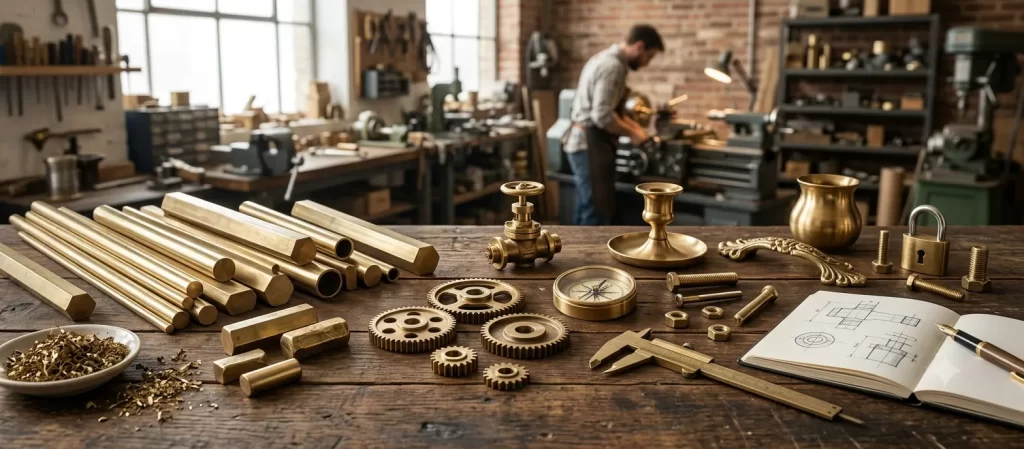
Is brass magnetic? Does it rust? Why does it turn green? Each question below gets a one-line answer first, then a clear explanation from the metallurgy team at Anand Brass Components, a brass manufacturer in Jamnagar, India’s brass city, since 1991.
⚡ Quick Answer
What is brass?
Brass is a metal alloy made mainly of copper and zinc, typically 55–95% copper and 5–45% zinc, sometimes with small
amounts of lead, tin, aluminium, silicon or arsenic. It is gold-colored, not magnetic and does not rust, because it
contains no iron, though it can tarnish and form a green patina. Brass melts at about 900–940 °C and has a density of
about 8.4–8.73 g/cm³. It is easy to machine and naturally antimicrobial, which is why it is used for plumbing
fittings, valves, electrical terminals, fasteners, locks, musical instruments and ammunition.
Brass is one of the most familiar metals in everyday life. You find it in door handles, water taps, trumpets,
keys and electrical plugs. It is also one of the most searched-about. People ask whether it sticks to a magnet,
whether it rusts in the rain, why their brass ring turned their finger green, and whether a thrift-store
candlestick is real brass or plated.
At Anand Brass Components we melt, extrude, forge and machine brass
every day in Jamnagar, Gujarat. We get these questions from engineers, buyers and curious customers alike. This
guide answers the 20 most common in plain language, with the numbers to back them up. Each answer starts with a
short verdict you can take away immediately.
🎯 Key takeaways
- Brass = copper + zinc.
More zinc makes it harder and paler. More copper makes it softer and more golden. - Brass is not magnetic.
If a magnet sticks, the item is probably steel with a brass plating. - Brass does not rust.
It tarnishes, darkens or develops a green patina (verdigris) instead. - It melts at about 900–940 °C
well below copper (1,085 °C). - Brass is generally safe to handle.
For drinking water, use certified lead-free brass. - There is no single “brass”.,
Grades such as C36000, C26000 and CW617N behave very differently, so specify the grade.
Brass properties at a glance
Use this as a quick reference. Values vary by grade, so check the exact alloy before designing a part.
| Property | Brass (general) | C36000 free-cutting brass | C26000 cartridge brass |
|---|---|---|---|
| Composition | 55–95% Cu, rest mainly Zn | 60–63% Cu, 2.5–3.0% Pb, rest Zn | 68.5–71.5% Cu, rest Zn |
| Melting range | ~900–940 °C | ~888–899 °C | ~916–954 °C (1,680–1,750 °F) |
| Density | 8.4–8.73 g/cm³ | 8.50 g/cm³ | 8.53 g/cm³ |
| Electrical conductivity | ~15–40% IACS | ~26% IACS | 28% IACS |
| Magnetic? | No (non-ferromagnetic) | No | No |
| Rusts? | No (no iron); tarnishes | No | No |
| Machinability rating | Varies | 100 (the industry benchmark) | 30 |
| Typical uses | Fittings, valves, hardware | Turned parts, fittings, inserts | Ammunition cases, deep-drawn parts |
Sources: Copper Development Association alloy data and published C36000 datasheets. Copper is 100% IACS by definition.
Basics: what brass is
Q1What is brass made of?
Copper and zinc, usually about two-thirds copper and one-third zinc.
Brass is an alloy, meaning a metal made by melting two or more elements together. The base is copper, typically 55–95% by weight, and the main addition is zinc, typically 5–45%. Small additions change its behavior:
- Lead (about 1–3%) breaks chips during machining, making “free-cutting” brass fast to turn on CNC lathes.
- Tin (about 1%) improves resistance to seawater, as in naval and admiralty brass.
- Arsenic (0.02–0.15%) suppresses dezincification in DZR brass.
- Silicon, bismuth or phosphorus replace lead in modern lead-free brasses such as C69300 (Eco Brass).
- Aluminium, manganese or iron raise strength in “high-tensile” brasses.
Q2Is brass a metal?
Yes. Brass is a metal, specifically a metal alloy rather than a pure element.
Brass has every property of a metal: it conducts electricity and heat, it is shiny, and it can be bent, drawn and cast. It isn’t on the periodic table because it is a mixture of two elements, copper (Cu) and zinc (Zn). It belongs to the family metallurgists call copper alloys, which also includes bronze and cupronickel.
Q3Is brass a pure metal or an alloy?
An alloy, a solid solution of zinc in copper.
At up to about 35% zinc, the zinc atoms sit inside copper’s crystal structure. This is called alpha brass, and it is soft and easy to cold-form. Between roughly 35% and 45% zinc, a second, harder phase appears, giving alpha-beta or duplex brass, which is ideal for hot forging and extrusion. This is why one plant can make springy cartridge cases and stiff forged valve bodies, both from “brass”.
Q4Is brass ferrous or non-ferrous?
Non-ferrous. Brass contains no significant iron.
Ferrous metals are based on iron, such as steel and cast iron. Brass is based on copper, so it is non-ferrous. In practice this means it doesn’t rust, isn’t magnetic and is valued as scrap. Recyclers separate it from steel using a magnet for exactly this reason.
Q5How is brass made?
Copper and zinc are melted together, cast, and then extruded, forged, rolled or machined into shape.
Modern brass is made by melting copper with zinc, usually with a large share of recycled brass scrap. The melt is cast into billets or ingots. At an integrated plant such as Anand Brass Components, billets are then extruded into rods and profiles, hot-forged into near-net shapes, or cast directly. CNC lathes then machine them into finished parts. Chemistry is checked with optical emission spectroscopy (OES) before parts are made. Our article on brass forging vs casting explains when each route is used.
Historically, Romans made “calamine brass” by heating copper with zinc ore. Direct melting of copper and zinc metal only spread through Europe from the 16th century.
Physical properties
Q6Is brass magnetic?
No. Brass is not magnetic, and a magnet will not stick to solid brass.
Copper and zinc are both non-ferromagnetic, so their alloy is too. Strictly, brass is very weakly diamagnetic, meaning it is faintly repelled by a magnetic field, but you’ll never notice that with a fridge magnet. There are three exceptions:
- Brass-plated steel is strongly magnetic, because the steel core is attracted.
- Brass with iron contamination can show slight attraction. Even about 1% iron gives a noticeable pull.
- Assemblies such as a brass lock with a steel spring or screw may attract at one spot.
Non-magnetic brass is chosen for compass housings, MRI-adjacent fittings, electrical switchgear and sensor bodies, where stray magnetism would interfere. See why brass dominates electrical connectors and switchgear.
Q7What is the melting point of brass?
About 900–940 °C (1,650–1,720 °F), depending on the grade.
Because brass is an alloy, it melts over a range rather than at one exact temperature. The more zinc, the lower the melting range. Free-cutting brass C36000 melts at about 888–899 °C, and cartridge brass C26000 at about 916–954 °C. For comparison, pure copper melts at 1,085 °C and zinc at 420 °C. Zinc also boils at about 907 °C, which is why molten brass gives off white zinc-oxide fumes and why foundries need proper fume extraction.
Q8What is the density of brass?
About 8.4–8.73 g/cm³, typically taken as 8.5 g/cm³ (8,500 kg/m³).
That makes brass slightly lighter than copper (8.96 g/cm³) and about 8% heavier than steel (about 7.85 g/cm³). Density matters when estimating part weight and cost, since brass is bought by the kilo. To estimate the weight of a brass rod, hex or tube, use our free Copper-Brass Weight Calculator.
Q9Does brass conduct electricity?
Yes. Brass conducts electricity well, at roughly a quarter of copper’s conductivity.
Common brasses run about 26–28% IACS, where pure annealed copper is 100%. That is too low for long power cables, but more than enough for terminals, plug pins, socket contacts and earthing parts. Brass beats copper there because it is stronger, harder-wearing and far easier to machine into threaded parts. Brass is also a good thermal conductor, which is why it appears in radiators and heat-exchanger parts.
Q10Is brass strong? Is it harder than copper?
Yes. Brass is stronger and harder than copper, though softer than steel.
Adding zinc strengthens copper. Typical brass rod has a tensile strength of roughly 340–470 MPa depending on temper, compared with about 210–250 MPa for annealed copper. Brass is softer than steel, which is an advantage in fittings and valves: brass threads seal well, don’t gall easily and don’t spark when struck. For a fuller materials comparison, read Brass vs Stainless Steel vs Copper.
Need brass parts made to your drawing?
Anand Brass Components controls alloy chemistry from the melt using OES testing, then extrudes, forges and CNC-machines in-house. Quotation within 24 hours.
Rust, tarnish and corrosion
Q11Does brass rust?
No. Brass does not rust, because rust is iron oxide and brass contains no iron.
“Rust” specifically means the flaky, reddish-brown iron oxide that forms on iron and steel. Brass can’t form it. Brass does react slowly with air and moisture, but the result is a thin surface film that usually protects the metal underneath, rather than flaking rust that eats through it. That is why brass fittings and valves last decades in plumbing systems where plain steel would fail.
Brass can still corrode under particular conditions, such as ammonia, some acids, and chloride-rich or aggressive water. Those cases are covered in Q14.
Q12Does brass tarnish? How long does it take?
Yes. Bare brass tarnishes, darkening from bright gold to brown over weeks to months.
Tarnish is a thin layer of copper and zinc oxides and sulfides. In humid, salty or polluted air it can appear within weeks, while indoors it may take months. It is purely cosmetic and can be polished off. If you want a lasting bright finish, choose a protective coating such as clear lacquer, or plating with nickel, chrome or tin. Our guide to brass surface finishes compares the options, and nickel plating on brass covers the most popular one in detail.
Q13Why does brass turn green?
The green is verdigris, a copper compound that forms with moisture, salts or acids.
When the copper in brass reacts with water, carbon dioxide, chlorides or acetic acid, it forms green-blue copper carbonates, chlorides or acetates, known collectively as verdigris or patina. You’ll see it on outdoor fittings, coastal hardware and old instruments. It’s also why a cheap brass ring can leave a green mark on skin: sweat contains salts and acids that react with the copper. The mark is harmless and washes off. Verdigris on decorative items can be cleaned. On functional parts like valves, heavy deposits are a sign of an aggressive environment.
Q14Is brass corrosion-resistant in water and outdoors?
Yes, in most conditions. Choose DZR or naval brass for aggressive water or seawater.
Brass resists ordinary fresh water and the atmosphere very well. Its main weakness is dezincification: in certain waters, especially soft, chloride-rich or stagnant water, zinc can leach out selectively and leave porous, weak copper. Standard high-zinc brass is therefore not recommended for seawater. The fixes are well established:
- DZR brass (for example CW602N) adds a trace of arsenic and is required by many European and Australian plumbing standards. See DZR brass vs standard brass.
- Naval and admiralty brass add about 1% tin for marine service.
- Plating with nickel or chrome protects outdoor and marine hardware.
Brass can also suffer stress-corrosion cracking (“season cracking”) in ammonia-rich environments. Stress-relief annealing after heavy cold work prevents it.
Safety and health
Q15Is brass toxic or safe to touch?
Brass is safe to touch and handle. The concern is lead, mainly for drinking water.
Handling brass doors, keys or tools is safe for normal use. Washing your hands after handling older leaded brass is sensible, since some traditional free-cutting grades contain 2–3% lead to aid machining. The main regulated issue is lead in contact with drinking water. In the United States, parts that touch potable water must meet a weighted-average lead content of 0.25% or less (NSF/ANSI 372) and the health-effects standard NSF/ANSI 61. Low-lead and lead-free brasses such as C69300 and CW724R exist for exactly this purpose. Read our lead-free brass components guide for the details.
Q16Is brass safe for drinking water and food?
Yes, when you use certified lead-free brass, and it is widely used in taps and fittings.
Brass has been used for water fittings for over a century because it machines well, seals well and resists corrosion. For modern potable-water use, specify a certified lead-free grade, and DZR where water is aggressive. For cookware, uncoated brass can react with acidic foods. Traditionally in India, brass vessels are tin-lined (“kalai”) for cooking. Plain brass is generally used for serving rather than cooking acidic dishes.
Q17Is brass antimicrobial?
Yes. Copper-rich brasses kill bacteria on contact and are EPA-registered as antimicrobial.
Copper ions are toxic to many bacteria and viruses. Since 2008 the US EPA has registered copper alloys with at least 60% nominal copper as antimicrobial. That covers many brasses, and today the registrations span hundreds of compositions. The approved claim is that, when cleaned regularly, these surfaces kill more than 99.9% of disease-causing bacteria within two hours. Cartridge brass C26000 and naval brass C46400 are on the registered list, which is why brass door plates and handles are common in hospitals and public buildings. The effect supplements cleaning; it does not replace it.
Identifying and valuing brass
Q18How can you tell if something is real brass?
Use a magnet first. Solid brass won’t attract it, but brass-plated steel will.
Work through these checks in order:
- Magnet test. No pull suggests solid brass, or another non-ferrous metal. A strong pull means plated steel or iron.
- Hidden scratch test. Scratch an unseen spot. Solid brass stays yellow underneath, while plated items show grey steel or white zinc alloy.
- Weight. Brass is dense at about 8.5 g/cm³, so it feels heavy for its size compared with aluminium or zinc die-cast.
- Color. Brass is yellow-gold. Copper is reddish-pink, and bronze is browner and duller (see Q19).
- Sound. Tapped brass gives a bright ring. Plated zinc alloy sounds dull.
- Lab test. For trade or high-value items, an XRF or OES analysis gives the exact alloy.
For engineered components, appearance tests are not enough. Always ask for a material test certificate (MTC) showing chemical composition. Anand Brass Components supplies an MTC with every export shipment, backed by in-house OES testing.
Q19What’s the difference between brass, bronze and copper?
Copper is a pure metal. Brass is copper plus zinc. Bronze is copper plus tin, and sometimes aluminium or silicon.
Copper is reddish and the best conductor of the three. Brass is yellow, cheaper and the easiest to machine. Bronze is browner, more wear-resistant and often better in seawater. We’ve written a full comparison: Brass vs Bronze: Key Differences, Uses & How to Tell Them Apart.
Q20Is brass valuable? Why is it priced by weight?
Yes. Brass has real metal value because of its copper content, and it is fully recyclable.
The price of brass follows copper and zinc on the metal exchanges, so brass is bought and sold by the kilogram or pound and its price moves daily. Scrap brass is valuable and almost all of it is recycled. Brass can be remelted again and again without losing quality, and much of the world’s new brass contains a high share of recycled metal. For a manufactured part, though, the metal is only one part of the price. Machining time, finishing, tolerances and volume often matter as much as the alloy.
Types and grades of brass
“Brass” covers dozens of standardized grades. These are the ones you’ll meet most often, with their US (UNS), European (EN) and Indian (IS) references where relevant.
| Grade | Typical composition | Key trait | Typical uses |
|---|---|---|---|
| C36000 / CW614N / IS 319 (free-cutting) | ~61% Cu, ~3% Pb, rest Zn | Best machinability (rated 100) | CNC turned parts, inserts, fittings, fasteners |
| CW617N (forging brass) | ~58% Cu, ~2% Pb, rest Zn | Excellent hot forging | Valve bodies, plumbing fittings |
| C26000 (cartridge brass, 70/30) | 70% Cu, 30% Zn | Very ductile, cold-formable | Ammunition cases, deep-drawn shells, radiator cores |
| C27000 / C27200 (yellow brass, 65/35) | ~65% Cu, 35% Zn | General purpose | Hardware, stamped parts |
| C46400 (naval brass) | ~60% Cu, ~1% Sn, rest Zn | Seawater resistance | Marine hardware, propeller shafts |
| CW602N (DZR brass) | ~62% Cu, Pb, trace As | Resists dezincification | Water fittings in aggressive water |
| C69300 / CW724R (silicon “Eco Brass”) | ~76% Cu, ~3% Si, rest Zn | Lead-free, strong, machinable | Potable-water parts (NSF 61/372) |
| C23000 (red brass, 85/15) | 85% Cu, 15% Zn | Reddish, corrosion resistant | Plumbing pipe, decorative work |
For grade-by-grade selection advice, read Brass Alloy Grades Explained and Brass Alloy for CNC Machining.
Where brass is used, and why
Brass appears wherever designers need a metal that machines easily, resists corrosion, conducts electricity, doesn’t spark and looks good. Here is how that translates by industry:
| Industry | Typical brass parts | Why brass |
|---|---|---|
| Plumbing & sanitary | Fittings, valves, CPVC/PPR inserts | Corrosion resistance, sealing threads, machinability |
| Electrical | Terminals, connectors, cable glands, transformer parts | Conductivity, non-magnetic, strength |
| Gas & oil | LPG fittings, regulators | Low-sparking, pressure-tight |
| Automotive & hydraulics | CNC parts, hose fittings | Precision machining, vibration resistance |
| Construction | Drop anchors, pool anchors, fasteners | No rust, durable outdoors |
| Lighting & décor | Lamp parts, door hardware | Appearance, easy plating |
| Music, defense, coins | Trumpets, saxophones, cartridge cases, coins | Acoustic quality, ductility |
Choosing brass for a manufactured part: a 5-step checklist
If you’re designing or buying brass components rather than just curious, these five steps prevent most problems we see:
Define the environment
Note whether the part sits in dry air, fresh water, aggressive water, seawater, gas or outdoors. This decides whether you need standard, DZR, naval or plated brass.
Check regulatory needs
Drinking water needs certified lead-free brass (NSF/ANSI 61 and 372 in the US). Electrical goods may need RoHS-compliant grades.
Match the grade to the process
Use free-cutting brass for CNC-turned parts, forging brass for hot-forged bodies, and 70/30 brass for deep drawing.
Specify finish and threads
Decide between natural, nickel, chrome or tin finish, and BSP, NPT or metric threads, before quoting.
Ask for proof
Require a material test certificate, first-article inspection and, for potable water, product-level certification. Our 12-point manufacturer audit checklist shows what to check.
How brass compares with other common metals
Many questions about brass are really comparisons in disguise: “Is brass better than stainless steel?”, “Is brass heavier than aluminium?” This table answers them side by side.
| Property | Brass | Copper | Bronze | Stainless steel (304) | Aluminium |
|---|---|---|---|---|---|
| Density (g/cm³) | ~8.5 | 8.96 | ~8.8 | ~8.0 | ~2.7 |
| Melting point | ~900–940 °C | 1,085 °C | ~950 °C | ~1,400–1,450 °C | ~660 °C |
| Magnetic? | No | No | No | Mostly no (slightly when cold-worked) | No |
| Rusts? | No | No | No | Resists rust | No (oxidizes) |
| Electrical conductivity | ~26–28% IACS | 100% IACS | ~12–15% IACS | ~2–3% IACS | ~60% IACS |
| Machinability | Excellent | Poor (gummy) | Fair–good | Difficult | Good |
| Antimicrobial | Yes (≥60% Cu grades) | Yes | Yes | No | No |
| Relative cost | Medium | High | High | Medium | Low |
Typical values for common grades. For a detailed head-to-head, see Brass vs Stainless Steel vs Copper and Brass vs Bronze.
Why brass comes in different colors
People are often surprised that two “brass” objects can look quite different. The color comes almost entirely from the copper-to-zinc ratio:
- 85–95% copper (gilding metal, red brass): a warm, reddish-gold that can be mistaken for bronze or copper.
- about 70% copper (cartridge brass): a classic bright, clean yellow-gold.
- about 60% copper (free-cutting and forging brass): a deeper, slightly paler yellow, the color of most taps and fittings.
- under 50% copper (“white brass”): silvery and brittle, rarely used for engineering.
Surface finish changes the look even more. Polished, brushed, antique (chemically darkened), lacquered or plated brass can range from mirror-bright gold to near black. If a buyer needs consistent appearance across batches, specify both the grade and the finish. Our brass finishes guide shows the common options.
Is brass sustainable? Recycling and energy
Brass is one of the most recyclable engineering materials. It can be remelted indefinitely without losing its properties, and scrap brass keeps high value because of its copper content, so very little ends up in landfill. Machining swarf (turnings) from a CNC shop is collected, cleaned and remelted, and a large share of new brass rod is made from recycled metal.
For buyers tracking supply-chain emissions, energy source matters too. Anand Brass Components operates a 1 MW solar power plant to supply part of its manufacturing energy. Details are on our infrastructure page. Choosing recycled-content brass and suppliers using renewable energy is an easy, measurable sustainability win.
Brass in India: why Jamnagar matters
India is one of the world’s major producers of brass components, and most of that production is concentrated in Jamnagar, Gujarat, widely known as the Brass City of India. Thousands of units there make fittings, inserts, turned parts, electrical components and hardware for domestic use and for export to the USA, UK, Europe and the Middle East. The cluster grew out of local metalworking skills and access to recycled brass scrap. It now spans the full chain, from melting and extrusion to CNC machining and plating. Read more in Why Jamnagar Leads Global Brass Manufacturing.
Common brass myths, corrected
- “Brass is gold-plated metal.” No. Brass is gold-colored all the way through. Gold-colored plating is a different thing, and is often applied over zinc or steel.
- “Green means the brass is ruined.” No. Verdigris is a surface layer, and the metal underneath is usually sound.
- “All brass contains dangerous lead.” No. Many grades contain little or no lead, and certified lead-free brass is standard for drinking water.
- “If it’s yellow and heavy, it’s brass.” Not always. Some bronzes and gold-tone alloys look similar. Use a magnet and a scratch test, or a lab test.
- “Brass and bronze are the same.” No. Brass is copper and zinc, while bronze is copper and tin. Their properties and uses differ.
Talk to a brass manufacturer, not a middleman
Anand Brass Components: founded 1991 in Jamnagar, ISO 9001 certified, in-house casting, extrusion, forging and CNC, exporting to 30+ countries.
More frequently asked questions about brass
Related guides from Anand Brass Components
Written by the Anand Brass Components Technical Team. Anand Brass Components is a brass parts
manufacturer and exporter at Plot 4110-4111, H-Road, GIDC Phase-III, Jamnagar, Gujarat 361004, India. Founded in
1991, ISO 9001 certified, with in-house casting, extrusion, forging, CNC machining and OES alloy testing. Contact:
info@anandbrass.com · +91 78743 05684.
References: Copper Development Association (alloy data, C26000, C36000,
C46400); US EPA antimicrobial copper alloy registrations; NSF/ANSI 61 and 372; published C36000 and C26000
datasheets; general metallurgical references on brass phases and dezincification. Property values are typical and
vary by grade, temper and supplier. Confirm with a material test certificate for engineering use.