
⚡ Quick Answer
Brass Forging vs Brass Casting is one of the most important comparisons for manufacturers, engineers, and OEM buyers when selecting the right brass component production method. Both processes offer unique advantages in terms of strength, durability, design flexibility, and cost-effectiveness.
Brass forging and brass casting are two widely used manufacturing processes for producing brass components. Brass forging offers superior strength, durability, and dimensional accuracy, making it ideal for high-performance applications. Brass casting provides greater design flexibility and cost-effectiveness for complex shapes.
The right choice depends on your project’s performance requirements, production volume, budget, and design complexity. Understanding the differences between these manufacturing methods helps buyers select the most suitable process for their applications.
What Is Brass Forging?
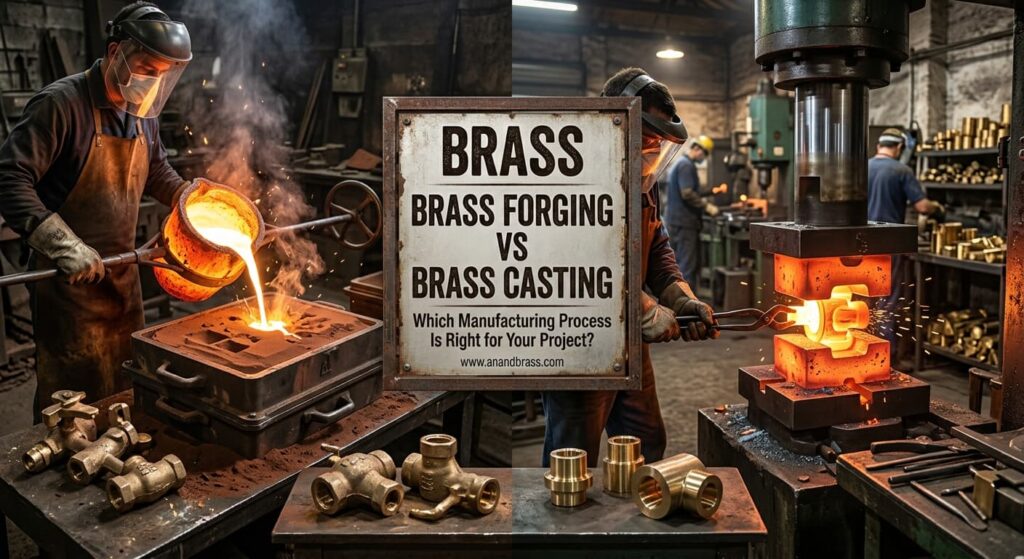
Brass forging is a manufacturing process where heated brass billets are compressed under high pressure to form the desired shape. During forging, the metal grain structure becomes aligned with the component’s shape, resulting in stronger and more durable parts.
- Higher Mechanical Strength : Improved grain flow enhances overall strength.
- Better Toughness : Components withstand impact and stress more effectively.
- Superior Fatigue Resistance : Ideal for repeated loading applications.
- Enhanced Dimensional Stability : Consistent dimensions and performance.
Forged brass components are commonly used in valves, fittings, connectors, fasteners, hydraulic systems, and automotive applications.
What Is Brass Casting?
Brass casting involves melting brass and pouring it into a mold cavity where it solidifies into the required shape. This process enables manufacturers to produce intricate and highly customized brass components.
- Complex Geometries : Easily creates intricate shapes.
- Custom Designs : Supports unique and specialized components.
- Large Component Manufacturing : Suitable for oversized brass parts.
- Reduced Machining : Near-net-shape production minimizes additional processing.
Cast brass parts are widely used in decorative hardware, pump bodies, marine products, plumbing systems, and architectural applications.
Brass Forging vs Brass Casting: Key Differences
Understanding the differences between Brass Forging vs Brass Casting helps manufacturers choose the most suitable production process based on strength, cost, complexity, and performance requirements.
Manufacturing Process
Forging shapes heated metal using high-pressure force, while casting uses molten metal poured into molds.
Strength & Performance
Forged brass components generally offer higher strength due to their refined grain structure. Cast brass may contain microscopic porosity that can affect performance under stress.
Durability
Forged brass performs better in demanding environments involving vibration, pressure, and cyclic loading.
Design Complexity
Casting is better suited for highly complex shapes, internal cavities, and decorative designs.
Production Volume
Forging is more economical for medium to high-volume production, while casting is often preferred for lower-volume custom projects.
Cost Considerations
Forging generally requires higher tooling investment but becomes cost-effective at scale. Casting typically offers lower upfront tooling costs.
Advantages of Brass Forging
When comparing Brass Forging vs Brass Casting, forging is generally preferred for applications that require higher mechanical strength and long-term durability.
- Exceptional Strength : Improved grain structure increases reliability.
- Improved Wear Resistance : Better performance under friction and repeated use.
- Higher Pressure Capability : Suitable for leak-proof and pressure-resistant applications.
- Longer Service Life : Fewer internal defects result in increased lifespan.
- Consistent Quality : Excellent dimensional repeatability across production batches.
Advantages of Brass Casting
In the Brass Forging vs Brass Casting debate, casting stands out for its ability to produce highly intricate shapes with lower tooling costs.
- Greater Design Flexibility : Produces highly detailed and complex parts.
- Lower Tooling Costs : Ideal for prototypes and smaller production runs.
- Large Component Capability : Efficient production of oversized brass components.
- Reduced Material Waste : Near-net-shape production minimizes machining requirements.
When Should You Choose Brass Forging?
Brass forging is the preferred option when your application requires:
- High mechanical strength
- Pressure-resistant components
- Long-term durability
- Tight dimensional tolerances
- High-volume production
Typical applications include brass valves, hydraulic fittings, industrial connectors, automotive components, and electrical terminals.
When Should You Choose Brass Casting?
Brass casting is ideal when your project requires:
- Complex geometries
- Decorative finishes
- Large component sizes
- Lower production volumes
- Cost-effective prototyping
Common applications include decorative hardware, pump housings, marine equipment, architectural products, and custom industrial parts.
Anand Brass: Your Trusted Brass Manufacturing Partner
Anand Brass specializes in delivering premium-quality brass components manufactured to international standards. Our expertise includes forged brass parts, precision-machined brass components, and custom-engineered solutions for industrial, electrical, plumbing, and OEM applications.
With advanced manufacturing capabilities, strict quality control systems, competitive pricing, and global export experience, Anand Brass provides dependable support from concept development to large-scale production.
Industry Standards & Resources
Understanding brass manufacturing standards can help buyers make informed decisions when comparing brass forging and brass casting processes.
- Learn about brass alloys through
Copper Development Association - Review international material specifications at
ASTM International - Explore quality management standards from
ISO 9001 Quality Management
🎯 Key Takeaways
- Choose Forging for Strength : Ideal for high-performance and pressure-resistant applications.
- Choose Casting for Complexity : Best for intricate designs and custom geometries.
- Consider Production Volume : Forging suits large runs while casting suits smaller batches.
- Evaluate Cost Structure : Compare tooling costs and long-term production economics.
- Match Process to Application : Select based on performance, durability, and design requirements.
Frequently Asked Questions
Ultimately, choosing between Brass Forging vs Brass Casting depends on your project’s design requirements, production volume, budget, and performance expectations.
Looking for High-Quality Brass Components?
Anand Brass manufactures premium forged brass parts, precision-machined components, and custom brass solutions for industrial, electrical, plumbing, and OEM applications. Our products deliver superior quality, durability, and performance while meeting international manufacturing standards.
Related Articles
- Brass Rod Manufacturer Buyer’s Guide — anandbrass.com/brass-rod-manufacturer-buyers-guide
- Brass Extruded Rods – Manufacturing & Applications — anandbrass.com/brass-extruded-rods
- Brass Inserts – Types & Applications — anandbrass.com/brass-inserts
- Brass Electrical Components — anandbrass.com/brass-electrical-components
- Custom Brass Components — anandbrass.com/custom-brass-components