
⚡ Quick Answer
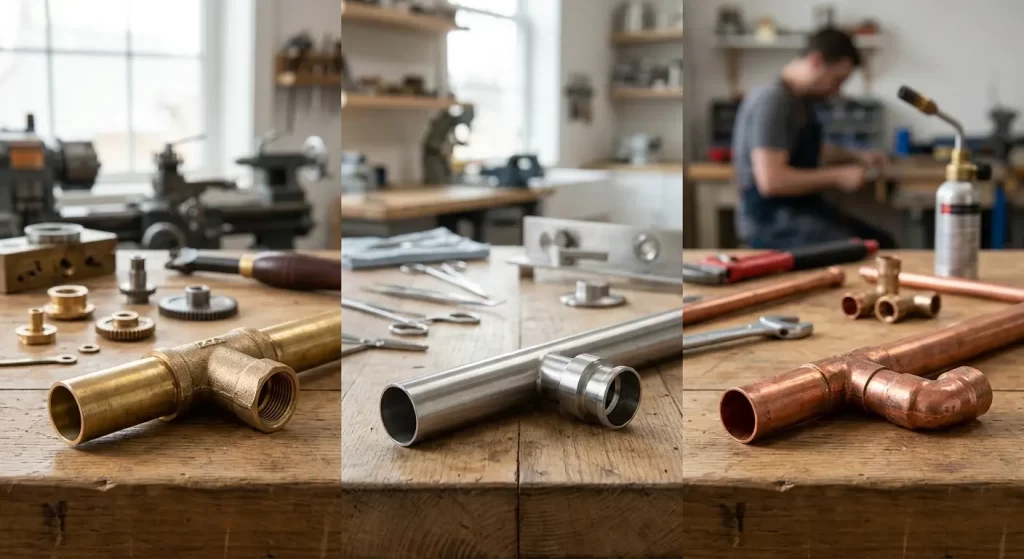
Choose brass for precision machined parts — fittings, valves, connectors, terminals — where machinability, corrosion resistance, and cost-efficiency matter most. Choose stainless steel for high-temperature, high-strength, or chemically aggressive environments. Choose copper when maximum electrical or thermal conductivity is the primary requirement (wiring, busbars, heat exchangers).
Choosing between brass, stainless steel, and copper is one of the most common material selection decisions in manufacturing. Each metal has clear strengths — and clear limitations. The right choice depends not on which metal is “best” in absolute terms, but which metal is best for your specific application, environment, and manufacturing process.
This guide provides a data-driven, property-by-property comparison to help engineers, designers, and procurement professionals make confident material decisions backed by facts rather than assumptions.
1. Why This Comparison Matters
In practice, brass, stainless steel, and copper frequently compete for the same applications: plumbing fittings, electrical hardware, precision machined parts, fasteners, and industrial connectors. Specifying the wrong metal can result in premature failure, excessive manufacturing cost, or unnecessary over-engineering.
The three most expensive material selection mistakes are: choosing stainless steel when brass would perform identically at lower cost; choosing copper when brass offers adequate conductivity with far better machinability; and choosing brass for extreme environments where only stainless steel can survive.
2. Master Comparison Table
This table compares the most commonly used grade of each metal in manufacturing applications.
| Property | Brass (C36000) | Stainless Steel (304) | Copper (C11000) |
|---|---|---|---|
| Composition | 61.5% Cu, 35.5% Zn, 3% Pb | 18% Cr, 8% Ni, 74% Fe | 99.9%+ Cu |
| Density (g/cm³) | 8.49 | 8.00 | 8.94 |
| Melting Point (°C) | 885–900 | 1,400–1,450 | 1,084 |
| Machinability Rating | 100 ★ | 45 | 20 |
| Tensile Strength (MPa) | 340–470 | 515–620 ★ | 220–365 |
| Yield Strength (MPa) | 124–310 | 205–310 ★ | 70–365 |
| Electrical Conductivity (% IACS) | 28 | 2.5 | 101 ★ |
| Thermal Conductivity (W/m·K) | 115 | 16 | 391 ★ |
| Corrosion Resistance | Very Good | Excellent ★ | Very Good |
| High-Temp Performance | Fair (to ~260°C) | Excellent (to ~870°C) ★ | Fair (to ~200°C) |
| Antimicrobial | Yes ★ | No | Yes ★ |
| Non-Sparking | Yes ★ | No | Yes ★ |
| Recyclability | 100% | 100% | 100% |
| Relative Material Cost | Medium | Medium-High | High |
| Manufacturing Cost (CNC) | Lowest ★ | Highest | High (gummy chips) |
★ indicates the best performer in each category. Green highlighting marks the winner.
3. Machinability Compared
Machinability is the single most important factor in determining the manufacturing cost of precision components. It affects cutting speed, tool wear, surface finish, and cycle time — all of which directly impact per-part cost.
| Factor | Brass (C36000) | SS 304 | Copper (C11000) |
|---|---|---|---|
| Machinability Rating | 100 | 45 | 20 |
| Typical Cutting Speed (m/min) | 90–180 | 30–60 | 20–60 |
| Chip Formation | Short, clean chips | Stringy, tough chips | Long, gummy chips |
| Tool Wear Rate | Low | High | Medium |
| Surface Finish Quality | Excellent (Ra 0.4–0.8µm) | Good (Ra 0.8–1.6µm) | Fair (smearing) |
Brass produces short, clean chips that clear easily from the cutting zone — a direct result of the lead particles acting as internal chip breakers. Stainless steel produces tough, stringy chips that can wrap around tools and workpieces, requiring chip breakers and slower speeds. Copper is notoriously “gummy” — its chips tend to weld onto cutting tools, causing poor surface finish and rapid tool wear.
🏆 Machinability Verdict
Brass wins decisively. For any component manufactured by CNC turning, drilling, or screw-machining, brass (C36000) delivers 2–3x the production speed of stainless steel at lower tool cost and better surface quality. This is why the global precision turned parts industry is dominated by brass.
4. Corrosion Resistance Compared
Corrosion resistance determines whether a component will maintain its functionality and appearance over years of service in its intended environment.
Brass
Brass resists corrosion from freshwater, mild acids, and atmospheric exposure very well. It develops a protective patina that shields the underlying metal. The main vulnerability is dezincification in certain chlorinated or high-chloride waters — preventable by using dezincification-resistant (DZR) or naval brass grades.
Stainless Steel
SS 304 forms a self-healing chromium oxide layer that provides excellent resistance to most chemicals, high temperatures, and aggressive environments. It outperforms brass in concentrated acids, strong alkalis, and temperatures above 300°C. However, it can suffer from chloride-induced pitting and stress corrosion cracking in high-chloride environments.
Copper
Copper offers very good corrosion resistance in most atmospheric and freshwater environments. Like brass, it develops a protective patina (verdigris). It resists biofouling in marine environments better than most metals. Its main weakness is attack by ammonia and sulfur compounds.
🏆 Corrosion Verdict
Stainless steel wins overall — its chromium oxide layer protects against the widest range of corrosive agents. However, for plumbing, marine, and atmospheric applications, brass and copper are more than adequate and often preferred for their antimicrobial properties and easier workability.
5. Electrical & Thermal Conductivity
Conductivity matters enormously in electrical hardware and heat transfer applications. The differences between these three metals are dramatic.
| Property | Brass | Stainless Steel | Copper |
|---|---|---|---|
| Electrical Conductivity (% IACS) | 28 | 2.5 | 101 |
| Thermal Conductivity (W/m·K) | 115 | 16 | 391 |
Copper is the undisputed leader in conductivity — 3.6x better than brass and 40x better than stainless steel for electrical applications. This is why power transmission cables, busbars, and motor windings are made from copper.
However, for electrical contact hardware — terminals, connectors, switch contacts, plug pins — brass is preferred despite its lower conductivity. The reason: brass provides the spring characteristics, wear resistance, and dimensional stability that contact hardware demands. A connector needs to maintain contact pressure over thousands of insertion cycles; pure copper is too soft for this.
Conductivity alone doesn’t determine the best material for electrical parts. For current-carrying wire, copper wins. For current-connecting hardware (terminals, pins, connectors), brass wins — because mechanical performance at the contact point matters more than bulk conductivity.
6. Strength & Hardness
Stainless steel is the strongest of the three metals in tensile and yield strength. However, strength must be evaluated in context — many applications don’t require the strength of stainless steel, and specifying it unnecessarily adds cost through harder machining and more expensive raw material.
- Stainless Steel 304 : Tensile 515–620 MPa — required for structural loads, high-pressure vessels, and extreme mechanical stress.
- Brass C36000 : Tensile 340–470 MPa — more than adequate for fittings, valves, fasteners, and precision components operating within normal service loads.
- Copper C11000 : Tensile 220–365 MPa — the softest option; strength is its weakest attribute.
Over-specifying stainless steel for components that will never experience loads exceeding brass’s capabilities. A plumbing fitting rated to 300 psi doesn’t need 620 MPa tensile strength — brass handles it comfortably while costing 30–50% less to manufacture.
7. Cost Analysis: Material vs. Manufacturing
The real cost of a component is not just the raw material price — it’s the total manufactured cost including machining time, tooling, finishing, and scrap. This is where brass’s economics become compelling.
Raw Material Cost (Approximate, 2026)
Copper is the most expensive per kilogram. Stainless steel and brass are in a similar range, though prices fluctuate with commodity markets. However, raw material cost is often only 30–40% of the total component cost.
Manufacturing Cost Advantage of Brass
- 2–3x faster CNC cycle times compared to stainless steel (higher cutting speeds + fewer passes).
- 3–5x longer tool life brass causes dramatically less tool wear than SS 304.
- Better surface finish off the machine — often eliminates secondary finishing operations.
- Higher scrap value — brass scrap commands a better recycling price than steel scrap.
For CNC turned parts, the total manufactured cost of a brass component is typically 30–50% lower than an identical part made from stainless steel. This is the fundamental economic reason why brass dominates the global precision turned components market.
At our Jamnagar manufacturing facility, we produce brass components on multi-spindle automats and CNC lathes at speeds that would be impossible with stainless steel. Our integrated facility — covering casting through CNC — further reduces total cost by eliminating supply chain markups between process stages.
8. Best Metal by Application
| Application | Best Metal | Reason |
|---|---|---|
| CNC Turned Parts | Brass | Machinability 100, lowest per-part cost |
| Electrical Terminals & Connectors | Brass | Spring properties + conductivity + wear resistance |
| Plumbing Fittings | Brass | Corrosion resistance + easy threading + antimicrobial |
| Gas System Fittings | Brass | Non-sparking property, critical safety factor |
| Power Cables & Busbars | Copper | Maximum electrical conductivity required |
| Heat Exchangers | Copper | Thermal conductivity 3.4x higher than brass |
| Motor Windings | Copper | Lowest resistance for electromagnetic efficiency |
| Chemical Processing Equipment | Stainless Steel | Resists concentrated acids and alkalis |
| Food Processing Equipment | Stainless Steel | FDA-compliant, easy to sanitize, no metallic taste |
| High-Temperature Applications (>300°C) | Stainless Steel | Maintains strength at elevated temperatures |
| Structural Fasteners (High-Load) | Stainless Steel | Superior tensile and yield strength |
| Decorative Hardware | Brass | Golden aesthetic + patina development |
9. When Brass Is the Clear Winner
Based on the data above, brass is the optimal choice when your application involves:
- High-volume CNC machining — nothing machines faster or cheaper than C36000 brass.
- Electrical contact hardware — terminals, pins, connectors, and switch contacts need brass’s balance of conductivity and mechanical resilience.
- Water and gas system fittings — corrosion resistance, easy threading, and non-sparking behavior make brass the industry standard.
- Threaded inserts for plastic — brass inserts for CPVC, UPVC, PPR, and injection-molded components provide durable metal threads in plastic housings.
- Cost-sensitive precision components — when stainless steel’s extra strength isn’t needed, brass saves 30–50% on manufacturing cost.
- Antimicrobial surfaces — hospitals, public buildings, and touch-point hardware benefit from brass’s EPA-registered antimicrobial properties.
Manufacturers like Anand Brass Components specialize in exactly these applications — producing precision brass components for electrical, plumbing, automotive, gas, and industrial sectors from their integrated Jamnagar facility.
🎯 Key Takeaways
- Brass wins on machinability — rating of 100 vs. 45 (SS) and 20 (Cu). This translates to 30–50% lower manufacturing cost for CNC parts.
- Copper wins on conductivity — 3.6x better than brass, 40x better than stainless steel. Use it for wiring and heat transfer.
- Stainless steel wins on strength and chemical resistance — use it for high-temp, high-load, or chemically aggressive environments.
- Total cost, not material cost, determines the right choice — brass’s machining speed advantage often makes it the most economical option overall.
- Brass is the all-rounder — adequate conductivity, good strength, excellent machinability, natural corrosion resistance, and antimicrobial properties make it the most versatile of the three metals for component manufacturing.
Frequently Asked Questions
Ready to Source Precision Brass Components?
Anand Brass Components delivers CNC-machined, forged, and extruded brass parts — from custom alloys to finished components — all manufactured in-house at our Jamnagar facility.
References
- Copper Development Association — Alloy Properties Database — copper.org
- ASM International — ASM Handbook Vol. 2: Properties and Selection of Nonferrous Alloys — asminternational.org
- ASTM International — Standards for Copper Alloys — astm.org
- U.S. EPA — Registered Antimicrobial Products with Copper Alloy Surfaces — epa.gov