
⚡ Quick Answer
Importing brass components from India to the USA comes down to six things done well: choosing a trusted, export-ready brass manufacturer in Jamnagar, classifying your parts under the correct HTS code (brass articles usually fall under Chapter 74, headings 7411, 7412, 7415, and 7419), understanding the current US duty layers, agreeing on the right Incoterms, insisting on proper quality documentation and ISPM-15 export packaging, and planning realistic lead times. Get a reliable partner like Anand Brass Components and a good customs broker in place, and the process is smooth and predictable. This guide walks through each step.
For procurement managers, distributors, and OEMs across the United States, India has become one of the most reliable and cost-effective places on earth to source precision brass parts. But importing well is a discipline. The difference between a smooth, profitable supply chain and a shipment stuck in customs usually comes down to a handful of decisions made early. This guide lays out the full path, from picking the right brass manufacturer in Jamnagar to landing your goods at a US port, so you can source with confidence in 2026.
Why Source Brass Components From India
India is one of the world’s largest producers and exporters of brass parts, and for good reason. American buyers consistently choose Indian suppliers for a combination of advantages that are hard to match elsewhere:
- Cost Efficiency Without Quality Loss : Competitive labor and raw-material access mean lower unit costs than most Western or East Asian sources, while quality stays high.
- Deep Manufacturing Expertise : Generations of brass craftsmanship, now paired with CNC precision and modern metallurgy.
- Customization and Flexibility : Indian manufacturers are known for taking a buyer’s drawing and delivering exactly to spec, in low or high volume.
- Export Maturity : Established exporters understand US compliance, documentation, and logistics, which removes most of the friction.
- China-Plus-One Resilience : As US buyers diversify supply chains away from a single country, India has become the leading alternative for metal components.
The key is that not all suppliers are equal. Sourcing well means finding a manufacturer that combines that national advantage with real export discipline, and that is where Jamnagar comes in.
Jamnagar: India’s Brass City
If you are importing brass from India, you are almost certainly importing from Jamnagar, a city in the state of Gujarat that is known across the world as India’s “Brass City.” Jamnagar produces a substantial share of the country’s brass parts and is home to thousands of manufacturing units, from tiny workshops to fully integrated, export-focused factories.
What makes the city special is its dense ecosystem. In one place you have foundries, extrusion plants, forging units, CNC machining shops, electroplaters, and testing labs, all clustered together. That concentration is why the top brass industries in Jamnagar can offer short lead times, deep customization, and competitive pricing that standalone factories elsewhere struggle to beat. When a US buyer works with a serious Jamnagar exporter, they are tapping into an entire supply network, not just a single shop.
Anand Brass Components is one such manufacturer. Based in the GIDC industrial estate in Jamnagar and exporting to more than 30 countries, it is a vertically integrated, ISO 9001 certified maker of brass inserts, fittings, fasteners, electrical parts, valves, anchors, and custom turned components, which is exactly the profile a US importer should look for. More on that below.
Step 1: Find a Trusted Manufacturer
This is the single most important decision, because the right partner prevents almost every problem that comes later. When vetting a brass manufacturer in Jamnagar, look for:
- Certifications : ISO 9001 quality management at minimum, plus RoHS, REACH, and NSF/lead-free capability if your parts touch drinking water.
- In-House Production : A vertically integrated factory (casting, extrusion, forging, machining, plating, testing under one roof) means better consistency and tighter lead times than a trader who outsources.
- US Export Track Record : Ask how long they have shipped to the United States and request references. Experience with US customs and logistics is worth a great deal.
- Material Traceability : They should provide mill test certificates and material certifications for every lot.
- Communication and Samples : Responsive engineering support, willingness to work from your drawings, and pre-production samples before bulk runs.
Quick Tip: Ask for a video walkthrough of the factory floor. A confident, established exporter like Anand Brass will happily show you their machinery and QC process. A reluctance to do so is a red flag.
Step 2: Classify With the Right HTS Code
Every product entering the United States needs a Harmonized Tariff Schedule (HTS) code, a 10-digit number that determines your duty rate and how customs treats your goods. The first six digits are the international HS code; the US adds four more. Getting this right is legally your responsibility as the importer, and misclassification causes delays, penalties, and back-duties.
Most brass components fall within Chapter 74 (copper and articles thereof). Common headings include:
- 7411 : Copper/brass tubes and pipes.
- 7412 : Copper/brass tube or pipe fittings (couplings, elbows, sleeves).
- 7415 : Nails, screws, bolts, nuts, washers and similar brass fasteners.
- 7419 : Other articles of copper/brass (many turned parts, inserts, misc components).
These are starting points, not final answers. The exact 10-digit code depends on the specific part, its function, and its composition. Always confirm classification with a licensed US customs broker, and when in doubt, use the official USITC HTS database or request a binding ruling from US Customs and Border Protection (CBP).
Step 3: Understand US Duties & Tariffs
Your landed cost is the sum of several layers, and in 2026 this is the area that changes most often, so treat any single number as something to verify live rather than assume.
- Base (MFN) Duty : The standard rate tied to your HTS code. For many brass articles this base rate is relatively low, but it varies by heading, so check yours.
- Additional Surcharges : US trade policy toward India has moved quickly in 2026. Country-level surcharges have been introduced, revised, and challenged in court within the same year, and some measures carry expiration dates. The practical takeaway is simple: confirm the current, combined rate for your exact HTS code and origin at the time you import.
- User Fees : Most shipments also pay a Merchandise Processing Fee (MPF) and, for ocean freight, a Harbor Maintenance Fee (HMF).
- AD/CVD Screening : Check whether your specific product carries any anti-dumping or countervailing duties, which are separate and can be significant.
Quick Tip: Because the India tariff picture shifted several times in 2026, build a little duty flexibility into any contract that delivers months out, and lean on your customs broker for the live number. The USITC HTS site and CBP are the authoritative sources.
Step 4: Choose Your Incoterms
Incoterms are the internationally recognized rules that define exactly where the seller’s responsibility ends and yours begins, covering cost, risk, and logistics. Agreeing on the right one up front prevents disputes later. The three most common for India-to-USA brass shipments:
- FOB (Free On Board) : Seller delivers goods onto the vessel at the Indian port; you handle ocean freight, insurance, and US import. Best when you have a freight forwarder and want control over shipping.
- CIF (Cost, Insurance, Freight) : Seller covers freight and insurance to the US port of arrival; you handle customs clearance onward. Best when you want a simpler quote to the US port.
- DDP (Delivered Duty Paid) : Seller handles everything including US duties, delivered to your door. Best when you want maximum simplicity and less paperwork.
For first-time importers, CIF or DDP reduces complexity. Experienced buyers often prefer FOB for control and cost transparency. A good exporter will quote you under whichever term you choose and explain the trade-offs.
Step 5: Documentation & Compliance
Clean paperwork is what keeps a shipment moving through customs. For brass components from India, expect to have:
- Commercial Invoice and Packing List : With accurate values, HTS codes, and country of origin.
- Bill of Lading : (Ocean) or air waybill.
- Certificate of Origin : Confirming Indian manufacture.
- Mill Test Certificates : And material certifications proving alloy composition.
- Compliance Documents Where Applicable : RoHS and REACH for many industrial parts, and NSF/ANSI 61 and 372 (lead-free) certification for anything carrying drinking water. If your parts fall under US safe-drinking-water rules, this is non-negotiable.
A quality exporter prepares these as a matter of routine. If a supplier hesitates when you ask for mill certs or lead-free documentation, treat it as a warning sign.
Step 6: Packaging, Shipping & Lead Times
Two logistics details trip up new importers most often: packaging standards and realistic timelines.
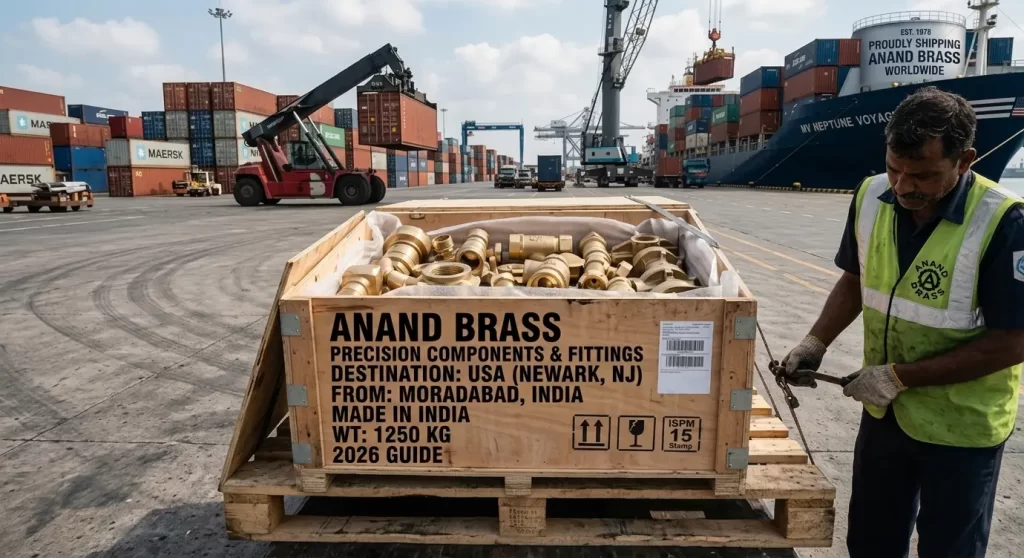
ISPM-15 wood packaging. If your goods ship on wooden pallets or in wooden crates, that wood must be heat-treated and stamped to the international ISPM-15 standard, or the entire shipment can be refused at the US port. Confirm your exporter uses compliant, export-grade packaging.
Shipping mode and time. Ocean freight is the standard for brass components by weight and cost, typically running several weeks in transit from an Indian port to the US, plus production lead time. Air freight is faster but far more expensive, usually reserved for urgent or high-value, low-weight orders.
Plan realistic lead times. Between production, inspection, ocean transit, and US customs clearance, a typical order spans a couple of months from purchase order to delivery. Established exporters give you an honest timeline and hit it, which is why supplier reliability matters as much as price.
The Import Journey at a Glance
Here is the whole process in sequence, from first inquiry to landed goods:
- 1. Source & Sample : Shortlist a trusted Jamnagar manufacturer, share drawings, and approve pre-production samples.
- 2. Classify & Quote : Confirm the HTS code with your broker and lock terms and Incoterms with the supplier.
- 3. Produce & Inspect : Manufacturing runs, with QC checks and mill certs generated for each lot.
- 4. Pack & Document : Export-grade, ISPM-15 compliant packaging, plus invoice, packing list, and compliance papers.
- 5. Ship : Ocean or air freight from the Indian port toward your US port of entry.
- 6. Clear & Deliver : Your broker files entry, duties are paid, customs releases, and goods reach your door.
Why Choose Anand Brass Components
Among the top brass industries in Jamnagar, Anand Brass Components has built its reputation with US and international buyers on exactly the qualities this guide recommends looking for:
- Vertically Integrated Manufacturing : Casting, extrusion, forging, CNC machining, and finishing under one roof in Jamnagar, for consistency and control.
- ISO 9001 Quality Systems : With material traceability and mill test certificates on every lot.
- Lead-Free and Compliant Options : Including alloys suited to NSF/ANSI 61 and 372 drinking-water requirements, plus RoHS-compliant parts.
- Proven US Export Experience : Shipping to America and 30-plus countries with export-grade, ISPM-15 packaging and clean documentation.
- Custom Manufacturing : From your drawings and specifications, in low or high volume, with responsive engineering support.
- Competitive, Transparent Pricing : And reliable lead times you can plan around.
In short, Anand Brass offers US buyers the national advantages of sourcing from India, delivered through a single dependable partner in the heart of the country’s brass capital. Whether you need brass inserts, fittings, fasteners, valves, anchors, or fully custom turned parts, the sourcing process becomes simple when your manufacturer already speaks the language of US compliance.
Industry Standards & Resources
Understanding US import requirements can help buyers make informed decisions when sourcing brass components from India.
- Review the Harmonized Tariff Schedule at
U.S. International Trade Commission (USITC) - Learn about duty rates and importing basics from
U.S. Customs and Border Protection (CBP) - Check lead-free certification requirements from
NSF International
🎯 Key Takeaways
- Start With the Supplier : A proven Jamnagar exporter with ISO 9001, mill certs, and US export experience prevents 90% of import headaches.
- Classification Is Your Responsibility : The correct HTS code sets your duty rate, so confirm it with a licensed customs broker.
- US Tariffs on India Shifted in 2026 : Always verify the live rate before you commit, because the layers change.
- Incoterms Decide Who Pays and Who Bears Risk : Know your FOB, CIF, and DDP before you sign.
- Documentation and Packaging Protect the Shipment : Mill certs, RoHS/NSF where needed, and ISPM-15 wood packaging keep customs moving.
Frequently Asked Questions
This article is general information for sourcing and import planning, not legal, customs, or tax advice. US tariff rates, trade measures, and classification rulings change and depend on your specific product and circumstances. Always confirm current HTS classification and duty rates with a licensed US customs broker and the official USITC and U.S. Customs and Border Protection resources before importing.
Ready to Source Brass Components From Jamnagar?
Tell us what you need, whether it is a standard catalog part or a custom component from your drawing. Anand Brass Components will get you a fast, transparent quote and export-ready delivery to the USA.
Related Articles
- Why Anand Brass Is a Leading Brass Manufacturer & Exporter — anandbrass.com/why-anand-brass-components-are-leading-brass-manufacturer-exporter
- Brass Components: The Complete Guide to Types & Applications — anandbrass.com/brass-components-the-complete-guide-to-types-applications-and-manufacturing-excellence
- Brass Turned Parts: Essential Components for U.S.A. Manufacturers — anandbrass.com/brass-turned-parts-essential-components-for-u-s-a-manufacturers