
💡 Quick Answer
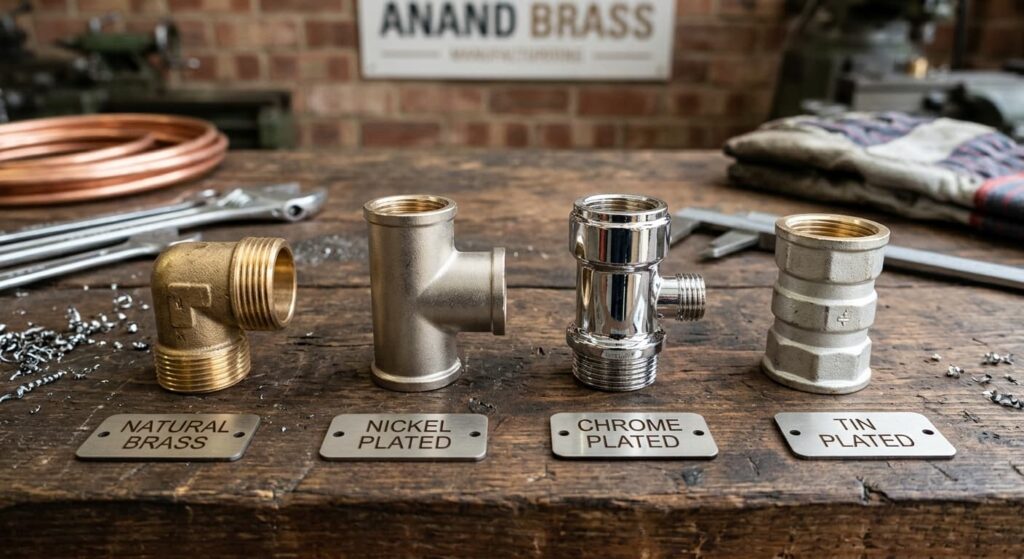
Natural brass is suitable when the original brass appearance is acceptable and additional coating performance is not required.
Nickel plating is commonly selected when buyers need a clean metallic appearance with improved surface protection and wear performance.
Chrome plating is generally used where a bright decorative surface, surface hardness and improved resistance to handling or environmental exposure are important.
Tin plating is particularly relevant for electrical and electronic components because it can improve solderability and provide a low-contact-resistance surface.
There is no single best finish for every brass component. The correct choice depends on application, environment, appearance, electrical requirements, coating thickness and applicable standards.
Table of Contents
- Quick Answer
- Why Is Surface Finishing Important for Brass Components?
- Natural Brass Finish
- Nickel-Plated Brass Components
- Chrome-Plated Brass Components
- Tin-Plated Brass Components
- Nickel vs Chrome vs Tin vs Natural Brass
- How Are Brass Components Prepared Before Plating?
- How Does Coating Thickness Affect Performance?
- Common Surface-Finish Specification Mistakes
- What Should OEM Buyers Include in Their Drawing or RFQ?
- How Anand Brass Components Supports Custom Finishing Requirements
- Key Takeaways
- Industry Standards & Quality Requirements
- Frequently Asked Questions
- Related Articles
Introduction
The performance of a brass component depends on more than its alloy, dimensions and machining accuracy. The final surface treatment can influence appearance, corrosion behaviour, electrical performance, solderability, wear resistance and suitability for the intended environment.
For OEM buyers, engineers and procurement teams, selecting a finish should therefore be part of the component specification rather than a decision made after machining.
Nickel plating, chrome plating, tin plating and natural brass are among the commonly specified options for machined and turned brass parts. Each serves a different purpose, and the right choice depends on where and how the component will be used.
Why Is Surface Finishing Important for Brass Components?
Brass already provides useful machinability, corrosion resistance and electrical properties, which is one reason it is widely used in electrical, plumbing, automotive, industrial and precision-engineering applications.
However, the base material alone may not meet every service requirement.
A surface treatment may be specified to:
- Improve resistance to environmental exposure
- Provide a consistent cosmetic appearance
- Improve solderability
- Reduce electrical contact resistance
- Improve resistance to wear or repeated handling
- Match surrounding components
- Meet customer-specific engineering requirements
- Reduce visible tarnishing
- Prepare a component for a particular assembly or operating environment
The finish should therefore be selected according to function.
A decorative plumbing component and an electrical terminal may both be manufactured from brass, but they can require completely different surface treatments.
Natural Brass Finish
A natural finish leaves the machined brass surface without an additional metallic coating.
After machining, components may still undergo processes such as cleaning, deburring, polishing or other specified finishing operations, but the visible surface remains brass.
Advantages of Natural Brass
Natural brass can be suitable when:
- The characteristic brass colour is preferred
- The component is used inside an assembly
- Additional plating is not necessary
- Cost control is important
- Electrical or mechanical requirements do not require another coating
- The application allows natural surface ageing
It also eliminates an additional plating process, which can simplify production for suitable applications.
What Buyers Should Consider
Untreated brass can gradually change appearance when exposed to air, moisture, chemicals or repeated handling.
This does not automatically mean that the component has failed. Surface oxidation and tarnishing can be normal characteristics of an exposed brass surface.
If consistent cosmetic appearance is important throughout the product’s service life, an alternative treatment may be more appropriate.
Nickel-Plated Brass Components
Nickel plating places a metallic nickel layer over the brass substrate through an appropriate plating process.
It is frequently chosen for components where both appearance and surface protection are important.
Why Nickel Is Applied to Brass
Depending on the component and specification, nickel plating may help provide:
- A uniform metallic appearance
- Improved surface protection
- Better resistance to handling and wear
- Reduced visible tarnishing of the underlying brass
- A suitable intermediate or final finish
- Improved consistency between production batches
Nickel-plated components are commonly found in electrical hardware, cable accessories, plumbing products, automotive components, instrumentation and industrial assemblies.
Appearance
Nickel can provide a clean silver-coloured metallic surface and may be produced in different appearance grades depending on the plating process and customer requirement.
Appearance alone, however, should not determine the specification.
Coating thickness, service conditions, base-material preparation and inspection requirements should also be defined.
Chrome-Plated Brass Components
Chrome-plated components are widely associated with a bright and visually consistent finish.
For decorative applications, chromium is commonly used as part of a coating system that can include a nickel layer underneath it.
This type of system is used where appearance and environmental protection are both important.
Common Applications
Chrome finishing may be considered for:
- Plumbing and sanitary components
- Visible fittings
- Decorative hardware
- Control components
- Equipment fittings
- Consumer-facing metal parts
Why Choose Chrome?
Depending on the coating system, chrome finishing can provide:
- Bright decorative appearance
- Improved surface hardness
- Better resistance to scratching and handling
- Improved resistance to tarnishing
- Easier maintenance of visible surfaces
The required coating system should always be matched with the actual service environment.
A component installed indoors will not necessarily need the same coating specification as one exposed to moisture, outdoor conditions or frequent cleaning.
Tin-Plated Brass Components
Tin plating is particularly useful for brass components used in electrical and electronic applications.
Unlike finishes selected primarily for visual appearance, tin is often specified because of its functional surface properties.
Why Tin Is Used on Brass Components
Electrodeposited tin can be used to provide:
- Good solderability
- Low electrical contact resistance
- Surface protection in suitable environments
- Improved compatibility with certain electrical assemblies
- Reduced oxidation of the immediate contact surface
Typical applications may include:
- Electrical terminals
- Connector components
- Contact parts
- Pins
- Electronic hardware
- Electrical fittings
ASTM B545 is one of the standards used for electrodeposited tin coatings. It includes requirements relating to factors such as coating thickness, integrity, adhesion and solderability.
Tin should still be specified according to the final operating conditions because coating thickness and porosity can influence corrosion performance.
Nickel vs Chrome vs Tin vs Natural Brass
The correct finish depends primarily on the function of the component.
| Finish | Main Purpose | Appearance | Typical Applications |
|---|---|---|---|
| Natural Brass | Simple functional finish | Gold/brass colour | Internal parts, industrial components |
| Nickel Plating | Protection + appearance | Silver metallic | Electrical, industrial, cable accessories |
| Chrome Plating | Decorative + protective finish | Bright reflective | Plumbing, sanitary and visible components |
| Tin Plating | Electrical + soldering performance | Silver/grey | Terminals, connectors and electrical parts |
Important: This table should be treated as a selection guide rather than a universal engineering rule. Operating environment, required coating thickness, mating materials and industry requirements still need to be evaluated.
How Are Brass Components Prepared Before Plating?
Good plating starts with proper surface preparation.
Even a correctly specified coating can perform poorly if contamination, machining residue, oil or surface defects remain on the component before finishing.
A typical workflow may include:
Step 1: Machining
The brass component is manufactured according to the approved drawing, including required dimensions, threads and tolerances.
Step 2: Deburring
Sharp edges, burrs and unwanted machining residue are removed where required.
Step 3: Cleaning
Oil, grease and manufacturing contaminants must be removed from the surface.
Step 4: Surface Preparation
Depending on the finish and required appearance, additional preparation or polishing may be carried out.
Step 5: Plating
The specified metallic coating is applied according to the required process.
Step 6: Inspection
Components may be checked for appearance, dimensional conformity, coating coverage and other customer-defined requirements.
Surface preparation is particularly important when cosmetic consistency is required.
How Does Coating Thickness Affect Performance?
Simply writing “nickel plated” or “tin plated” on a drawing may not always provide enough information.
The coating thickness can directly affect the performance and consistency of the finished component.
A coating that is too thin may provide insufficient coverage for the intended application. Excessive coating can also create problems where dimensions, threads or mating surfaces have tight tolerances.
This becomes especially important on:
- Threaded components
- Precision bores
- Small-diameter pins
- Connector surfaces
- Press-fit components
- Tight-tolerance mating features
The engineering drawing should therefore clearly identify where plating is required and whether critical dimensions apply before or after finishing.
Common Surface-Finish Specification Mistakes
OEM buyers can avoid many quality disputes by defining the finishing requirement before production begins.
Mistake 1: Specifying Only a Colour
“Silver finish” is not a complete engineering requirement.
Nickel, chrome and tin can all appear silver-coloured while providing very different functional properties.
Mistake 2: Not Defining Coating Thickness
Where coating thickness affects function or compliance, the required value or applicable standard should be clearly stated.
Mistake 3: Ignoring Threaded Areas
Plating can affect thread dimensions.
The drawing should define whether threads need plating and what post-plating tolerance is expected.
Mistake 4: Selecting a Finish Only for Appearance
The operating environment should also be considered.
Moisture, temperature, electrical contact, chemicals and repeated handling can all influence finish selection.
Mistake 5: Not Providing an Approved Sample
For appearance-critical parts, an approved reference sample can reduce subjective disagreements regarding colour, brightness and cosmetic quality.
What Should OEM Buyers Include in Their Drawing or RFQ?
A detailed RFQ helps the manufacturer understand both the component and the finishing requirement.
Where applicable, provide:
- Component drawing
- Brass alloy or material grade
- Required dimensions
- Dimensional tolerances
- Thread specifications
- Finish or plating type
- Required plating thickness
- Areas that should remain unplated
- Cosmetic requirements
- Applicable standard
- Inspection requirements
- Packaging requirements
- Order quantity
- Annual expected volume
- Approved sample requirements
If dimensions are critical after finishing, this should be clearly communicated.
The more complete the specification, the lower the risk of misunderstanding during quotation, sampling and mass production.
How Anand Brass Components Supports Custom Finishing Requirements
Anand Brass Components manufactures custom brass components for OEM and industrial requirements using customer drawings, samples and technical specifications.
Depending on the component requirement, parts can be manufactured using processes such as CNC machining, automatic turning, forging and other precision-production methods.
Finishing requirements can also be considered as part of the complete component specification rather than treated separately after machining.
Customers can specify factors such as:
- Required brass grade
- Component dimensions
- Threads
- Tolerances
- Natural finish
- Nickel plating
- Chrome plating
- Tin plating
- Other customer-defined finishing requirements
Reviewing these requirements before production helps ensure that machining allowances, tolerances and final inspection criteria are aligned with the finished component.
📌 Key Takeaways
- Surface treatment should be selected according to application rather than appearance alone.
- Natural brass is suitable where an additional metallic coating is unnecessary.
- Nickel plating combines metallic appearance with useful surface protection.
- Chrome systems are commonly selected for decorative and visible components.
- Tin plating is particularly useful where solderability and electrical contact performance matter.
- Plating thickness can affect threads and precision dimensions.
- Critical dimensions should be evaluated in relation to the finished component.
- OEM drawings should clearly identify the coating type, thickness and applicable standard.
- Approved samples can help control cosmetic expectations during mass production.
Industry Standards & Quality Requirements
Surface-finishing requirements vary by industry, component and operating environment.
Relevant specifications may include:
ISO 1456
ISO 1456 covers decorative electrodeposited coatings including nickel, nickel plus chromium, copper plus nickel and copper plus nickel plus chromium on materials including copper and copper alloys.
It provides coating designations related to coating type, thickness and intended service conditions.
ASTM B545
ASTM B545 covers electrodeposited tin coatings on metallic articles.
The specification addresses requirements including coating appearance, thickness, integrity, adhesion and solderability.
OEM buyers should specify the required standard only where it is relevant to the component and end application.
Customer drawings, sector-specific regulations and end-use requirements should always take priority when defining the final specification.
Frequently Asked Questions
Request a Custom Brass Component Quote
Need brass components manufactured according to your drawing, tolerance and finishing requirements?
Send your engineering drawing, brass grade, required quantity and coating specification to Anand Brass Components for manufacturing review.
Contact Anand Brass Components → Request a Custom Brass Component Quote →
When preparing the RFQ, clearly defining brass surface finishes alongside material grade, tolerances, thread requirements and final inspection criteria helps reduce ambiguity between the engineering drawing and the finished component.
A complete specification also allows the manufacturing and finishing requirements to be reviewed together before sampling or mass production begins.