
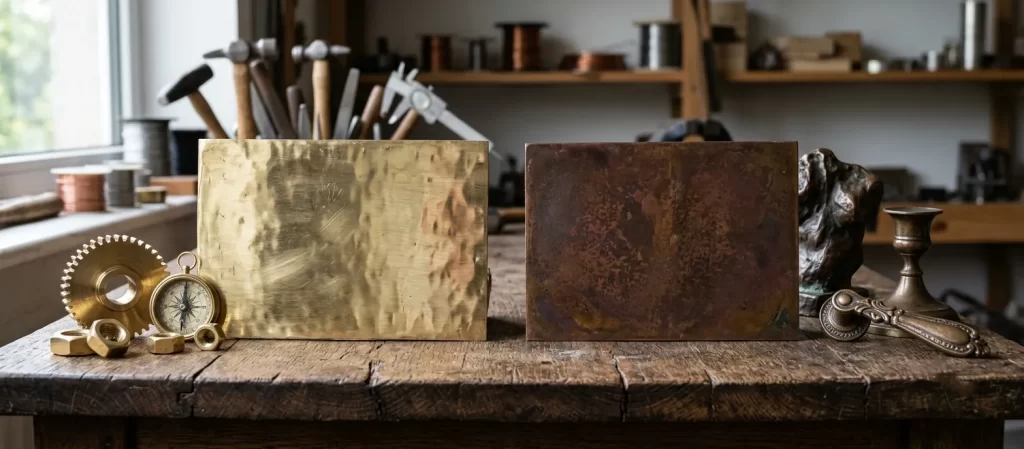
They look alike, they both start with copper, and they’re constantly confused, sometimes even in museum catalogs. This guide from Anand Brass Components explains what separates brass from bronze, which one to choose for your part, and six ways to tell them apart.
⚡ Quick Answer
What is the difference between brass and bronze?
Brass is copper alloyed mainly with zinc. Bronze is copper alloyed mainly with tin, and modern bronzes often add
aluminium, silicon, phosphorus or manganese. Brass is brighter yellow-gold, cheaper, easier to machine and has a lower
melting point (about 900–940 °C). Bronze is reddish-brown, harder, more wear-resistant and generally better in
seawater, and melts at about 950 °C or higher. Choose brass for fittings, valves, electrical terminals, fasteners and
decorative hardware. Choose bronze for bearings, bushings, marine propellers, springs, bells and sculpture.
Ask ten people to point out the bronze in a room full of brass and copper objects, and most will get it wrong. The
confusion is understandable. Both are copper alloys, both are golden-brown, and some commercial names actively
mislead: “commercial bronze” (90% copper, 10% zinc) and “architectural bronze” are technically brasses, because zinc
is their main addition.
At Anand Brass Components we manufacture brass parts every day in Jamnagar, and we regularly help buyers decide
whether a part should be brass or bronze. This guide covers what we tell them: the real compositional difference,
how the two compare on every property that matters, where each one belongs, and how to identify them.
🎯 Key takeaways
- The one-word difference:
brass = zinc, bronze = tin. Both are mostly copper. - Brass is easier and cheaper to machine.
Free-cutting brass C36000 is the industry machinability benchmark, rated 100. - Bronze wears and slides better.
That makes it the standard for bearings and bushings. - Bronze generally handles seawater better.
Standard brass can dezincify, though naval and DZR brass close much of the gap. - Color is a clue, not proof.
Brass is yellow, bronze is reddish-brown. Confirm with a test. - Neither is magnetic and neither rusts,,
unless iron or nickel has been added.
Brass
Copper + zinc (typically 5–45% Zn)
- Bright yellow-gold
- Melts ~900–940 °C
- Excellent machinability
- Lower cost
Bronze
Copper + tin (classic ~88/12), or Al, Si, P
- Reddish-brown, duller
- Melts ~950 °C+
- Hard, low-friction, wear-resistant
- Higher cost (tin is expensive)
Brass vs bronze: side-by-side comparison
| Property | Brass | Bronze | Edge |
|---|---|---|---|
| Main alloying element | Zinc | Tin (or aluminium, silicon, phosphorus) | — |
| Color | Bright yellow to gold | Reddish-brown to dull gold | — |
| Melting point | ~900–940 °C | ~950 °C (alloy-dependent, up to ~1,050 °C) | Bronze (heat) |
| Density | ~8.4–8.73 g/cm³ | ~7.5–8.9 g/cm³ (Al bronze is lighter) | — |
| Hardness & wear resistance | Moderate | Higher | Bronze |
| Friction against steel | Moderate | Low, excellent bearing material | Bronze |
| Machinability | Excellent (C36000 = 100) | Fair to good (C93200 ≈ 70, C51000 ≈ 20) | Brass |
| Electrical conductivity | ~26–28% IACS | ~12–15% IACS (typical) | Brass |
| Seawater corrosion | Fair (naval/DZR grades good) | Very good to excellent | Bronze |
| Fresh-water corrosion | Very good | Very good | Tie |
| Magnetic? | No | No (unless Fe/Ni added) | Tie |
| Rust? | No | No | Tie |
| Cost | Lower | Higher | Brass |
| Typical parts | Fittings, valves, terminals, fasteners, inserts, hardware | Bearings, bushings, propellers, springs, bells, statues | — |
Values are typical. Machinability ratings use C36000 = 100 as the reference. Conductivity figures are for C26000/C36000 (brass) and C93200/C51000 (bronze), from Copper Development Association and supplier datasheets.
Composition and types
What is brass made of?
Brass is copper plus zinc, typically 55–95% copper and 5–45% zinc. Small additions tailor it: lead for machinability, tin for seawater, arsenic for dezincification resistance, and silicon or bismuth for lead-free grades. For a full breakdown, see our companion guide What Is Brass? 20 Common Questions Answered.
What is bronze made of?
Classic tin bronze is about 88% copper and 12% tin. Today “bronze” is a family name for copper alloys where the main addition is something other than zinc:
| Bronze type | Typical composition | Key trait | Typical uses |
|---|---|---|---|
| Tin bronze | ~88% Cu, ~12% Sn | Hard, corrosion resistant | Castings, gears, art |
| Phosphor bronze (C51000) | Cu + 4.2–5.8% Sn + 0.03–0.35% P | Springy, fatigue-resistant | Springs, electrical contacts, bellows |
| Leaded tin bronze / bearing bronze (C93200) | 81–85% Cu, ~7% Sn, ~7% Pb, ~3% Zn | Self-lubricating, machinable | Bushings, bearings, thrust washers |
| Aluminium bronze (C95400) | ~85% Cu, ~11% Al, ~4% Fe | Very strong, wear and seawater resistant | Heavy-duty bearings, gears, marine hardware, valve seats |
| Silicon bronze | Cu + ~2.8–3.8% Si | Strong, weldable, corrosion resistant | Marine fasteners, sculpture |
| Bell metal | ~77% Cu, ~23% Sn | Resonant, brittle | Bells, cymbals |
| Gunmetal | ~88% Cu, 8–10% Sn, 2–4% Zn | Pressure-tight castings | Pump and valve bodies |
“Commercial bronze” (C22000: 90% Cu, 10% Zn), “architectural bronze” (about 57% Cu, 40% Zn, 3% Pb) and “manganese bronze” (a high-strength brass) are all brasses by composition. Always specify by UNS or EN grade number, never by trade name alone.
Properties compared
Strength and hardness
Both alloys come in a wide range of strengths, so the grade matters more than the family. In general, bronze is harder and more wear-resistant, while brass is more ductile and easier to form. Aluminium bronze C95400, for example, has a minimum tensile strength of about 586 MPa, which is stronger than common brasses (roughly 340–470 MPa for free-cutting rod). Leaded bearing bronze C93200 is softer, at about 241 MPa minimum, because it is designed to slide and conform rather than carry high stress.
Melting point
Brass melts at about 900–940 °C, and lower as zinc content rises. Most bronzes melt somewhat higher, around 950 °C for classic tin bronze and over 1,000 °C for aluminium bronze. The lower melting point is part of why brass is easy to cast, forge and extrude in volume.
Friction and wear
This is bronze’s signature advantage. Bronze slides against steel with low friction and resists galling, which is why bushings, bearings, worm gears and thrust washers are traditionally bronze. Oil-impregnated sintered bronze bearings run for years with no external lubrication.
Conductivity
Brass conducts electricity better than most bronzes, at about 26–28% IACS compared with roughly 12–15% for common bearing and phosphor bronzes. That’s why plug pins, terminals and connectors are usually brass. Phosphor bronze wins where a spring contact must flex millions of times.
Magnetism
Neither is magnetic in normal compositions. Aluminium bronzes containing iron or nickel can show slight attraction.
Corrosion and seawater: which lasts longer?
Neither alloy rusts, since rust is iron oxide. Both form protective surface films and develop a green patina over time. The difference shows in harsh environments:
- Seawater: bronze is the classic marine metal. Aluminium and silicon bronzes resist seawater and cavitation very well, which is why propellers and submerged bearings are bronze. Standard high-zinc brass can suffer dezincification in seawater. Naval brass (about 1% tin) performs much better, but bronze still leads for submerged service.
- Fresh and potable water: both perform well. For plumbing, brass dominates because of cost and machinability. Use DZR brass where water is aggressive, and certified lead-free brass for drinking water.
- Atmosphere: both weather well outdoors. Bronze statues develop the familiar brown-green patina, while brass darkens and can go green near the coast.
- Bronze disease: chloride contamination can cause progressive “bronze disease” on archaeological bronzes. It is mostly a conservation issue, not an engineering one.
If you’re choosing between brass and bronze only for corrosion, check whether a coated brass part would do the job. Nickel- or chrome-plated brass is often the most cost-effective answer for outdoor and splash-zone hardware. See our brass surface finishes guide.
Cost and machinability: why most precision parts are brass
For high-volume precision parts, brass usually wins for two reasons.
1. Material cost. Both alloys are priced mainly on copper, but zinc is much cheaper than tin. A
brass bar is therefore usually cheaper per kilo than an equivalent bronze bar.
2. Machining cost. Free-cutting brass machines faster than almost any other metal. Its rating of
100 is the benchmark every other alloy is measured against. Bearing bronze C93200 rates about 70, aluminium bronze
C95400 about 60, and phosphor bronze C51000 about 20. In practice, a turned part can cycle significantly faster in
brass, with less tool wear. Across tens of thousands of parts, that often outweighs the raw-material difference.
That’s why components such as CPVC and PPR inserts, turned parts, fasteners and plumbing fittings are almost always brass. To compare
machining grades, read Brass Alloy for CNC
Machining.
Not sure whether your part should be brass or bronze?
Send the drawing and operating conditions. The Anand Brass Components engineering team will recommend the grade and quote within 24 hours.
Uses: which alloy belongs where
| Application | Usually | Why |
|---|---|---|
| Plumbing fittings, adapters, couplings | Brass | Machinability, sealing threads, cost, lead-free/DZR options |
| Water and gas valves (bodies, spindles) | Brass | Forging brass CW617N is ideal for hot-forged bodies |
| Electrical terminals, plug pins, connectors | Brass | Higher conductivity, easy plating |
| Cable glands | Brass (often nickel-plated) | Precise threads, conductivity for earthing |
| Threaded inserts for plastics | Brass | Fast knurling and threading, cost |
| Decorative hardware, lamp parts, door furniture | Brass | Bright gold color, polishes and plates well |
| Concrete and pool anchors | Brass | No rust, durable outdoors, machinable |
| Sleeve bearings, bushings, thrust washers | Bronze | Low friction, conformability, wear resistance |
| Worm gears, heavy-duty gears | Bronze | Wear resistance under sliding load |
| Ship propellers, submerged marine parts | Bronze | Seawater and cavitation resistance |
| Springs, flexing electrical contacts | Phosphor bronze | Fatigue resistance, springiness |
| Bells, cymbals | Bronze | Resonance |
| Statues, cast sculpture | Bronze | Fills fine mould detail, attractive patina |
| Brass instruments (trumpet, trombone) | Brass | Formability and acoustic tradition |
| Non-sparking tools | Either | Both are low-sparking; aluminium bronze and beryllium copper are common |
Explore the brass product lines Anand Brass Components manufactures: valves, electrical parts, cable glands, lamp parts, pool anchors and drop anchors.
6 ways to tell brass from bronze
Use the tests in this order, from quickest to most reliable:
-
Look at the color in good light
Brass is bright yellow to gold, a bit like gold jewelry. Bronze is darker, redder and browner, closer to an old penny. Clean a small spot first, because tarnish hides the true color.
-
Check for patina
Aged bronze typically develops an even brown-to-green patina. Aged brass tends to darken unevenly and goes green mainly where moisture collects.
-
Listen to it
Tap it with a metal tool. Bronze, especially high-tin bell bronze, rings with a deeper, longer tone. Brass sounds brighter and sharper.
-
Use a magnet (to rule out plating)
Neither alloy is magnetic. If a magnet sticks, the item is plated steel, whatever the color.
-
Consider what the object is
Bearings, bushings, propellers, bells and statues are usually bronze. Fittings, valves, terminals, keys, lamp parts and instruments are usually brass.
-
Get a lab analysis
Color and sound are guides only. An XRF scan or OES analysis gives the exact composition in seconds. For industrial parts, ask the supplier for a material test certificate.
Never accept “bronze” or “brass” on a drawing without a grade number. Anand Brass Components verifies every melt by OES and supplies an MTC listing copper, zinc, lead, tin and other elements with every shipment.
Brass vs bronze for jewelry, home décor and kitchenware
Many people compare brass and bronze when buying something for the home rather than specifying an industrial part. The same metallurgy applies, but the priorities are different:
- Jewelry: both can leave a green mark on skin, because sweat reacts with the copper. The mark is harmless and washes off. Bronze is slightly less prone to it and holds a warm color. Brass looks closer to gold. A clear coating on either reduces discoloration.
- Door handles and fixtures: brass dominates. It polishes to a bright gold, plates easily and is antimicrobial in common grades, which is why it is used on high-touch surfaces in public buildings.
- Lighting: brass is standard for lamp holders, canopies and threaded fittings because it machines precisely and conducts electricity. See our brass lamp parts.
- Statues and outdoor art: bronze is the traditional choice. It casts fine detail and weathers to an even patina.
- Kitchen and serving ware: both are traditional in India. Brass vessels used for cooking acidic foods are typically tin-lined. Bronze (kansa, a high-tin bronze) is valued for serving dishes and bowls.
- Outdoor furniture fittings and marine hardware: bronze or plated brass. Uncoated standard brass near the sea will darken and may dezincify over time.
For décor, the decision is mostly about color and finish: brass for bright gold, bronze for warm brown and patina. For anything that carries load, water or electricity, follow the engineering guidance above.
Which is better: brass or bronze?
Neither is better overall. Each is better for a job. Here’s the decision rule we use with customers:
- Choose brass when you need precise threads and features, high-volume machining, good electrical conductivity, a bright decorative finish, or the lowest cost per part. That covers most plumbing, electrical and hardware parts.
- Choose bronze when the part slides or rotates against steel, works submerged in seawater, must act as a spring, or needs maximum wear resistance.
- Consider coated or special brass first when the only concern is corrosion. DZR, naval or nickel-plated brass often delivers what’s needed at lower cost than bronze.
For the wider comparison with steel and copper, read Brass vs Stainless Steel vs Copper.
Where copper fits in
Copper is the pure metal that both alloys are built on. It is reddish-pink, the best conductor of the three (100% IACS), softer than both alloys, and melts at 1,085 °C. Adding zinc makes brass and adding tin makes bronze. Each addition trades some conductivity for strength, hardness or machinability. In short: copper for conductivity, brass for machinability and cost, bronze for wear and seawater.
How to specify brass or bronze on a drawing
Most sourcing problems start with a drawing that just says “brass” or “bronze”. Suppliers in different countries use different standards, so give a grade number and, ideally, its equivalents. This table maps the most common grades across US (UNS), European (EN) and Indian (IS) systems:
| Alloy | US (UNS) | Europe (EN) | India / other | Typical use |
|---|---|---|---|---|
| Free-cutting brass | C36000 | CW614N (CuZn39Pb3) | IS 319 Type I; BS CZ121 | CNC turned parts, inserts |
| Forging brass | C37700 | CW617N (CuZn40Pb2) | BS CZ122 | Valve bodies, fittings |
| Cartridge brass | C26000 | CW505L (CuZn30) | BS CZ106 | Deep-drawn parts |
| DZR brass | C35330 (approx.) | CW602N (CuZn36Pb2As) | BS CZ132 | Aggressive-water fittings |
| Lead-free silicon brass | C69300 | CW724R (CuZn21Si3P) | — | Potable-water parts |
| Phosphor bronze | C51000 | CW451K (CuSn5) | PB102 | Springs, contacts |
| Leaded bearing bronze | C93200 | CC493K (approx.) | SAE 660 | Bushings, bearings |
| Aluminium bronze | C95400 | CC331G (approx.) | — | Heavy-duty bearings, marine |
Equivalents are approximate. Compositions and property limits differ slightly between standards, so confirm against the governing standard on your drawing.
On the drawing, include: alloy grade, standard (for example ASTM B16 or EN 12164), temper, finish, thread standard and any regulatory requirement such as NSF/ANSI 61 and 372 or RoHS. That single block of text prevents most quoting errors. Our article on how custom brass components are manufactured for OEMs shows a complete RFQ package.
Real-world example: one assembly, both alloys
Brass and bronze often work side by side. Take a typical water pump or gate valve assembly:
- Valve or pump body: brass. A hot-forged CW617N body is quick to produce, holds pressure and machines into clean threads. For drinking-water systems, a lead-free grade is specified.
- Spindle or stem: brass or DZR brass. It is machined from free-cutting or DZR rod for precision threads.
- Bushing or guide: bronze. A C93200 bearing-bronze bush lets the steel shaft rotate with low friction for years.
- Gland nut and fittings: brass, often nickel-plated for appearance and protection.
Each alloy is used where its strengths matter: brass for shape, threads and cost, bronze for sliding wear. That’s the logic to apply to your own designs. Explore our brass valve components and CNC brass parts.
Care and cleaning: brass vs bronze
Both alloys clean the same basic way, but owners usually want different results. Brass is typically kept bright, while bronze is usually allowed to keep its patina.
| Task | Brass | Bronze |
|---|---|---|
| Routine cleaning | Mild soap and warm water, dry thoroughly | Mild soap and water, dry thoroughly |
| Removing tarnish | Brass polish, or a lemon-and-salt or vinegar paste, then rinse | Usually avoided, since patina is valued; use specialist cleaners only if required |
| Green verdigris | Mild acid (vinegar) followed by neutralizing rinse | Gentle cleaning; seek conservation advice for antiques |
| Long-term protection | Clear lacquer, wax, or nickel/chrome plating | Microcrystalline wax |
| Avoid | Ammonia-based cleaners (risk of stress cracking), abrasive pads on plated parts | Harsh abrasives that remove patina unevenly |
Many “brass” products are lacquered or plated. Polishing them removes the protective layer and makes tarnish worse. Clean them with soap and water only.
Common brass vs bronze mix-ups
- Trusting trade names. “Commercial bronze,” “architectural bronze” and “manganese bronze” are brasses.
- Judging by color alone. Red brass (85% copper) looks bronze-like, and some yellow bronzes look like brass.
- Specifying bronze “to be safe” for plumbing. This often adds cost without benefit, when DZR or lead-free brass meets the standard.
- Using brass for a heavily loaded bushing. Brass can gall against steel under sliding load, where bronze would be the right call.
- Assuming “lead-free” applies to both. Lead-free certification is specific to the grade and product, for brass and bronze alike.
A short history: bronze came first
Bronze is the older alloy. Tin-copper artifacts date back to about 4650 BCE, and bronze gave its name to the Bronze Age, when it was the leading material for tools, weapons and art. Brass came later. Early brasses held 5–15% zinc, and the Romans produced “calamine brass” by heating copper with zinc ore, using it for coins from 23 BC. Direct alloying of copper with zinc metal reached Europe only in the 16th century, opening the way for modern industrial brass. Today brass is the workhorse of precision manufacturing. In India, the city of Jamnagar has become one of the world’s largest brass component hubs.
Final verdict
Brass and bronze are both copper alloys. Brass uses zinc, bronze uses tin, and that one difference drives everything else. Brass is brighter, cheaper, more conductive and far easier to machine, which makes it the default for fittings, valves, terminals, fasteners, inserts and hardware. Bronze is harder, slides better and stands up to seawater, which makes it the default for bearings, bushings, propellers, springs and sculpture. When in doubt, specify by grade number and ask for a material test certificate.
For precision brass components made to your drawing, with chemistry verified from the melt, talk to Anand Brass Components. We’ve manufactured in Jamnagar since 1991 and export to 30+ countries.
Precision brass parts, made to your drawing
In-house casting, extrusion, forging and CNC machining. ISO 9001 certified. MTC with every shipment.
Frequently Asked Questions
phosphorus). That difference makes brass brighter, cheaper and easier to machine, and bronze harder, more
wear-resistant and better in seawater.
However, strength varies widely by grade, so compare specific alloys rather than families.
finished brass parts typically cost less.
is fine outdoors in most conditions and can be plated for extra protection.
darker colour makes tarnish less noticeable and it develops an even patina.
Standard brass can dezincify in seawater; naval brass is acceptable for many above-water marine fittings.
protects the mating shaft.
lead-free and dezincification-resistant grades for drinking water.
slight attraction.
It contains little or no zinc.
housings, with little galvanic corrosion risk.
Related guides from Anand Brass Components
References
-
ISO 9001 Quality Management Standards –
https://www.iso.org/iso-9001-quality-management.html - ASTM International – https://www.astm.org/
- Copper Development Association – https://copperalliance.org/
Written by the Anand Brass Components Technical Team. Anand Brass Components is a brass parts
manufacturer and exporter at Plot 4110-4111, H-Road, GIDC Phase-III, Jamnagar, Gujarat 361004, India. Founded in 1991,
ISO 9001 certified. Contact: info@anandbrass.com · +91 78743 05684 · +91 81401 51497.
References: Copper Development Association alloy data (C26000, C36000);
Concast datasheets for C93200, C95400 and C51000; general metallurgical references on brass, bronze and
dezincification. Values are typical and vary by grade, temper and supplier. Confirm with a material test certificate
for engineering use.