
⚡ Quick Answer
Nickel plating on brass components is an electrochemical surface-finishing process that deposits a thin layer of nickel onto brass parts. This protective coating improves corrosion resistance, wear resistance, hardness, and appearance while extending the component’s lifespan in demanding industrial environments. Nickel-plated brass components are widely used in electrical, plumbing, automotive, telecommunications, aerospace, electronics, and industrial manufacturing applications.
Nickel plating on brass components is one of the most widely used surface-finishing processes in modern manufacturing. Brass offers excellent machinability, corrosion resistance, electrical conductivity, and durability, but many industrial environments require even greater protection against wear, oxidation, and harsh operating conditions. This is why nickel plating on brass components has become the preferred finishing solution across multiple industries.
Nickel plating enhances the performance and appearance of brass by creating a durable protective layer that improves corrosion resistance, increases hardness, reduces wear, and provides a clean, professional finish. As a result, nickel-plated brass components are widely used in industries such as electrical, automotive, plumbing, telecommunications, aerospace, electronics, and industrial manufacturing.
Whether you manufacture precision brass inserts, cable glands, electrical terminals, pipe fittings, or custom CNC-machined parts, nickel plating significantly extends product lifespan while maintaining dimensional accuracy and aesthetic appeal.
In this guide, you’ll learn everything about the brass nickel plating process, its advantages, available plating types, industrial applications, quality standards, and how to choose the right manufacturing partner for high-quality nickel-plated brass components.
What is Nickel Plating on Brass Components?
Nickel plating on brass components not only improves product durability but also enhances corrosion resistance, surface hardness, and appearance. Manufacturers worldwide rely on nickel plating on brass components for applications where long service life and consistent performance are essential.
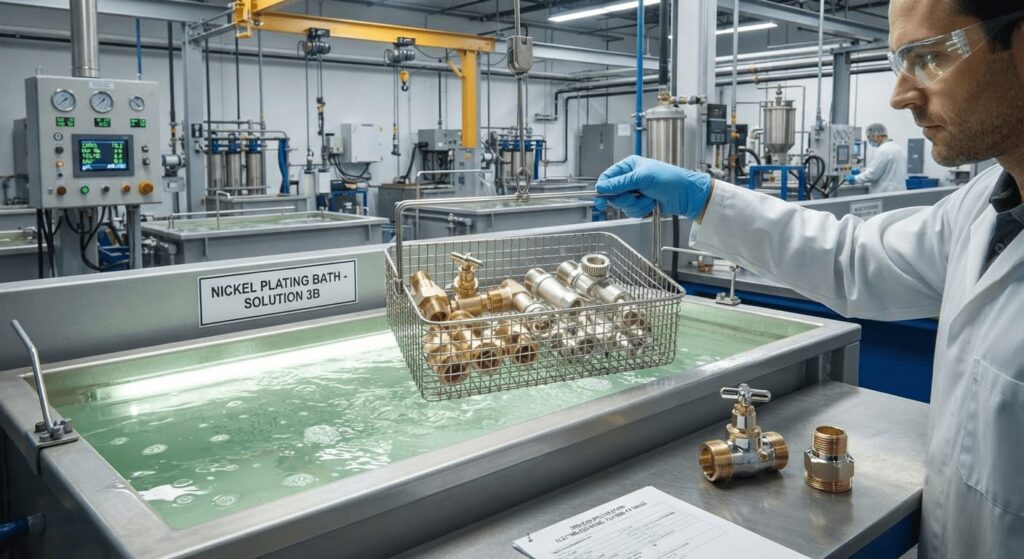
Nickel plating on brass components is a surface finishing process in which a thin layer of nickel is deposited onto a brass part to improve its durability, corrosion resistance, wear resistance, and appearance. The plating creates a protective barrier that shields the brass substrate from moisture, chemicals, oxidation, and mechanical wear while maintaining the component’s dimensional accuracy.
This process is commonly used for precision-engineered brass components operating in demanding environments. Industries such as electrical, plumbing, automotive, telecommunications, aerospace, electronics, and industrial manufacturing rely on nickel-plated brass parts for improved performance and longer service life.
Nickel plating also provides a smooth, bright metallic finish that enhances the product’s appearance, making it suitable for both functional and decorative applications. Unlike untreated brass, which may tarnish over time, nickel-plated brass components retain their finish and performance with minimal maintenance.
Why is Nickel Plating Used on Brass Components?
Because of these advantages, nickel plating on brass components has become the preferred finishing process for OEM manufacturers, exporters, and industrial equipment manufacturers looking for long-lasting, corrosion-resistant brass parts.
Manufacturers choose nickel plating because it significantly enhances the performance of brass without affecting its excellent machinability and strength.
- Corrosion Protection : Protects brass against corrosion and oxidation.
- Greater Hardness : Increases surface hardness and scratch resistance.
- Wear Resistance : Improves resistance to abrasion and mechanical wear.
- Longer Service Life : Extends the lifespan of industrial components.
- Professional Finish : Creates a clean, uniform, and attractive metallic appearance.
- Harsh Environment Performance : Performs reliably in humid, marine, and chemical environments.
- Lower Maintenance : Reduces maintenance and replacement costs.
- Reliable Performance : Enhances reliability in electrical and mechanical assemblies.
These advantages make nickel plating one of the most widely used finishing methods for precision brass components.
How Does Nickel Plating Work?
Nickel plating is typically carried out using either an electroplating or an electroless plating process. During plating, nickel ions are deposited onto the cleaned brass surface, creating a uniform protective coating.
The coating thickness can be adjusted according to the application’s performance requirements, environmental conditions, and customer specifications. The finished nickel layer acts as a durable protective shield while preserving the precise dimensions of the original brass component.
Step-by-Step Nickel Plating Process for Brass Components
High-quality nickel plating involves several carefully controlled stages to ensure excellent adhesion, uniform coating thickness, and long-term durability.
| Step | Process | Purpose |
|---|---|---|
| 1 | Surface Inspection | Checks the brass component for defects or contamination. |
| 2 | Degreasing & Cleaning | Removes oil, grease, dust, and machining residues. |
| 3 | Acid Pickling | Eliminates surface oxides and prepares the brass for plating. |
| 4 | Water Rinsing | Removes chemical residues before plating. |
| 5 | Nickel Plating | Deposits a controlled nickel coating using electroplating or electroless plating. |
| 6 | Final Rinsing | Cleans the plated component to remove residual chemicals. |
| 7 | Drying & Polishing | Enhances appearance and prevents water stains. |
| 8 | Quality Inspection | Measures coating thickness, adhesion, finish quality, and corrosion resistance. |
Manufacturing Workflow
Raw Brass Component
↓
Surface Inspection
↓
Degreasing & Cleaning
↓
Acid Pickling
↓
Water Rinse
↓
Nickel Plating
↓
Final Rinse
↓
Drying & Polishing
↓
Quality Inspection
↓
Packaging & Dispatch
Why Surface Preparation is Critical
The quality of a nickel-plated brass component depends heavily on proper surface preparation. Even the most advanced plating equipment cannot produce a durable finish if the brass surface contains oil, oxidation, or other contaminants.
Before plating, manufacturers carefully clean and prepare every component to ensure maximum coating performance.
- Strong Adhesion : Creates a secure bond between the brass substrate and the nickel coating.
- Uniform Thickness : Ensures an even nickel coating across the entire surface.
- Smooth Finish : Produces a clean, defect-free metallic appearance.
- Improved Corrosion Resistance : Enhances protection against moisture, chemicals, and oxidation.
- Extended Product Life : Increases durability while reducing maintenance and replacement costs.
Poor surface preparation can lead to peeling, blistering, uneven coating, and premature failure, making this one of the most important stages of the nickel plating process.
Types of Nickel Plating for Brass Components
Nickel plating for brass components is primarily carried out using two methods: Electrolytic Nickel Plating and Electroless Nickel Plating. The selection depends on the application’s performance requirements, coating uniformity, durability, and operating environment.
1. Electrolytic Nickel Plating
Electrolytic nickel plating, also known as electroplating, uses an electric current to deposit a layer of nickel onto the brass surface. It provides a bright finish, excellent corrosion resistance, and improved wear protection, making it ideal for high-volume industrial production.
Common Applications
- Brass cable glands
- Brass inserts
- Electrical terminals
- Plumbing fittings
- Decorative hardware
2. Electroless Nickel Plating
Electroless nickel plating is a chemical deposition process that applies nickel evenly across the entire brass component without using electricity. It delivers a highly uniform coating with exceptional corrosion and wear resistance, making it the preferred choice for precision and complex-shaped components.
Common Applications
- CNC brass components
- Automotive parts
- Hydraulic fittings
- Aerospace components
- Precision industrial parts
Electrolytic vs Electroless Nickel Plating
| Feature | Electrolytic Nickel Plating | Electroless Nickel Plating |
|---|---|---|
| Process | Uses electric current | Chemical deposition |
| Coating Finish | Bright finish | Uniform finish |
| Corrosion Resistance | High | Very High |
| Best For | Standard industrial components | Precision and complex-shaped components |
| Cost | More economical | Higher due to advanced process |
Today, nickel plating on brass components is used across numerous industries because it delivers outstanding durability while maintaining the dimensional accuracy of precision-machined brass parts.
Industrial Applications of Nickel-Plated Brass Components
Nickel-plated brass components are widely used across industries that require high durability, corrosion resistance, and long-term reliability. The protective nickel coating extends the service life of brass parts while maintaining their strength, precision, and appearance in demanding operating environments.
1. Electrical & Electronics Industry
Nickel-plated brass combines the excellent electrical conductivity of brass with the corrosion resistance of nickel, making it ideal for reliable electrical connections.
Common Components
- Electrical terminals
- Connectors
- Switchgear parts
- Earthing accessories
- Brass neutral links
2. Plumbing & Sanitary Systems
Nickel plating protects plumbing components from water, humidity, and temperature variations while maintaining an attractive finish.
Common Components
- Pipe fittings
- Compression fittings
- Valves
- Faucet components
- Plumbing connectors
3. Automotive Industry
Automotive manufacturers use nickel-plated brass components because they withstand heat, vibration, moisture, and continuous operation.
Common Components
- Sensor housings
- Battery terminals
- Fuel system fittings
- Electrical connectors
- Precision fasteners
4. Telecommunications Industry
Reliable communication systems depend on corrosion-resistant connectors that deliver consistent signal transmission in indoor and outdoor environments.
Common Components
- RF connectors
- Cable glands
- Antenna fittings
- Communication connectors
5. Industrial Machinery
Industrial equipment often operates in harsh environments where friction, chemicals, and continuous usage demand superior wear resistance.
Common Components
- Hydraulic fittings
- Pneumatic connectors
- Precision machined parts
- Industrial valves
6. Renewable Energy Systems
Solar and wind energy systems require durable components capable of withstanding years of outdoor exposure and harsh weather conditions.
Common Components
- Solar panel connectors
- Battery terminals
- Electrical junction components
- Grounding accessories
Applications by Industry
| Industry | Common Nickel-Plated Brass Components |
|---|---|
| Electrical & Electronics | Terminals, connectors, neutral links |
| Plumbing | Valves, fittings, faucet parts |
| Automotive | Battery terminals, sensor housings, connectors |
| Telecommunications | Cable glands, RF connectors, antenna fittings |
| Industrial Machinery | Hydraulic fittings, valves, CNC components |
| Renewable Energy | Solar connectors, grounding accessories |
Why Industries Prefer Nickel-Plated Brass Components
Manufacturers across the world choose nickel-plated brass because it provides the ideal combination of strength, corrosion resistance, electrical conductivity, durability, and cost-effectiveness. Compared to untreated brass, the nickel coating significantly improves product performance while reducing maintenance requirements.
Whether used in electrical systems, plumbing installations, automotive assemblies, telecommunications equipment, or precision industrial machinery, nickel-plated brass components deliver dependable performance, longer service life, and excellent appearance in demanding environments.
- Superior Corrosion Resistance : Protects components from moisture, chemicals, and oxidation.
- High Wear Resistance : Reduces abrasion and extends component lifespan.
- Improved Surface Hardness : Provides better scratch and impact resistance.
- Professional Metallic Finish : Delivers an attractive and long-lasting appearance.
- Excellent Value : Offers long-term reliability with reduced maintenance and replacement costs.
Industry Standards & References
The following international standards and technical resources provide reliable guidance for nickel plating, metallic coatings, and quality requirements for brass components.
🎯 Key Takeaways
- Enhanced Protection : Nickel plating protects brass components against corrosion, oxidation, and environmental damage.
- Longer Service Life : Improved hardness and wear resistance significantly extend component durability.
- Two Plating Methods : Electrolytic and electroless nickel plating are selected based on application requirements.
- Wide Industrial Usage : Nickel-plated brass components are widely used in electrical, plumbing, automotive, telecommunications, industrial machinery, and renewable energy sectors.
- Choose an Experienced Manufacturer : High-quality plating, precision machining, and strict quality control ensure reliable long-term performance.
Frequently Asked Questions
Looking for High-Quality Nickel-Plated Brass Components?
Anand Brass Components manufactures precision nickel-plated brass components for electrical, plumbing, automotive, industrial, and OEM applications. Contact our team today for custom manufacturing solutions and competitive pricing.
Related Articles
- Brass Components: The Complete Guide to Types, Applications & Manufacturing Excellence — Read Article
-
OEM Brass Parts Manufacturing: Everything You Need to Know — Read Article
-
Top Brass Components Manufacturer in Jamnagar — Read Article