
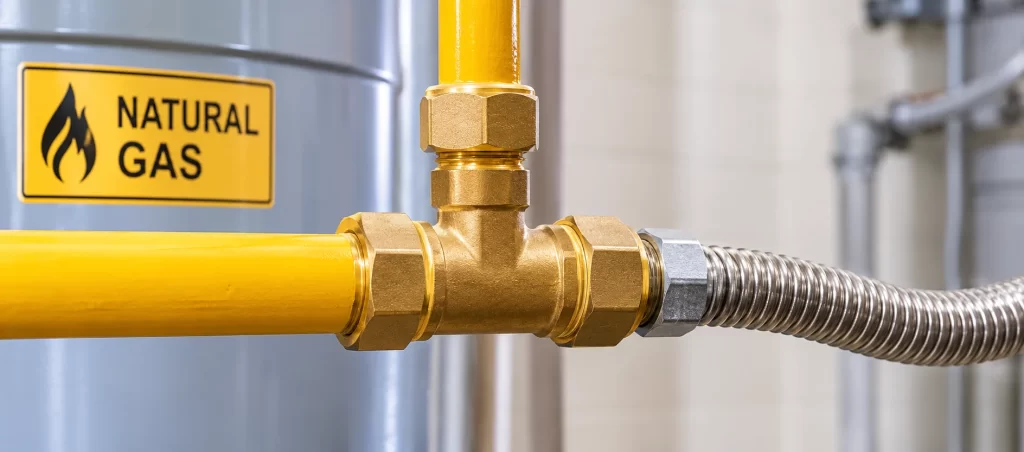
Yes, brass is one of the most common materials in US gas systems, but not every brass fitting belongs on a gas line. This guide from Anand Brass Components explains what the International Fuel Gas Code and NFPA 54 allow, which brass fittings are right for natural gas and propane, and the mistakes that cause leaks.
⚡ Quick Answer
Can you use brass fittings on gas lines?
Yes, if the fittings are made, rated and approved for fuel gas and installed to code. In the US, the International Fuel Gas Code (IFGC) and NFPA 54 (National Fuel Gas Code) govern gas piping. Brass threaded pipe fittings, 45° flare fittings (the traditional choice for copper gas tubing), gas valves and appliance connectors are all widely used for both natural gas and propane. What you should not do is use ordinary water-plumbing brass, such as standard compression fittings or unrated parts, on a gas line. Use only fittings listed or approved for gas, use a gas-rated thread sealant, test every joint with a leak-detection solution, and follow your local code and the authority having jurisdiction. If you’re not qualified, use a licensed gas fitter.
“Can I use brass fittings on my gas line?” is one of the most searched plumbing questions in the US, and the answers online are often contradictory. One forum says “brass is brass”, another says “never”. The truth sits between them and comes down to which brass fitting, which gas, which code and who installs it.
At Anand Brass Components we manufacture precision brass gas parts for US and international buyers, including fittings, valve components, regulator parts and connectors. This guide explains the rules in plain language. It is general information, not a substitute for your local code or a licensed professional.
🎯 Key takeaways
- Brass is widely accepted in gas systems for threaded fittings, flare fittings, valves and connectors.
- The code cares about the joint type and approval, not only the metal. IFGC 403.10 sets the rules for pipe and tubing joints.
- Flare fittings (SAE 45°) are the traditional brass fitting for copper gas tubing. Ordinary water-type compression fittings should not be used on gas.
- The same gas-rated brass fittings generally serve natural gas and propane, but pressures and regulators differ.
- Use yellow gas-rated PTFE tape or gas-rated pipe dope on tapered threads, never on flare or compression seats.
- Leak-test with soap solution or a gauge, never a flame.
- 403.10IFGC section on gas pipe & tubing joints
- 45°Flare angle used for gas tubing fittings
- 175 psiMax rating covered by ASME B16.33 gas valves
- 0.3 grH₂S per 100 scf limit for copper & brass
Why brass is used for gas in the first place
Brass, an alloy of copper and zinc, has properties that suit fuel gas:
- Corrosion resistance. Brass doesn’t rust, so threads and sealing faces stay clean for decades, indoors and outdoors.
- Machinability. Brass machines into precise, smooth threads and flare seats, and a gas-tight seal depends on that accuracy.
- Low-sparking. Brass is far less likely than steel to create sparks when struck, which is useful around flammable gas.
- Forgeability. Hot-forged brass gives dense, pressure-tight bodies for valves and fittings.
- Compatibility with copper tubing, which is common for propane and, where permitted, natural gas.
For background on the alloy, see What Is Brass? 20 Common Questions Answered.
What the US fuel gas code actually says
Most US jurisdictions adopt either the International Fuel Gas Code (IFGC) or NFPA 54 / ANSI Z223.1 (National Fuel Gas Code), often with local amendments. The relevant IFGC rules sit in Chapter 4, Section 403.10 (“Metallic piping joints and fittings”). Here is a plain-English summary. Exact wording varies by edition and jurisdiction.
| Provision | What it requires (plain English) | What it means for brass |
|---|---|---|
| 403.10.1 Pipe joints | Pipe joints must be threaded, flanged, brazed, welded, or made with listed press-connect fittings. Brazing alloys must melt above 1,000 °F (538 °C) and contain no more than 0.05% phosphorus | Brass threaded pipe fittings (NPT) are a standard way to join gas pipe |
| 403.10.2 Tubing joints | Tubing joints must use approved gas tubing fittings, brazing (above 1,000 °F), or press-connect fittings complying with ANSI LC-4 | Brass flare fittings and other fittings must be approved for gas tubing |
| 403.10.3 Flared joints | Flared joints only in nonferrous pipe and tubing systems, where proven suitable and where the design prevents separation | Brass flare fittings on copper tubing are permitted when properly installed and supported |
| 403.10.4 Special / metallic fittings | Couplings, proprietary joints, saddle tees, gland-type compression fittings and flared, flareless or compression-type tubing fittings must be used within the manufacturer’s pressure-temperature ratings, suit vibration and thermal movement, be braced against separation, and be approved | Any compression-style fitting on gas must be specifically approved for gas, not a general water fitting |
Summarized from IFGC Chapter 4 (2012–2024 editions as published by ICC and adopted locally). Local codes can be stricter. For example, some jurisdictions require SAE heavy-duty 45° flare fittings for 2 psi tubing systems. Always confirm with your local authority having jurisdiction (AHJ).
In the code, “approved” means acceptable to the code official, usually because the product is listed or certified to a recognized standard for gas service. A brass fitting from the plumbing aisle with no gas rating doesn’t meet that test, even if it’s the same size and thread.
Which brass fittings are allowed on gas, and which aren’t
| Brass item | Typically acceptable for gas? | Conditions |
|---|---|---|
| Forged brass NPT pipe fittings (elbows, tees, nipples, plugs, bushings) | Yes | Rated for gas service; gas-rated thread sealant |
| SAE 45° flare fittings and flare nuts | Yes | On nonferrous (copper) tubing; correct flare; listed for gas |
| Gas ball valves and shut-off valves | Yes | Listed for gas (e.g. CSA/ANSI Z21.15 or ASME B16.33 as applicable) |
| Appliance connector fittings | Yes | As part of a connector listed to ANSI Z21.24 / CSA 6.10 |
| CSST system fittings | Yes | Only the CSST manufacturer’s own listed fittings |
| Gas-approved compression or flareless fittings | Sometimes | Only if specifically approved for gas and allowed locally |
| Standard water compression fittings (olive / ferrule type) | No | Not rated for fuel gas |
| Cast brass fittings of unknown rating, hose barbs, garden hose fittings | No | Not designed or listed for gas |
| Push-fit (push-to-connect) water fittings | No | O-ring water fittings are not gas fittings |
Brass fitting types used in gas systems
Threaded (NPT) pipe fittings
Forged brass fittings with NPT tapered threads join black steel or brass pipe, and connect valves, regulators and appliances. NPT threads seal on the thread flanks, so a gas-rated sealant is required. Common shapes include elbows, tees, couplings, nipples, bushings, caps and plugs. Our guide to types of pipe fittings explains each one.
Flare fittings (SAE 45°)
A flare fitting seals metal-to-metal between a 45° flared tube end and the fitting’s cone, clamped by a flare nut. No sealant is used on the flare. Flare fittings are the traditional brass fitting for soft copper gas tubing in propane systems, appliance hookups, RVs and gas grills. Industry specifications reference SAE J513 and ASME B16.26 for flare fittings.
Gas valves
Brass ball valves and plug valves are standard for appliance shut-offs and branch isolation. Look for gas listings. Valves for appliances and appliance connectors are typically listed to ANSI Z21.15 / CSA 9.1, while larger metallic shut-off valves in piping systems can fall under ASME B16.33 (NPS ½–2, up to 175 psi).
Appliance connectors
Flexible stainless-steel gas connectors, listed to ANSI Z21.24 / CSA 6.10, use brass flare nuts and adapters at each end. Never substitute a water braided hose. See our braided hose guide for why water hoses are a different product.
Regulator and meter-set parts
Brass is common in regulator bodies, inlet and outlet fittings, tank connections (POL and similar for propane) and meter swivels.
For gas, forged brass is preferred for pressure-containing parts because it is dense and free of casting porosity. Forging also lets manufacturers like Anand Brass Components produce strong valve and fitting bodies at high volumes. See brass forging vs casting.
Sourcing brass gas parts for the US market?
Anand Brass Components forges and machines brass gas fittings, valve bodies and regulator parts to your drawings, with OES-verified alloy chemistry and an MTC with every shipment.
Flare vs compression fittings on gas lines
This is where most confusion starts. Both look like a nut on a fitting, but they seal differently:
| Feature | 45° flare fitting | Standard compression fitting |
|---|---|---|
| How it seals | Flared tube end clamped against a matching 45° cone (metal-to-metal) | A ferrule (olive) squeezed onto the tube |
| Tube preparation | Tube must be flared with a flaring tool | Tube is cut square, with no flaring |
| Resistance to pull-out and vibration | High, because the flare can’t slip out | Lower; can loosen under vibration if not supported |
| Typical use | Gas tubing, refrigeration, automotive | Water supply lines, low-pressure fluids |
| Gas use | Traditional, widely accepted choice | Only if specifically approved for gas; standard water types are not |
To understand compression fittings in depth, including where they are the right choice, read Compression Fittings Explained.
Brass fittings for propane vs natural gas
In most cases the same gas-rated brass fittings are used for both. The differences lie in the system:
| Factor | Natural gas | Propane (LP gas) |
|---|---|---|
| Typical appliance supply pressure | About 7 in. water column (low pressure) | About 11 in. water column after the second-stage regulator |
| Upstream pressure | Utility service pressure to the meter | Much higher tank pressure upstream of the regulators |
| Common piping | Black steel, CSST, PE (underground); copper where permitted | Copper tubing, CSST, black steel, PE (underground) |
| Brass flare fittings | Used where copper tubing is permitted | Very common |
| Copper and brass restrictions | Not where gas contains more than 0.3 grains of hydrogen sulfide per 100 scf; some utilities restrict copper | Generally permitted |
| Appliance orifices | Natural gas orifices | LP orifices. Appliances must be converted when switching gas |
Pressures are typical residential values and vary by utility, region and appliance. Fittings must be rated for the pressure at their location, which matters most upstream of propane regulators.
Some natural gas supplies contain sulfur compounds that attack copper. That’s why the code restricts copper and brass where hydrogen sulfide exceeds 0.3 grains per 100 standard cubic feet, and why some utilities don’t allow copper tubing for natural gas at all. Check with your gas utility.
Brass gas valves and connectors: standards to look for
| Standard | Covers |
|---|---|
| ANSI Z21.15 / CSA 9.1 | Manually operated gas valves for appliances, appliance connector valves and hose-end valves |
| ASME B16.33 | Manually operated metallic gas valves, NPS ½–2, for gas piping systems up to 175 psi |
| ANSI Z21.24 / CSA 6.10 | Connectors for gas appliances |
| ANSI Z21.69 / CSA 6.16 | Connectors for movable gas appliances |
| ANSI Z21.75 / CSA 6.27 | Connectors for outdoor gas appliances and manufactured homes |
| ANSI Z21.41 / CSA 6.9 | Quick-disconnect devices for gas appliances |
| ANSI LC-4 / CSA 6.32 | Press-connect fittings for gas piping |
| SAE J513 / ASME B16.26 | Flare fittings (dimensions and design) |
Buyers sourcing components for listed products should agree in advance which standard applies, and which tests the finished product must pass. Anand Brass Components manufactures to customer drawings and specifications. Listing and certification of the finished product remains with the brand owner.
Thread standards on brass gas fittings: NPT, NPTF, flare and BSP
Many leaks on new installations come from mismatched threads rather than bad brass. In US gas work you will meet four thread families:
| Thread | Where you see it | How it seals | Sealant? |
|---|---|---|---|
| NPT (ASME B1.20.1) | Pipe fittings, valves, regulators, appliance inlets | Tapered threads wedge together; sealant fills the spiral gap | Yes, gas-rated |
| NPTF dryseal (ASME B1.20.3) | Some valve and regulator ports | Thread crests and roots crush together for a tighter seal | Usually still used on gas for safety |
| SAE 45° flare (UNF threads) | Flare nuts and flare fittings on copper tubing and connectors | The threads only clamp; the flare cone seals | No |
| BSP / BSPT (ISO 7, ISO 228) | Imported European or Asian appliances | 55° thread angle; not compatible with NPT | Not for mixing with NPT |
NPT and BSPT look similar and some sizes will even start to thread together, but the 60° vs 55° thread angle and different pitches mean they will never seal reliably. If you import appliances or components, insist on NPT threads for the US market and verify them with thread gauges. Our US thread and size chart guide covers identification in detail.
Brass fittings for grills, RVs, fire pits and outdoor gas
Outdoor and mobile appliances account for a large share of “brass gas fitting” searches, and they have a few particular points:
- Gas grills and fire pits. Most use a brass flare or NPT connection at the regulator and burner manifold. For natural gas grills, use an outdoor-rated connector or quick-disconnect listed for the purpose (for example ANSI Z21.75 or Z21.41), never a garden or water hose.
- RVs and campers. Propane systems in RVs commonly use copper tubing with brass flare fittings. Vibration on the road is why flare fittings, not compression, are the norm, and why the tubing must be well supported.
- Propane tank connections. Cylinder and tank valves use brass connections such as POL and ACME (Type 1). These are specialised, listed parts. Replace worn O-rings and damaged connectors rather than improvising.
- Converting a grill or heater between gases. Switching between propane and natural gas involves the orifices and regulator, not just the fittings. Use the manufacturer’s conversion kit.
- Outdoor corrosion. Brass weathers well, but salty coastal air can tarnish it. This is cosmetic. See how to clean brass, and never use abrasive cleaners on sealing faces.
Thread sealants for brass gas fittings
- Tapered (NPT) threads: use a thread sealant rated for gas. That means either yellow PTFE gas tape (thicker than white plumbing tape) or a pipe joint compound listed for gas, including LP gas where relevant.
- Flare and compression seats: no sealant. These seal on the flare or ferrule, and tape or dope can stop them seating or contaminate the gas stream.
- Apply sealant to male threads only, leaving the first one or two threads bare so sealant doesn’t enter the pipe.
Installation and leak testing: the safe sequence
Gas work is regulated, and in many US jurisdictions it requires a licensed professional and a permit. The steps below explain good practice so you can understand and check the work. They are not an invitation to work on gas if you aren’t qualified.
Shut off the gas and ventilate
Turn off the supply at the appliance valve or meter, put out any pilot lights, and make sure the area is ventilated.
Choose listed parts
Confirm every fitting, valve and connector is rated for gas and for the pressure at that point in the system.
Prepare the joint correctly
Clean the threads, apply gas-rated sealant to male NPT threads only, and make flares with a proper flaring tool to the correct dimension.
Assemble without overtightening
Brass is softer than steel. Overtightening can split flare nuts or crack fittings. Use two wrenches to avoid twisting the line.
Support the piping
Brace tubing so joints can’t be pulled apart by movement, vibration or gas pressure.
Pressure-test where required
New piping is typically pressure-tested to the code-required pressure and duration before appliances are connected.
Leak-check every joint
Apply a gas leak-detection solution or soapy water and watch for bubbles, or use an electronic gas detector. Never use a flame.
Restore gas and relight
Open the supply, purge air as required, relight pilots and check appliance operation.
When brass is not the right choice for gas
- Sour gas. Copper and brass shouldn’t be used where gas contains significant hydrogen sulfide (above 0.3 grains per 100 scf).
- High-pressure industrial lines beyond the fitting’s rating. These may need steel, welded joints or forged steel fittings.
- Buried service lines. Underground gas piping is usually PE plastic or coated steel with specific transition fittings.
- CSST systems, unless the fittings are the CSST manufacturer’s own listed fittings.
- Unknown or unrated parts. If you can’t confirm a gas rating, don’t use it.
Common mistakes with brass fittings on gas lines
- Using water compression fittings on gas because they fit the tubing.
- Using white PTFE tape instead of gas-rated yellow tape or gas-listed dope.
- Putting tape on flare seats, which stops the metal-to-metal seal.
- Mixing NPT and BSP threads on imported parts. They look similar but won’t seal.
- Re-using old flare nuts or connectors that are cracked or deformed.
- Overtightening brass and cracking the fitting or nut.
- Leak-testing with a lighter. Always use soap solution or a detector.
- Skipping the permit and inspection where local law requires them.
For buyers and OEMs: sourcing brass gas parts
If you design or import gas valves, regulators, grills, heaters, RV appliances or connectors, the brass components inside them decide how safe and durable the product is. When sourcing:
| Item | Why it matters |
|---|---|
| Alloy grade (e.g. forging brass CW617N / C37700, free-cutting C36000) | Strength, porosity-free bodies, machinability |
| Forged vs machined-from-bar | Pressure integrity of bodies |
| Thread standard (NPT, NPTF dryseal, SAE flare, UNF) | Correct sealing and interchangeability |
| Flare seat geometry and finish | Metal-to-metal seal quality |
| 100% leak or pressure testing | Catches porosity and machining defects |
| Material test certificates | Traceable chemistry for audits and listings |
| Target standard for the finished product | Aligns component tolerances with listing tests |
Anand Brass Components has supplied brass gas parts to US buyers for years. Learn more on our US brass gas parts supplier page. For the sourcing and import process, see How to Import Brass Components from India and our 2026 US tariff guide.
Final word
Brass and gas go together, as long as the brass is made for gas. Gas-rated brass NPT fittings, 45° flare fittings, listed valves and listed connectors are standard in US natural gas and propane systems. Ordinary water fittings, unrated parts and improvised joints are not. Follow the IFGC or NFPA 54 as adopted locally, use the right sealant, leak-test properly, and use a licensed professional when the law requires one.
For manufacturers and importers, Anand Brass Components offers precision-forged and machined brass gas components with controlled chemistry and full documentation, made in Jamnagar since 1991.
Talk to a brass gas parts manufacturer
Forged valve bodies, flare fittings, regulator parts and connectors, made by Anand Brass Components. ISO 9001 certified, exporting to the US since 2012.
Frequently Asked Questions
Related guides
Written by the Anand Brass Components Technical Team. Anand Brass Components is a brass parts manufacturer and exporter at Plot 4110-4111, H-Road, GIDC Phase-III, Jamnagar, Gujarat 361004, India. Founded in 1991, ISO 9001 certified, with in-house forging, extrusion, CNC machining and OES alloy testing. Contact: info@anandbrass.com · +91 78743 05684.
Safety & legal disclaimer: This article is general information as of 19 November 2026 and is not code advice. Fuel gas installations are governed by the code adopted in your jurisdiction (IFGC, NFPA 54 or local amendments) and the authority having jurisdiction. Many areas require a licensed installer and permit. If you smell gas, leave the building and call your gas utility or 911 from a safe place. References: International Fuel Gas Code, Chapter 4, Section 403.10 (ICC); NFPA 54 / ANSI Z223.1; ASME B16.33; ANSI Z21.15/CSA 9.1; ANSI Z21.24/CSA 6.10; SAE J513; ASME B16.26; IRC G2414.