
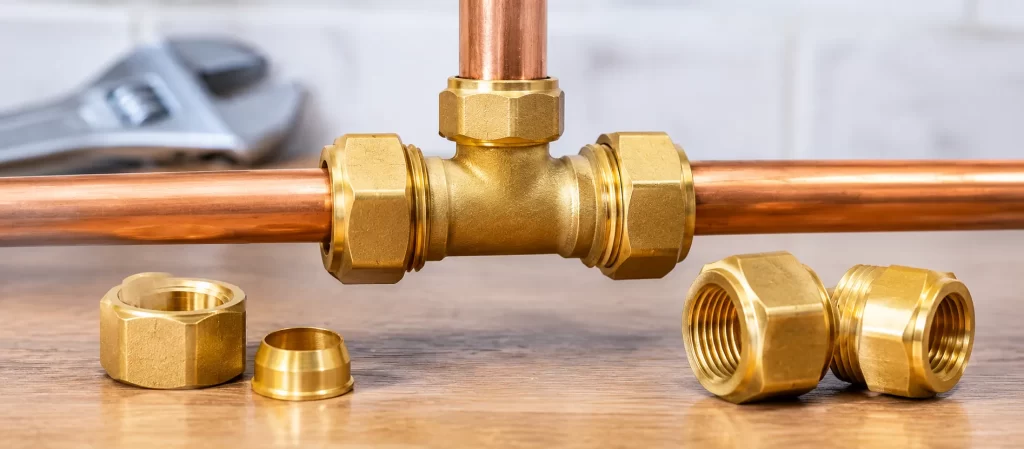
Compression fittings connect pipes and tubes with no soldering, glue or special tools, just a nut, a ring and a wrench. This guide from Anand Brass Components, a brass fittings manufacturer, explains how they seal, which size you need, how tight to make them, and when push-fit, flare or sweat joints are the better choice.
⚡ Quick Answer
What is a compression fitting and how does it work?
A compression fitting joins two pipes or tubes using three parts: a body, a compression nut and a ferrule (called an “olive” in the UK). You slide the nut and ferrule onto the pipe, push the pipe into the body, and tighten the nut. The nut drives the ferrule into the tapered seat of the body, squeezing it onto the pipe to form a watertight metal-to-metal seal. No heat, solder or glue is needed. For typical brass olive fittings, tighten hand-tight, then about one more full turn with a wrench (follow the manufacturer’s instruction). Don’t put PTFE tape on the compression threads, because the ferrule makes the seal. Compression fittings are ideal for faucet and toilet supplies, shut-off valves, and repairs in tight spaces. They are not for buried or hidden joints, or for fuel gas unless specifically approved.
🎯 Key takeaways
- Three parts: body, nut and ferrule (olive). The ferrule makes the seal, not the threads.
- Sized by the tube’s outside diameter: 1/4″, 3/8″, 1/2″ OD in the US; 8, 10, 15, 22, 28 mm in the UK and EU.
- Don’t overtighten. Hand-tight plus about one turn is typical for brass olives, and overtightening causes leaks.
- Use an insert (stiffener) when fitting compression onto PEX or other plastic pipe.
- Compression vs push-fit: compression is cheaper and more compact, while push-fit is faster and needs no tools.
- Keep them accessible. Many codes and good practice avoid compression joints inside walls or underground.
- 3Parts: body, nut, ferrule
- ~1 turnPast hand-tight (typical brass olive)
- 0Heat, solder or glue needed
- ODSized by the tube’s outside diameter
What is a compression fitting?
A compression fitting is a mechanical connector that joins pipe or tubing by compressing a ring onto the outside of the pipe. It’s one of the oldest and most widely used “no-heat” joints in plumbing, and it’s everywhere: under your kitchen sink, behind your toilet, on your refrigerator ice-maker line, and in instrumentation, hydraulics and compressed-air systems.
Compression fittings are popular because they:
- need only two wrenches, with no torch, solder, flux, glue or crimp tool,
- work in wet pipes, where soldering is hard,
- can be taken apart for service,
- join different materials, such as copper to PEX, with the right inserts,
- are compact and inexpensive.
Most plumbing compression fittings are made of brass, sometimes chrome- or nickel-plated for visible locations.
The three parts of a compression fitting
| Part | Also called | What it does | Typical material |
|---|---|---|---|
| Body | Fitting body, union, valve outlet | Has male threads and an internal tapered seat (cone) that the ferrule is driven into | Forged or machined brass |
| Compression nut | Cap nut, coupling nut | Threads onto the body and pushes the ferrule into the seat | Brass, sometimes plated |
| Ferrule | Olive (UK), sleeve, compression ring | A soft ring that deforms onto the pipe and against the seat to make the seal | Brass or copper; plastic (acetal) for some plastic-pipe fittings |
| Insert (when needed) | Pipe stiffener, liner | Supports plastic or thin-wall pipe from inside so it doesn’t collapse | Brass, stainless or plastic |
How a compression fitting seals
When you tighten the nut, three things happen at once:
- The nut drives the ferrule forward into the body’s tapered seat.
- The taper squeezes the ferrule inwards, so it bites onto and slightly deforms the pipe’s outer surface, gripping it permanently.
- The ferrule’s outer face seals against the seat, and its inner face seals against the pipe.
The result is two metal-to-metal seals, one between ferrule and pipe and one between ferrule and body, held by the nut. The threads only provide clamping force. They don’t seal, which is why thread sealant isn’t normally needed.
Once tightened, the ferrule is permanently swaged onto the pipe. You can undo the nut and re-tighten it, but you can’t slide the ferrule off without cutting it. That’s normal.
Types of compression fittings
| Type | How it differs | Typical use |
|---|---|---|
| Single-ferrule (olive) plumbing fitting | One soft brass or copper ring | Household water supply, valves, radiators |
| Type A (non-manipulative, UK) | Pipe end isn’t shaped; the olive does the work (BS EN 1254-2) | Above-ground copper water pipe |
| Type B (manipulative, UK) | The pipe end is flared or swaged before assembly | Underground or high-security joints where permitted |
| Two-ferrule instrumentation fitting | Front and back ferrules give a very strong grip and seal | Instrumentation, hydraulics, labs, process plants |
| Compression fitting for PEX / PE pipe | Includes an insert; ferrule may be brass or plastic | PEX, PE and MDPE water pipe |
| Compression angle stop and straight stop valves | Valve with a compression outlet | Sink, toilet and appliance shut-offs |
| Compression unions, elbows, tees, reducers, adapters | Standard shapes with compression ends, often mixed with threaded ends | Repairs and branch connections |
For the full family of fitting shapes (elbows, tees, couplings, unions and more), see our companion guide Types of Pipe Fittings: Names, Uses & Chart.
Compression fitting sizes: US and metric
Compression fittings are sized by the outside diameter (OD) of the tube they fit, not by nominal pipe size. This is the most common source of buying mistakes in the US, because copper water pipe is sold by nominal size, which is not its OD.
| Compression size (tube OD) | Fits | Common use |
|---|---|---|
| 1/4″ OD | 1/4″ OD copper or plastic tubing | Ice makers, water filters, RO systems |
| 3/8″ OD | 3/8″ OD supply tubing; also 1/4″ nominal copper (3/8″ OD) | Faucet and toilet supply lines, angle stop outlets |
| 1/2″ OD | 1/2″ OD tubing; also 3/8″ nominal copper (1/2″ OD) | Some faucet supplies |
| 5/8″ OD | 1/2″ nominal copper pipe (5/8″ OD) | Angle stop inlets on 1/2″ copper |
| 7/8″ OD | 3/4″ nominal copper pipe (7/8″ OD) | Main supply branches, water heater connections |
Example: a “1/2-inch nominal × 3/8-inch OD compression angle stop” fits on 1/2″ copper pipe (which is 5/8″ OD) and has a 3/8″ OD compression outlet for the supply line.
| Size (pipe OD) | Common use |
|---|---|
| 8 mm / 10 mm | Microbore heating, small supplies |
| 15 mm | Standard domestic hot and cold water, radiators |
| 22 mm | Mains and heating flow and return |
| 28 mm | Larger supplies and boiler circuits |
| 35 mm, 42 mm, 54 mm | Commercial installations |
Some sizes are close, for example 15 mm vs 5/8″ (15.9 mm) and 22 mm vs 7/8″ (22.2 mm), but they are not interchangeable. A mismatched olive or nut is a guaranteed slow leak.
Where compression fittings are used
- Angle stops and straight stops under sinks and toilets, which is the most common household use.
- Faucet and toilet supply lines, including the outlet of braided supply hoses. See our braided hose fittings size guide.
- Ice makers, water filters and RO systems on 1/4″ tubing.
- Radiator valves and heating pipework (very common in the UK and Europe).
- Repairs: compression couplings fix pinhole leaks or join pipe when soldering isn’t practical.
- Instrumentation and hydraulics, using two-ferrule designs.
- Compressed air and lubrication lines.
Where they’re usually avoided: inside walls and ceilings without access, underground (unless a Type B or specifically approved fitting), on fuel gas (unless approved; see brass fittings for gas lines), and where heavy vibration or movement could loosen the joint.
Sourcing brass compression fittings or valve parts?
Anand Brass Components forges and machines compression nuts, olives, bodies, unions and angle-stop parts to your drawings, in US and metric sizes, with lead-free options.
How to install a compression fitting step by step
Turn off the water and drain the line
Close the supply valve and open a faucet to relieve pressure. Keep a towel and bucket handy.
Cut the pipe square
Use a tube cutter for copper, or a PEX cutter for plastic. A hacksaw cut is rarely square enough. The pipe end must be round and undamaged.
Deburr and clean
Remove internal and external burrs, then clean the outside of the pipe where the ferrule will sit. Scratches along the pipe can cause leaks.
Slide on the nut, then the ferrule
Put the nut on first (threads facing the fitting), then the ferrule. If the ferrule has a longer tapered side, follow the maker’s orientation.
Insert the pipe fully into the body
Push the pipe all the way to the body’s internal stop. For plastic pipe, fit the insert first.
Hand-tighten the nut
Thread the nut onto the body by hand until snug, keeping the pipe pushed in.
Tighten with two wrenches
Hold the body with one wrench, then turn the nut about one more full turn with the other (see “How tight?” below).
Turn the water on and check
Open the supply slowly and inspect for drips. If it weeps, tighten a further quarter turn at a time.
How tight should a compression fitting be?
This is the most asked compression fitting question, because both under- and over-tightening cause leaks.
| Fitting | Typical guidance |
|---|---|
| Brass olive on copper (plumbing) | Hand-tight, then about 1 to 1¼ turns with a wrench |
| Compression on PEX or plastic pipe (with insert) | Hand-tight, then about ½ to 1 turn. Plastic olives need less |
| Re-making an existing joint | Hand-tight, then about ¼ turn past the previous position |
| Two-ferrule instrumentation fittings | Per the manufacturer, often 1¼ turns from finger-tight on first assembly, using a gap gauge |
Signs of overtightening: a ferrule that crushes the pipe out of round, a split nut, distorted threads, or a joint that leaks no matter how hard you turn it. Brass is relatively soft, and more force doesn’t mean a better seal.
Do you use plumber’s tape on compression fittings?
Generally no. The ferrule makes the seal, and the threads only clamp. PTFE tape on the threads doesn’t add sealing and can make it easier to overtighten. Tape on the ferrule or seat can actually cause leaks.
That said, a widespread trade practice, especially in the UK, is to apply a thin smear of jointing compound or a couple of wraps of PTFE on the olive (not the threads) to help it seat on old or slightly scratched pipe. Some manufacturers allow this and some say no. Follow the instructions that came with your fitting. On new, clean pipe, a dry olive is normally all you need.
Many fittings have a compression end and a tapered threaded end (for example a 1/2″ NPT × 3/8″ compression adapter). Use tape or sealant on the tapered NPT side, but not on the compression side.
Compression fittings on PEX, PE and plastic pipe
Compression fittings can be used on plastic pipe, but you must fit an insert (pipe stiffener) into the pipe end. Without it, the ferrule crushes the soft pipe, and the joint leaks or pulls apart under pressure.
- Use the insert specified for that pipe’s inside diameter and material.
- Some PEX and PE compression fittings use a split brass ring or plastic olive designed for plastic.
- Check the pipe maker’s approval. Some PEX brands specify crimp, clamp or expansion fittings only.
- PVC and CPVC: some compression fittings are rated for these. Check the fitting’s markings.
Compression vs push-fit vs flare vs sweat vs threaded
| Feature | Compression | Push-fit | Flare | Sweat (soldered) | Threaded (NPT) |
|---|---|---|---|---|---|
| Tools | Two wrenches | None (deburr tool) | Flaring tool, wrenches | Torch, solder, flux | Pipe wrenches, threader |
| Seal | Metal ferrule | EPDM O-ring with stainless grip ring | Metal-to-metal 45° flare | Solder fills joint | Tapered threads and sealant |
| Speed | Fast | Fastest | Medium | Slower | Slow |
| Cost per fitting | Low | Higher | Low to medium | Lowest | Low |
| Removable | Yes (ferrule stays on pipe) | Yes, with release collar | Yes | Only by heating | Yes |
| Concealed in walls | Generally avoid | Some are approved | Generally avoid | Yes | Yes |
| Vibration resistance | Moderate | Moderate | High | High | High |
| Fuel gas | Only if approved | No (water types) | Yes, traditional | Yes (brazed) | Yes |
| Best for | Shut-offs, supplies, repairs | Quick repairs, DIY | Gas, refrigeration | Permanent copper runs | Steel and brass pipe |
Compression vs push-fit (SharkBite-style)
Push-fit fittings seal with an O-ring and grip with a stainless steel tooth ring. You just push the pipe in. They’re faster and need no tools, but they cost several times more per fitting, are bulkier, and rely on a rubber seal. Compression fittings are cheaper, smaller and all-metal, but need wrenches and the right technique. Many plumbers use compression for shut-off valves and push-fit for emergency repairs.
Compression vs flare
Both use a nut, but a flare fitting seals on a flared tube end, which can’t slip out. That makes flare fittings more vibration-resistant and the traditional choice for gas and refrigeration. Compression is simpler and the standard choice for water.
Example: replacing a compression angle stop valve
The single most common compression job in American homes is replacing a seized or leaking angle stop, the small shut-off valve under a sink or behind a toilet. Here’s how the principles above apply:
- Shut off the main water and open a faucet to drain the line.
- Disconnect the supply line from the valve outlet (usually a 3/8″ OD compression nut).
- Loosen the valve’s inlet nut on the copper stub-out, holding the valve body with a second wrench.
- Remove the old olive. Use an olive puller, or cut the pipe behind the olive if there’s enough stub-out left (at least about 1″ of clean pipe is needed for the new fitting).
- Clean and check the pipe. Remove corrosion and scratches with fine emery cloth, and confirm the stub is round.
- Choose the right valve. For 1/2″ nominal copper, the inlet is 5/8″ OD compression; the outlet is usually 3/8″ OD compression. A quarter-turn ball-type angle stop is far less likely to seize than an older multi-turn stop.
- Fit the escutcheon, nut and new olive, push the valve fully onto the pipe and tighten hand-tight plus about one turn.
- Reconnect the supply line, restore water slowly, and check both joints for drips over the next few minutes and again the next day.
If the stub-out is PEX or CPVC rather than copper, use a valve rated for that pipe, with the correct insert. If you’re not confident, a plumber can usually do this in under an hour.
Pressure and temperature ratings
Household brass compression fittings comfortably handle normal municipal water pressure (typically 40–80 psi) and domestic hot water temperatures. The fitting’s real limits depend on:
- The pipe material. Plastic pipe and plastic olives have lower pressure-temperature ratings than copper and brass.
- The fitting design. Two-ferrule instrumentation fittings are rated for thousands of psi on stainless tubing, while single-olive plumbing fittings are designed for water service.
- Correct installation. A fitting is only as good as the cut, insertion depth and tightening.
- The manufacturer’s markings and literature. Always check the rated working pressure and temperature, especially for heating, compressed air or industrial use.
If your home’s water pressure is above about 80 psi, most plumbing codes call for a pressure-reducing valve. Excess pressure stresses every joint in the system, compression or otherwise.
Why is my compression fitting leaking? Fixes
| Symptom | Likely cause | Fix |
|---|---|---|
| Slow drip at nut | Slightly under-tightened | Tighten ¼ turn and re-check |
| Leak gets worse when tightened | Overtightened, crushed or misaligned ferrule | Cut off the ferrule, use a new ferrule and nut, re-make |
| Leak on a new joint | Pipe not fully inserted, cut not square, burrs or scratches | Remake with a clean, square, deburred pipe end |
| Leak on plastic pipe | No insert, wrong ferrule | Fit the correct insert and ferrule type |
| Leak after years | Vibration, temperature cycling, corrosion | Re-tighten slightly or replace the fitting |
| Leak at threads (other end) | Tapered thread side not sealed | Use PTFE tape or dope on the NPT side only |
| Mismatched parts | Metric olive on imperial pipe or vice versa | Use matching size and brand of nut and olive |
Can you reuse a compression fitting? Removing the olive
The body and nut can usually be reused. The ferrule usually can’t, because it’s swaged onto the pipe. To remove it:
- Cut the pipe behind the ferrule, if you have enough length to spare.
- Use an olive puller (compression sleeve puller), an inexpensive tool that draws the ferrule off without damaging the pipe.
- As a last resort, carefully saw a shallow slot in the ferrule and twist it off with a screwdriver, taking care not to cut the pipe.
When re-making a joint, use a new ferrule (and ideally a new nut from the same brand), and make sure the pipe surface is smooth.
Materials, standards and quality
Most compression fittings are brass, because it machines precisely, resists corrosion and is softer than the pipe at the ferrule, so it seals well. Quality factors to look for:
- Lead-free brass for drinking water in the US (NSF/ANSI/CAN 61 and 372 compliance). See our lead-free brass guide.
- DZR (dezincification-resistant) brass in aggressive water areas, which is common in the UK and EU. See DZR brass vs standard brass.
- Forged bodies for pressure integrity. See forging vs casting.
- Accurate seats and threads: an off-angle seat or poor thread form causes leaks.
- Plating (chrome or nickel) for exposed fittings. See brass surface finishes.
- Standards: EN 1254-2 in Europe for copper-tube compression fittings, and certification to the relevant ASME or NSF standards for US potable water products.
Anand Brass Components manufactures precision brass compression components, including nuts, olives, bodies, unions and valve parts, for sanitary and plumbing brands in the US, UK and Europe. Every batch is alloy-verified by OES spectrometer and thread-gauged. Learn more on our quality page.
Final word
Compression fittings are simple, cheap and reliable when done right: a square, clean cut; nut, then ferrule; pipe fully home; hand-tight plus about one turn; and no tape on the compression side. They’re the go-to fitting for shut-off valves, supply lines and quick repairs. For gas, concealed joints or heavy vibration, choose flare, soldered or approved alternatives instead.
For buyers and brands, quality starts long before the wrench: the alloy, the accuracy of the seat angle, the thread form and the softness of the olive all decide whether a fitting seals first time. That’s why plumbing brands specify forged, lead-free or DZR brass, thread-gauged nuts and batch-tested chemistry when they source compression components, and it’s the standard Anand Brass Components manufactures to.
Talk to a brass fittings manufacturer
OEM compression fittings, nuts, olives and valve components, made by Anand Brass Components in Jamnagar since 1991. Lead-free and DZR options, MTC with every lot.
Frequently Asked Questions
Related guides
Written by the Anand Brass Components Technical Team. Anand Brass Components is a brass parts manufacturer and exporter at Plot 4110-4111, H-Road, GIDC Phase-III, Jamnagar, Gujarat 361004, India. Founded in 1991, ISO 9001 certified, with in-house forging, extrusion, CNC machining and OES alloy testing. Contact: info@anandbrass.com · +91 78743 05684.
Note: This article is general information as of 19 November 2026. Tightening values are typical, so always follow the fitting manufacturer’s instructions and your local plumbing code (e.g. UPC, IPC, or UK Water Regulations). References: BS EN 1254-2; NSF/ANSI/CAN 61 & 372; manufacturer installation instructions.