
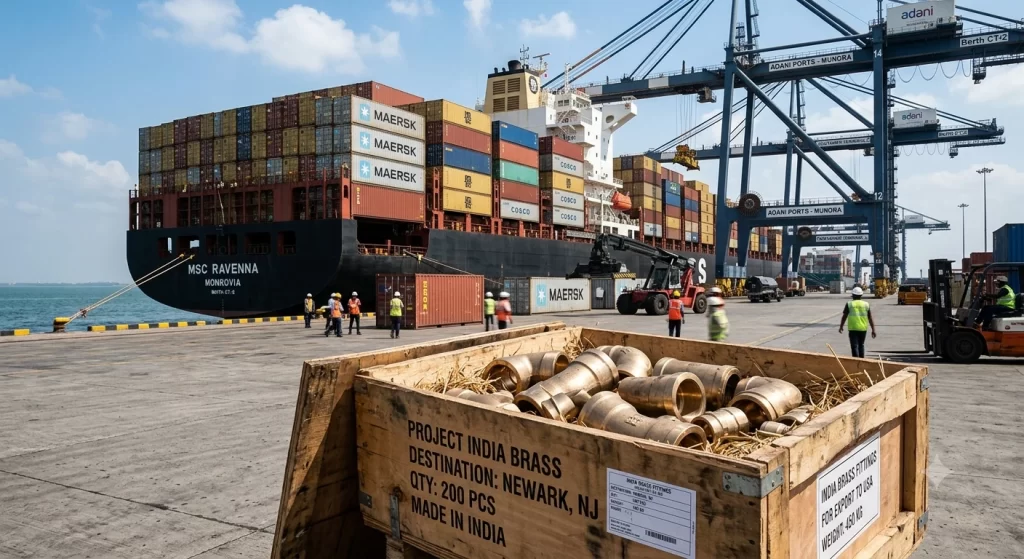
IEEPA tariffs were struck down, Section 122 expired, Section 301 arrived, and Section 232 now taxes the full value of copper articles at 50%. This guide from Anand Brass Components shows which layer hits your brass part — and what it really costs to land it in the United States.
⚡ Quick Answer
How much US duty do brass components from India pay in 2026?
It depends on the HTS code. Brass articles classified in Chapter 74 — pipe fittings (7412.20), rods (7407.21), fasteners (7415), sanitary ware (7418.20.10) and “other articles of copper” (7419) — pay the normal MFN duty plus a 50% Section 232 copper tariff on the full customs value since 6 April 2026. Brass parts classified outside Chapter 74 — for example valves (8481) or electrical terminals (8536) — generally avoid Section 232 but pay MFN duty plus a 10% Section 301 tariff that has applied to Indian goods since 24 July 2026. The two do not stack: goods subject to Section 232 are exempt from the Section 301 forced-labor tariff. On top of duty, importers pay the Merchandise Processing Fee (0.3464%) and, for ocean freight, the Harbor Maintenance Fee (0.125%).
For US buyers of brass parts, 2026 has been the most volatile tariff year in a generation. The reciprocal rate on Indian goods moved from 50% to 18%. Then the Supreme Court struck the IEEPA tariffs down entirely. A temporary 10% surcharge filled the gap for 150 days before being replaced by a new Section 301 action. Meanwhile, the copper tariff quietly became the biggest cost driver of all. Many importers are still quoting landed costs based on rules that no longer exist.
We are Anand Brass Components, a vertically integrated brass manufacturer in Jamnagar that has shipped to American OEMs, distributors and importers since 2012. Our export desk rebuilds customer landed-cost models every time the rules change. This guide shares that working method with you. It covers which duty layer applies to which part, how to read the HTS schedule, the traps that trigger CBP penalties, and the practical levers that still reduce cost.
🎯 Key takeaways
- Classification decides everything. The same brass alloy can face a 50% duty or a 10% duty
depending on whether the finished part falls in Chapter 74 or Chapter 84/85. - Section 232 copper now applies to full value. Since 6 April 2026 the 50% rate covers the entire
customs value, not just the copper content. - Section 301 (forced labor) adds 10% for India. It took effect on 24 July 2026 and stacks on MFN,
but it does not apply to goods already covered by Section 232. - IEEPA refunds may be available. Importers who paid IEEPA tariffs before the Supreme Court’s 20
February 2026 decision should talk to their broker about refund claims. - Brass rod has its own trade remedy. Antidumping and countervailing duty orders cover brass rod
from India, separate from all the tariffs above. - Documentation is now a cost item. CBP rejects copper entries that are missing required
smelt-and-cast data, and a misclassified entry can cost more than the duty itself.
What changed for brass imports from India in 2026
To understand today’s duty stack, you need the sequence of events. Each change altered the landed cost of an Indian brass fitting, and some changes created refund rights that are still open.
| Date | Event | What it meant for brass parts |
|---|---|---|
| 1 Aug 2025 | Section 232 copper tariff begins at 50% | Applied to semi-finished copper products and copper-intensive derivatives, initially on copper content only |
| Feb 2026 | US–India interim trade framework | Reciprocal (IEEPA) rate on Indian goods cut from 50% to 18% |
| 20 Feb 2026 | Supreme Court invalidates IEEPA tariffs | Reciprocal and “penalty” tariffs end; importers may pursue refunds of IEEPA duty paid |
| 24 Feb 2026 | Section 122 global surcharge | 10% on most imports for a maximum of 150 days |
| 6 Apr 2026 | Proclamation 11021 (Section 232 overhaul) | 50% / 25% rates now apply to full customs value; brass rods, fittings, fasteners and sanitary ware placed in the 50% annex |
| 8 Jun 2026 | Proclamation 11032 | Relief for machinery, HVAC and agricultural equipment; copper program left unchanged |
| 24 Jul 2026 | Section 122 expires; Section 301 forced-labor tariffs start | India placed in the 10% tier, stacking on MFN; Section 232 goods exempt |
| 14 Sep 2026 | CBP enforcement of copper reporting | ACE rejects entry summaries missing required copper smelt-and-cast country data |
Sources: Congressional Research Service, White House proclamation annexes, USTR Federal Register notice (July 2026), CBP CSMS guidance. Rates can change quickly — confirm with your licensed customs broker before each entry.
Both the Section 122 surcharge and the Section 301 forced-labor tariffs face litigation at the Court of International Trade. Budget on the rates in force today, but keep entry records organized in case refund rights open up again.
The five duty layers on an Indian brass part
Every US entry of brass components is built from up to five layers. Most landed-cost mistakes happen because a buyer adds a layer that doesn’t apply, or misses one that does.
1. MFN (Column 1 General) duty
This is the base rate in the Harmonized Tariff Schedule of the United States (HTSUS). For brass it is usually low. For example, copper-alloy pipe and tube fittings under HTS 7412.20.00 carry a 3% general rate. India has no free-trade agreement with the US and lost GSP eligibility in 2019, so Indian goods pay the full Column 1 rate.
2. Section 232 copper tariff
This is the heavyweight. Since 6 April 2026, articles listed in Annex I-A of Proclamation 11021 pay 50% of their full customs value. The copper list in that annex includes brass bars, rods and profiles (7407.21), brass wire (7408.21), brass plate and strip (7409.21/.29), brass tubes (7411.21), copper-alloy pipe fittings (7412.20.00), copper nails, washers, rivets, screws, bolts and nuts (7415), brass sanitary ware (7418.20.10), and other articles of copper (7419.20 and 7419.80). Chapter 74 goods get no metal-content exemption: the 15% weight threshold in the proclamation applies only to products outside Chapters 72, 73, 74 and 76.
3. Section 301 forced-labor tariff
USTR’s final action took effect at 12:01 a.m. ET on 24 July 2026. It places India in the 10% tier, stacked on top of MFN. The action exempts several categories, including aluminum, steel and copper goods that already pay Section 232 duties. According to the Government of India, roughly 45% of India’s US-bound exports (for example, generic pharmaceuticals and smartphones) are exempt. Most brass parts outside Chapter 74 are not exempt.
4. Antidumping and countervailing duties (AD/CVD)
These are company-specific trade remedies, not general tariffs. For the brass industry, the one that matters is the AD/CVD order on brass rod from India, covered in detail below.
5. User fees: MPF and HMF
These are not duties, but they sit on the same entry summary. For fiscal year 2026 (entries from 1 October 2025), the Merchandise Processing Fee is 0.3464% of entered value, with a floor of $33.58 and a cap of $651.50 per formal entry. The Harbor Maintenance Fee adds 0.125% for ocean shipments, with no cap. The MPF bounds are adjusted for inflation every 1 October, so check the FY2027 figures for entries from that date.
Section 232 and Section 301 are calculated on the customs value (usually FOB/transaction value). They are not calculated on the CIF value or on the MPF. A 50% Section 232 duty does not increase your MPF, because MPF is also based on entered value.
HTS codes for common brass components (and which tariff applies)
The table below maps the product lines Anand Brass Components exports to the US against their most common classification. Remember that classification follows the finished article, not the alloy. A brass cable gland, a brass valve and a brass nut are all made of the same metal, yet they can land in three different chapters.
| Product | Typical HTSUS heading | Section 232 (copper) | Section 301 (India) |
|---|---|---|---|
| Brass pipe fittings (elbows, tees, couplings, nipples, adapters) | 7412.20.00 | 50% — Annex I-A | Exempt (232 good) |
| Brass extruded rods & profiles | 7407.21 | 50% — Annex I-A | Exempt (232 good) |
| Brass screws, bolts, nuts, washers, rivets | 7415.21 / 7415.29 / 7415.33 / 7415.39 | 50% — Annex I-A | Exempt (232 good) |
| Brass sanitary ware & parts | 7418.20.10 | 50% — Annex I-A | Exempt (232 good) |
| Other brass articles (many turned parts, pool anchors, drop anchors) | 7419.80 (e.g. 7419.80.50) | 50% — Annex I-A | Exempt (232 good) |
| Brass valves, taps & cocks (complete) | 8481.80 | Not listed in copper annex | 10% |
| Valve bodies & valve parts | 8481.90 | Listed only as aluminum derivatives — brass parts with no aluminum generally not covered | 10% |
| Brass terminals & connectors | 8536.90 / 8538.90 | Generally not covered unless aluminum ≥15% by weight | 10% |
| Brass lamp parts | 9405.99.20 | Listed in Annex II (removed from scope) | 10% |
| Brass cable glands | Varies (7419.80, 8536/8538 or 8547 depending on design) | Depends on classification | Depends on classification |
| Brass inserts for CPVC/PPR fittings | Commonly 7419.80 or 7412.20, depending on function | 50% if classified in Ch. 74 | Exempt if 232 applies |
Classification is the importer’s legal responsibility. This table is a starting point for your broker, not a ruling. For a high-volume part, request a binding ruling from CBP through the eRulings program before your first shipment.
Moving a brass fitting from 7412 into a Chapter 84 heading just to avoid a 50% duty is exactly what CBP’s Base Metals Center of Excellence looks for. If the part is a pipe fitting, it is a pipe fitting. Misclassification can bring penalties of up to four times the lost revenue for negligence, plus the duty itself. The legitimate route is to make sure the description and function on your commercial invoice are accurate, so a part that genuinely belongs in Chapter 84 or 85 is classified there.
Section 232 vs Section 301: side-by-side comparison
US buyers often ask which of the two “new tariffs” applies to their brass order. Here are the differences that affect your purchasing decisions.
| Factor | Section 232 (copper) | Section 301 (forced labor) |
|---|---|---|
| Legal basis | Trade Expansion Act of 1962 — national security | Trade Act of 1974 — unfair trade practices |
| Rate for Indian brass | 50% (Annex I-A) or 25% (Annex I-B) | 10% (India tier) |
| Applies to | Products listed by HTS code, from any country | All products of 60 listed economies, minus exemptions |
| Base | Full customs value (since 6 Apr 2026) | Customs value |
| Stacks with MFN? | Yes | Yes (flat stacking for India) |
| Stacks with each other? | No — Section 232 goods are exempt from the forced-labor Section 301 action | |
| Switching country helps? | No — applies to copper articles from every origin (the UK gets reduced rates) | Partly — countries outside the 60 are not affected; China/Vietnam pay 12.5% |
| Status | In force; periodic proclamations adjust annexes | In force; challenged at the Court of International Trade |
The most important takeaway is the “switching country” row. Because Section 232 copper applies to every origin, moving a Chapter 74 brass fitting from India to China, Vietnam or Mexico does not remove the 50%. Those origins pay the same Section 232 duty. What still differs between origins is the underlying price: Jamnagar’s alloy, machining and labor costs. That is why India remains competitive on brass even at a 50% duty rate. You can read why in our overview of Jamnagar’s brass manufacturing cluster.
Antidumping and countervailing duties on brass rod from India
Separately from the tariffs, the US Department of Commerce issued a countervailing duty (CVD) order on brass rod from India, applicable 13 February 2024. The final subsidy rate for “all others” was 2.24%. An antidumping (AD) order on brass rod from India (and from Brazil, Mexico, South Africa and South Korea) followed on 13 June 2024, after the US International Trade Commission found injury to the domestic industry. In July 2026, the Court of International Trade remanded Commerce’s AD determination on Indian brass rod for further review. The rate could therefore change.
What this means in practice:
- Rod importers (for example, US machine shops buying Indian bar stock) must post AD/CVD cash deposits on top of Section 232 and MFN duty.
- Finished-component importers generally fall outside the order, because a machined fitting or turned part is no longer “rod.” Scope language is precise, however. If a part is only cut to length or lightly worked, ask your broker to check it against the scope before you ship.
- Buying machined components instead of raw rod is often the simpler route. The manufacturer absorbs the metal-conversion step, and you import a finished article. Our brass rod buyer’s guide explains when bar stock still makes sense.
Need a landed-cost quote, not just an FOB price?
Send your drawing. Anand Brass Components returns a quotation within 24 hours, with a suggested HTS heading for your broker, alloy options and ocean and air timelines to your US port.
Landed cost: two worked examples
Here are the real numbers. Both examples use the same order, a $40,000 FOB Mundra consignment of brass parts shipped by ocean to a US East Coast port. Freight, insurance, brokerage and drayage figures are illustrative. Replace them with your forwarder’s quote.
| Cost line | A: Brass pipe fittings (HTS 7412.20.00) | B: Brass part outside Ch. 74 (MFN assumed 3%) |
|---|---|---|
| FOB value | $40,000.00 | $40,000.00 |
| Ocean freight (illustrative) | $3,200.00 | $3,200.00 |
| Cargo insurance (illustrative) | $150.00 | $150.00 |
| MFN duty (3%) | $1,200.00 | $1,200.00 |
| Section 232 copper (50%) | $20,000.00 | — |
| Section 301 (10%) | — (exempt) | $4,000.00 |
| MPF (0.3464%) | $138.56 | $138.56 |
| HMF (0.125%) | $50.00 | $50.00 |
| Customs brokerage (illustrative) | $450.00 | $450.00 |
| Drayage to warehouse (illustrative) | $900.00 | $900.00 |
| Total landed cost | $66,088.56 | $50,088.56 |
| Landed cost vs FOB | +65.2% | +25.2% |
Duties and fees are calculated on FOB value as the customs value. Your actual customs value depends on the Incoterm and any assists, royalties or packing costs that must be added under 19 U.S.C. §1401a.
Reading the example correctly: the $16,000 gap between A and B comes entirely from classification. That is why the first conversation with your supplier should be about the part’s function and HTS heading, not about the unit price. A supplier who is 5% cheaper on FOB means nothing if you guessed the classification wrong.
Divide the total landed cost by the number of pieces. Compare that figure to your domestic alternative, not the FOB price. For many turned and forged brass parts, Jamnagar still wins on landed cost. The margin is thinner in 2026, which makes yield, scrap rate and packing density more important than before.
Step-by-step: importing brass components from India in 2026
This is the sequence we walk new US customers through. Nothing in it is theoretical; each step exists because skipping it has cost an importer money.
-
Define the part by function, not by material
Write a one-line description of what the part does (“threaded male adapter for connecting ½” NPT pipe to CPVC fitting”). That description drives classification. Share the drawing, finish and thread spec. Our guide to how custom brass components are manufactured for OEMs shows what a complete RFQ package looks like.
-
Confirm the HTS heading with your broker
Your broker, not your supplier, owns the classification. Ask the supplier for a suggested heading and the reasoning behind it. For recurring parts, file a binding ruling request with CBP.
-
Check every tariff layer for that heading
Check the MFN rate, Section 232 annex listing, Section 301 exemption status and any AD/CVD scope. Write the result into your costing sheet with the date you checked it.
-
Choose the alloy for the US market
Potable-water parts need NSF/ANSI 61 and 372 compliant low-lead brass. See our lead-free brass components guide. Aggressive water may call for DZR brass. Alloy choice changes price, but it does not change the Section 232 rate.
-
Verify the manufacturer
Check the ISO 9001 certificate, in-house processes, material test certificates and export track record. Our 12-point audit checklist for US importers covers each item.
-
Approve samples, then lock the Incoterm
Samples normally ship by express courier in 3–5 days. After approval, agree FOB or CIF terms in writing, because the Incoterm determines who pays freight and what customs value you declare.
-
Collect smelt-and-cast data before the goods ship
For copper articles, ask your supplier for the country where the copper was smelted and cast. CBP now requires this data on the entry summary for covered lines. Getting it after the vessel sails causes delays.
-
Ship, file ISF and clear customs
Ocean transit from Mundra or Nhava Sheva (JNPT) to US ports is typically 25–35 days; air freight takes 5–7 days. Your broker files the Importer Security Filing at least 24 hours before loading and submits the entry and entry summary after arrival.
-
Audit the entry and keep records for five years
Compare the duty assessed with your costing sheet. CBP can review entries for five years, and refund opportunities such as IEEPA refunds or post-summary corrections depend on clean records.
Import documents checklist for brass parts
| Document | Who issues it | Why it matters in 2026 |
|---|---|---|
| Commercial invoice | Exporter | Must describe function, material and quantity precisely enough to support the HTS heading |
| Packing list | Exporter | Net and gross weights per carton; supports the 15% metal-weight test for non-Chapter 74 goods |
| Bill of lading / airway bill | Carrier or forwarder | Proof of shipment date, which is critical when rates change mid-transit |
| Certificate of origin | Indian chamber / EPC | Establishes Indian origin for the Section 301 tier |
| Material test certificate (MTC) | Manufacturer | Alloy chemistry (Cu, Zn, Pb) from OES testing; required for lead-free claims |
| Smelt & cast declaration | Manufacturer / mill | Required data on copper entries; missing data causes ACE rejection |
| NSF/ANSI 61 & 372 evidence | Certifier | Mandatory for potable-water parts sold in the US |
| ISPM-15 packaging mark | Exporter | Wooden pallets and crates must be heat-treated and stamped |
Anand Brass Components includes an MTC with every US shipment and packs to ISPM-15. Details of our testing lab are on our Quality & Approvals page.
Common mistakes US importers make with brass tariffs
- Adding Section 232 and Section 301 together. For goods covered by Section 232, the forced-labor Section 301 duty does not apply. Adding both overstates cost by 10 points and can kill a viable project.
- Assuming “brass” always means Section 232. Brass valves under 8481.80 and brass lamp parts under 9405.99.20 are not in the copper annex. Treating them as if they were overstates the duty by 40 points.
- Using a 2025 costing sheet. Before 6 April 2026, Section 232 applied only to copper content. Old models that calculate 50% of the copper value understate today’s duty.
- Ignoring AD/CVD when buying rod. Bar stock from India carries AD/CVD deposits on top of every tariff.
- Vague invoice descriptions. “Brass parts” is not a description. CBP rate-advances vague entries to the highest plausible heading.
- Forgetting the MPF cap. Five $50,000 entries pay MPF five times. One consolidated $250,000 entry hits the $651.50 cap once.
- Not tracking IEEPA refund eligibility. Duty paid under IEEPA before February 2026 may be recoverable. Check deadlines with your broker or trade counsel.
Talk to an exporter who ships to the US every week
Anand Brass Components: ISO 9001 certified, 30+ export countries, 15,000 sq ft vertically integrated plant in Jamnagar GIDC.
Contact our team for customized brass components manufactured to your required specifications, dimensions, materials, and application requirements.
Legitimate ways to reduce landed cost on brass parts
You can’t negotiate the tariff. You can influence the value it applies to and everything around it. These are the levers our US customers use most:
Engineer weight out of the part
Duty follows value, and value in brass follows weight. Hollow sections, reduced wall thickness where pressure ratings allow, and near-net forgings instead of bar-turned parts all lower the metal cost per piece. Our comparison of brass forging vs casting shows where forging saves material. Use our Copper-Brass Weight Calculator to test design changes quickly.
Choose the right alloy for the job
Over-specifying an alloy raises value, and the tariff multiplies that. Our guide on choosing brass alloys for CNC machining helps match the grade to the real requirement.
Consolidate shipments
Fewer, larger entries reduce MPF (capped per entry), brokerage fees and per-container overheads. Once the value exceeds about $188,000, the MPF stays at the cap.
Consider finishing in the US
If plating or assembly adds significant value, importing unplated parts and finishing them domestically keeps that value out of the dutiable base. See brass surface finishes explained to decide which finishes make sense where.
Explore duty drawback and FTZs
If you re-export brass parts, or products containing them, duty drawback can recover up to 99% of duties and fees. A Foreign-Trade Zone can defer duty until goods enter US commerce. Both need specialist setup, but they pay off at volume.
The US buyers who stayed with Indian brass through 2026 did not switch countries. They redesigned parts and consolidated orders. A 10% weight reduction on a Chapter 74 part saves more than 10% of the metal cost, because the 50% duty is removed from that value too.
Industry trends to watch (late 2026 – 2027)
- Refined copper tariff. The administration has proposed a phased universal duty on refined copper, reported as 15% from 2027 and 30% from 2028. Commerce was due to report on the US copper market by 30 June 2026. That could raise US domestic brass prices and narrow the gap with imports.
- Rolling Section 232 inclusions. The April 2026 proclamation lets Commerce and USTR add copper derivatives on a rolling basis. Parts outside the annex today may not stay outside.
- Litigation over Section 301. Lawsuits filed on 24 July 2026 challenge the forced-labor tariffs. A ruling could open another refund window.
- US–India trade negotiations. The February 2026 framework showed that bilateral deals can move rates quickly. Watch for any agreement that changes India’s Section 301 tier.
- Traceability. Smelt-and-cast reporting is the start of deeper metal-origin tracking. Suppliers that can document their supply chain will be preferred.
Final verdict: is importing brass components from India still worth it?
Yes, for most parts — as long as you cost them correctly. Brass articles outside Chapter 74, such as valves, electrical terminals and lamp parts, pay roughly MFN plus 10%, which rarely threatens the business case. Chapter 74 articles such as fittings, fasteners and rods pay MFN plus 50% from every country, so India’s manufacturing cost advantage still decides the comparison against other suppliers. The importers who lose money are those who guess the HTS code, use outdated tariff sheets or buy on FOB price alone.
If you want a supplier that helps with that thinking, Anand Brass Components has been manufacturing in Jamnagar since 1991 and exporting to the US since 2012. You get a quote within 24 hours, samples in 3–5 days, and an MTC with every shipment. For the operational side of your first order, read our companion guide, How to Import Brass Components from India to the USA.
Frequently Asked Questions
full customs value, for a combined 53% before fees. They are exempt from the 10% Section 301 forced-labor tariff
because they are already covered by Section 232.
under HTSUS 7412.20.00, “Of copper alloys.” Brass valves and taps are classified separately under heading 8481.
fasteners, sanitary ware and other articles of copper in Chapter 74 are in Annex I-A at 50% of full value. Brass
products classified in other chapters, such as valves (8481) or lamp parts (9405), are generally not covered by
the copper tariff.
A brass part pays either Section 232 or Section 301, not both. Both stack on the normal MFN duty.
of the MFN duty. Some product categories are exempt, including goods already subject to Section 232.
be eligible for refunds and should consult their customs broker or trade attorney about claims and deadlines.
Finished machined components are generally outside the rod order’s scope, but lightly processed rod may not be.
Check the scope before shipping.
copper content. For a $10,000 entry of brass fittings, the Section 232 duty is $5,000.
formal entry). The Harbor Maintenance Fee is 0.125% of cargo value on ocean shipments. Budget for customs
brokerage, ISF filing, drayage and a customs bond as well.
rates). For non-Chapter 74 parts, China and Vietnam are in the 12.5% Section 301 tier, compared with India’s 10%.
Manufacturing cost and quality then decide the comparison.
days, and express courier samples arrive in 3–5 days. Allow extra time for customs clearance, especially for
copper entries needing smelt-and-cast data.
accurate function-based description and a suggested heading, but your licensed customs broker should confirm it.
For recurring parts, request a CBP binding ruling.
finishing parts in the US, using duty drawback on re-exports and operating through a Foreign-Trade Zone.
Deliberate misclassification is not a legal option and carries penalties.
fitting and a standard brass fitting both fall under 7412.20.00. Lead-free brass matters for NSF/ANSI 61 and 372
compliance in US potable-water applications.
Looking for High-Quality DZR Brass Components?
Anand Brass Components manufactures precision DZR Brass and brass plumbing components for manufacturers, distributors, contractors, and OEM buyers. From standard plumbing components to fully customized solutions, we provide precision manufacturing, consistent quality, competitive pricing, and reliable global supply.
Related guides from Anand Brass Components
- Sourcing How to Import Brass Components from India to the USA
- Supplier audit 12-Point Audit Checklist for Jamnagar Brass Manufacturers
- Compliance Lead-Free Brass: NSF 61, NSF 372 & Drinking Water Standards
- Technical US Thread & Size Chart for Brass Hose and Sanitary Fittings
- Market How India Supplies the USA Plumbing Market
- Materials Brass vs Stainless Steel vs Copper
References
- ISO 9001 Quality Management Standards – https://www.iso.org/iso-9001-quality-management.html
- ASTM International – https://www.astm.org/
- Copper Development Association – https://copperalliance.org/
Written by the Anand Brass Components Export Desk. Anand Brass Components is a brass parts manufacturer and exporter based at Plot 4110-4111, H-Road, GIDC Phase-III, Jamnagar, Gujarat 361004, India. Founded in 1991, ISO 9001 certified, with in-house casting, extrusion, forging, CNC machining and finishing. Contact: info@anandbrass.com · +91 78743 05684 · +91 81401 51497.
Disclaimer: This article is general information about US tariffs as of 26 September 2026 and is not legal or customs advice. Tariff rates, annexes and exemptions change frequently. Confirm classification and duty with a licensed US customs broker or trade attorney before importing. References: Congressional Research Service (IN12614); White House Proclamation 11021 annexes (April 2026) and Proclamation 11032 (June 2026); USTR Section 301 forced-labor final action (July 2026); Federal Register CVD and AD orders on brass rod from India (February and June 2024); CBP Dec. 25-10 (FY2026 user fees); USITC Harmonized Tariff Schedule.