
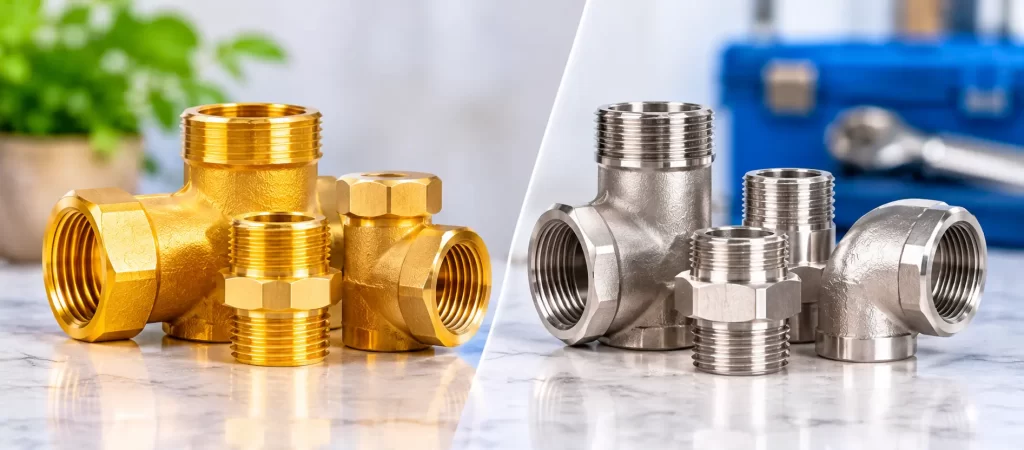
Brass and stainless steel are the two most common metals for threaded and compression fittings, and buyers often ask which is “better”. The honest answer is that each wins in different places. This guide from Anand Brass Components, a brass fittings manufacturer in Jamnagar, compares them on corrosion, strength, temperature, machinability, cost and code compliance, with practical advice for buyers in India and the USA.
⚡ Quick Answer
Choose brass for household and commercial water lines, gas lines, compressed air, hose fittings, valves and general plumbing: it machines into precise, leak-tight threads, resists corrosion in fresh water, doesn’t gall, and usually costs less as a finished fitting. Choose stainless steel (304 or 316) for high pressures and temperatures, seawater and chemicals, hydraulics, and food, dairy or pharmaceutical systems that need hygienic, cleanable surfaces. For drinking water, both are acceptable when certified, but brass must be lead-free.
🎯 Key takeaways
- Brass: easy to machine, seals well, no galling, good in fresh water, economical.
- Stainless: stronger, hotter, more chemical- and salt-resistant, but prone to thread galling.
- 316 beats 304 where chlorides (salt, coastal air) are present.
- Use DZR brass in aggressive water and lead-free brass for US drinking water.
- Brass and stainless can be joined in fresh water; isolate them in seawater.
Brass vs stainless steel fittings: comparison chart
| Property | Brass (free-cutting / forging) | Stainless steel 304 / 316 |
|---|---|---|
| Main elements | Copper + zinc (some lead or lead-free additions) | Iron + chromium + nickel (316 adds molybdenum) |
| Density | ~8.4–8.5 g/cm³ | ~8.0 g/cm³ |
| Melting range | ~880–940 °C | ~1,400–1,450 °C |
| Tensile strength | Moderate (roughly 340–480 MPa depending on temper) | Higher (about 515 MPa minimum, annealed) |
| Fresh water corrosion | Very good (DZR for aggressive water) | Excellent |
| Seawater / chlorides | Fair; special alloys needed | 304 fair, 316 good |
| Machinability | Excellent (C36000 is the benchmark) | Difficult; slower, more tool wear |
| Thread galling | Very low | High risk, stainless-on-stainless |
| Thermal conductivity | High | Low |
| Magnetic? | No | 304/316 essentially non-magnetic when annealed |
| Spark resistance | Low-sparking | Can spark |
| Antimicrobial surface | Yes (copper alloy) | No, but very cleanable |
| Typical finished cost (small fittings) | Lower to similar | Higher |
Corrosion resistance
Brass
Brass contains no iron, so it doesn’t rust. In normal tap, borewell and municipal water it forms a thin protective film and lasts decades. Two things to watch:
- Dezincification: in soft, acidic or high-chloride water, zinc can leach out of standard brass, leaving weak, porous copper. DZR brass prevents this.
- Ammonia: brass under stress can crack in ammonia-bearing environments (stress corrosion cracking), so avoid it in refrigeration plants using ammonia and in some agricultural uses.
Stainless steel
Stainless resists corrosion through a chromium oxide layer. 304 is fine for most water and indoor use. 316, with molybdenum, better resists chlorides, so it’s preferred in coastal, marine, swimming pool and chemical environments. Stainless can still suffer pitting and crevice corrosion in stagnant salty water.
Strength, pressure and temperature
Stainless steel is stronger and keeps its strength at much higher temperatures, so it’s the choice for hydraulics, steam, high-pressure gas and process lines. Brass fittings are more than strong enough for domestic and commercial water, LPG and natural gas service lines, compressed air and most hose connections. Forged brass is denser and stronger than cast brass, which is why quality fittings are hot forged; see brass forging vs casting.
Machinability and galling
Free-cutting brass (C36000 / CW614N / IS 319) is the reference material for machinability. It cuts fast, makes short chips, holds tight tolerances and produces smooth threads and sealing seats, which is why most small threaded fittings, valves and adapters are brass.
Stainless steel work-hardens and machines slowly. Its threads also gall: under pressure and friction, stainless surfaces can cold-weld and tear. Installers use anti-seize, tighten slowly, or pair a stainless part with a brass nut. Brass-on-brass and brass-on-stainless threads rarely gall.
On compression fittings, a brass nut and ferrule seal easily on copper or plastic tube. For stainless tube in high-pressure instrumentation, use stainless compression fittings designed for it. See compression fittings explained.
Cost: which is cheaper?
Raw brass can cost more per kg than 304 stainless, because brass is mostly copper. But for small fittings, machining time dominates the price, and brass machines several times faster with less tool wear. So a finished brass elbow, adapter or valve body is often cheaper than the stainless equivalent, while large, simple stainless parts can compete on price. Brass also has high scrap value, which lowers net cost for manufacturers. For how brass prices move, read brass price per kg.
Get brass fittings priced for your project
Forged and CNC-machined brass fittings in NPT, BSP and metric threads, standard, lead-free or DZR, from Jamnagar. Send a drawing or sample for a quote.
Drinking water rules
Both materials are used for potable water. In the USA, any fitting in contact with drinking water must meet the federal lead-free definition (no more than 0.25% weighted average lead on wetted surfaces) and is usually certified to NSF/ANSI 61 and 372. That means traditional leaded free-cutting brass can’t be used for those parts; lead-free alloys such as silicon or bismuth brasses are used instead. Stainless steel naturally meets the lead limit, but still needs certification for many projects. In India, BIS standards apply to plumbing products, and lead-free brass is increasingly requested by export-oriented and premium brands. Details are in our lead-free brass guide.
Best material by application
| Application | Usually best | Reason |
|---|---|---|
| Home water supply, bathroom and kitchen fittings | Brass (lead-free for US) | Cost, sealing, easy installation |
| Hard or aggressive water | DZR brass or stainless | Dezincification resistance |
| LPG / natural gas service lines | Brass (listed for gas) | Low-sparking, standard practice |
| Garden hose and irrigation connectors | Brass | Durable, won’t crack, easy threading |
| Compressed air (shop systems) | Brass | Economical, good sealing |
| Hydraulics and high-pressure lines | Stainless or carbon steel | Strength and pressure rating |
| Steam and high temperature | Stainless | Retains strength when hot |
| Marine, coastal, pools | 316 stainless (or naval brass/bronze) | Chloride resistance |
| Food, dairy, pharma | 316 stainless | Hygiene, cleanability, regulations |
| Chemical processing | Stainless (grade per chemical) | Chemical resistance |
| Electrical, earthing, cable glands | Brass | Conductivity, machinability |
| Ammonia refrigeration | Stainless or steel | Brass is vulnerable to ammonia |
Can you mix brass and stainless steel fittings?
Yes, in most fresh-water, air and gas systems brass and stainless are joined without problems because they sit fairly close on the galvanic series. Risk rises in seawater, salty or constantly wet conditions, where the less noble metal can corrode faster. In those cases, use one material throughout or fit an insulating (dielectric) fitting. Also avoid connecting brass or copper directly to galvanised steel without a dielectric union.
India vs USA buyer notes
🇮🇳 India
- Brass dominates CP fittings, concealed valves, angle valves and gas fittings.
- Stainless steel is growing in premium bathroom accessories, coastal projects and food plants.
- BSP threads (IS 554) are standard.
- Hard borewell water in many regions makes DZR brass or good plating worthwhile.
🇺🇸 USA
- Lead-free brass is the default for potable water fittings and valves.
- NPT threads; brass is standard for gas flare and hose fittings.
- Stainless is common in food service, commercial kitchens, marine and process plants.
- Many importers source forged brass fittings from India to diversify from China; see India vs China for brass components.
Frequently Asked Questions
Related guides
Written by the Anand Brass Components Technical Team. Anand Brass Components is a brass parts manufacturer and exporter at Plot 4110-4111, H-Road, GIDC Phase-III, Jamnagar, Gujarat 361004, India. Founded in 1991, ISO 9001 certified. Contact: info@anandbrass.com · +91 78743 05684.
Note: General reference information as of 28 November 2026. Material values are typical and vary by alloy and temper; follow applicable codes and the fitting maker’s ratings. References: ASTM B16, B124 (brass); ASTM A276, A182 (stainless); NSF/ANSI/CAN 61 & 372; US Safe Drinking Water Act Section 1417; IS 554.