
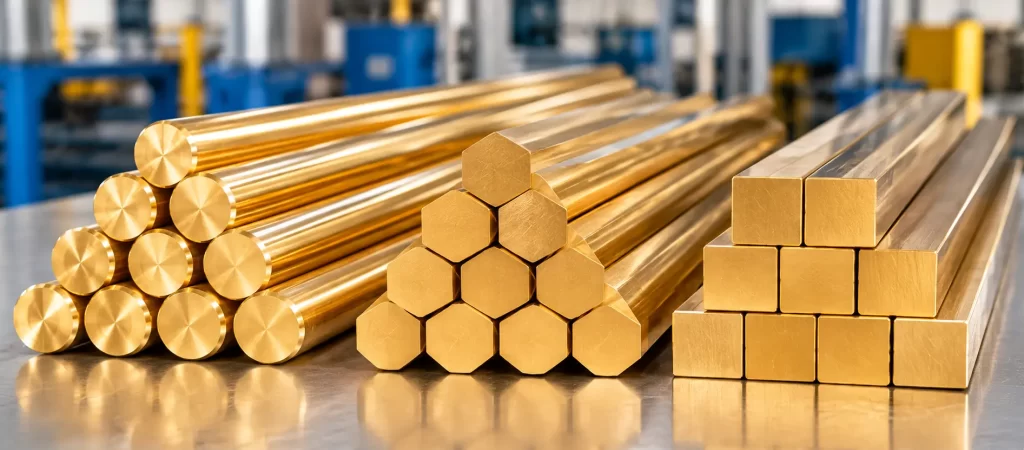
Brass rod is bought by weight but specified by size, so every buyer, machinist and estimator needs a quick way to convert one into the other. This reference from Anand Brass Components, a brass extrusion rod manufacturer in Jamnagar, gives ready weight tables in metric (kg/m) for India and imperial (lb/ft) for the USA, the formulas behind them, and worked examples. For instant results, use our free copper-brass weight calculator.
⚡ Quick Answer
Brass rod weight per metre (kg/m), using a density of 8.5 g/cm³:
- Round rod: d² × 0.00668 (d = diameter in mm)
- Hex rod: s² × 0.00736 (s = across flats in mm)
- Square rod: s² × 0.0085 (s = side in mm)
In inches (lb/ft, density 0.307 lb/in³): round = d² × 2.893, hex = s² × 3.190, square = s² × 3.684. Example: a 25 mm round brass rod weighs about 4.17 kg/m, and a 1″ round rod weighs about 2.89 lb/ft.
- 8.5g/cm³ typical brass density
- 0.307lb/in³ for C36000
- +10%Hex vs round of same size
- +27%Square vs round of same size
Brass rod weight formulas
Weight = cross-sectional area × length × density. The factors below already combine the area formula and brass density.
| Shape | Area | Metric (kg/m, size in mm) | Imperial (lb/ft, size in inches) |
|---|---|---|---|
| Round | π/4 × d² | d² × 0.00668 | d² × 2.893 |
| Hexagon (across flats) | 0.866 × s² | s² × 0.00736 | s² × 3.190 |
| Square | s² | s² × 0.0085 | s² × 3.684 |
| Flat / rectangle | w × t | w × t × 0.0085 | w × t × 3.684 |
| Hollow (tube) | π/4 × (D² − d²) | (D² − d²) × 0.00668 | (D² − d²) × 2.893 |
To convert to weight per foot from kg/m, multiply by 0.672. To convert lb/ft to kg/m, multiply by 1.488.
Brass rod weight chart (metric, kg/m)
| Size (mm) | Round (kg/m) | Hex A/F (kg/m) | Square (kg/m) |
|---|---|---|---|
| 3 | 0.060 | 0.066 | 0.077 |
| 4 | 0.107 | 0.118 | 0.136 |
| 5 | 0.167 | 0.184 | 0.213 |
| 6 | 0.240 | 0.265 | 0.306 |
| 8 | 0.427 | 0.471 | 0.544 |
| 10 | 0.668 | 0.736 | 0.850 |
| 12 | 0.961 | 1.060 | 1.224 |
| 14 | 1.308 | 1.443 | 1.666 |
| 16 | 1.709 | 1.884 | 2.176 |
| 19 | 2.410 | 2.657 | 3.068 |
| 20 | 2.670 | 2.944 | 3.400 |
| 22 | 3.231 | 3.563 | 4.114 |
| 25 | 4.172 | 4.601 | 5.312 |
| 30 | 6.008 | 6.625 | 7.650 |
| 32 | 6.836 | 7.538 | 8.704 |
| 38 | 9.640 | 10.630 | 12.274 |
| 40 | 10.681 | 11.778 | 13.600 |
| 50 | 16.690 | 18.403 | 21.250 |
Brass rod weight chart (inch, lb/ft)
| Size (in) | Round (lb/ft) | Hex A/F (lb/ft) | Square (lb/ft) |
|---|---|---|---|
| 1/8 | 0.045 | 0.050 | 0.058 |
| 3/16 | 0.102 | 0.112 | 0.130 |
| 1/4 | 0.181 | 0.199 | 0.230 |
| 5/16 | 0.283 | 0.312 | 0.360 |
| 3/8 | 0.407 | 0.449 | 0.518 |
| 1/2 | 0.723 | 0.798 | 0.921 |
| 5/8 | 1.130 | 1.246 | 1.439 |
| 3/4 | 1.628 | 1.795 | 2.072 |
| 7/8 | 2.215 | 2.443 | 2.821 |
| 1 | 2.893 | 3.190 | 3.684 |
| 1-1/4 | 4.521 | 4.985 | 5.756 |
| 1-1/2 | 6.510 | 7.178 | 8.289 |
| 2 | 11.574 | 12.762 | 14.736 |
Values are theoretical. Actual weights vary slightly with alloy and size tolerance.
Calculate any size in seconds
Round, hex, square, flat and tube, in brass or copper, with metric or inch units.
Worked examples
Example 1: Round rod order (India)
You need 200 rods of 12 mm round brass, each 3 m long.
- kg/m = 12² × 0.00668 = 144 × 0.00668 = 0.962 kg/m
- Per rod = 0.962 × 3 = 2.886 kg
- Total = 2.886 × 200 = 577 kg
Example 2: Hex bar for fittings (India)
22 mm A/F hex rod, 500 kg ordered. How many metres?
- kg/m = 22² × 0.00736 = 484 × 0.00736 = 3.562 kg/m
- Length = 500 ÷ 3.562 = about 140 metres
Example 3: Inch hex stock (USA)
A shop needs 12-foot bars of 3/4″ hex C36000, 50 bars.
- lb/ft = 0.75² × 3.190 = 0.5625 × 3.190 = 1.794 lb/ft
- Per bar = 1.794 × 12 = 21.5 lb
- Total = 21.5 × 50 = about 1,076 lb
Brass density by grade
| Alloy | Typical composition | Density (g/cm³) | Density (lb/in³) |
|---|---|---|---|
| Free-cutting brass (C36000 / CW614N / IS 319 Type I) | ~61.5% Cu, ~3% Pb, bal. Zn | 8.5 | 0.307 |
| Forging brass (C37700 / CW617N) | ~59% Cu, ~2% Pb, bal. Zn | 8.4 | 0.305 |
| Cartridge brass (C26000) | 70% Cu, 30% Zn | 8.5 | 0.308 |
| Naval brass (C46400) | ~60% Cu, ~0.75% Sn, bal. Zn | 8.4 | 0.304 |
| Lead-free / low-lead brass (e.g. C69300, bismuth brasses) | Varies | 8.2–8.5 | 0.30–0.31 |
For a full explanation of what brass is made of, see What is brass? Composition and properties.
Brass rod grades: India vs USA
🇮🇳 India
- Rods are sold by weight in kg, priced against daily copper and brass scrap rates.
- IS 319 covers free-cutting brass bars, rods and sections.
- Common sizes: 3–60 mm round, 6–50 mm hex, in 3 m or cut lengths.
- Many machine shops in Jamnagar, Rajkot and Ahmedabad buy hex rod directly for fittings.
🇺🇸 USA
- Rod is specified to ASTM B16 (C36000 free-cutting brass) in inch sizes.
- Standard lengths are often 12 ft; prices are quoted per lb.
- Lead-free alloys are needed for potable water parts (NSF/ANSI 61 & 372).
- Imported finished parts are usually more economical than importing raw rod.
Choosing between grades? See brass alloy for CNC machining and what drives brass prices per kg.
Why actual weight differs from the chart
- Size tolerance: extruded and drawn rod is made to a tolerance band; a rod on the upper limit weighs more.
- Alloy: high-copper alloys are slightly denser than high-zinc alloys.
- Hex corners: commercial hex has slightly rounded corners, so it’s marginally lighter than theory.
- Cut lengths: saw cuts and end crop reduce usable length.
- Scale and moisture: negligible on clean rod, but check on billing.
Tips for buying brass rod
- Specify alloy (IS 319 / C36000 / CW614N), shape, size, tolerance and length.
- Ask for a mill test certificate with chemical composition.
- Confirm straightness and surface finish for bar-fed CNC machines.
- Check whether the price is per kg of rod or per piece after cutting.
- For large programmes, compare buying rod versus buying finished brass turned parts.
Frequently Asked Questions
Related guides
Written by the Anand Brass Components Technical Team. Anand Brass Components is a brass parts manufacturer and exporter at Plot 4110-4111, H-Road, GIDC Phase-III, Jamnagar, Gujarat 361004, India. Founded in 1991, ISO 9001 certified, with in-house extrusion, forging and CNC machining. Contact: info@anandbrass.com · +91 78743 05684.
Note: Theoretical weights for reference as of 28 November 2026. Invoice weights depend on actual dimensions and alloy. References: IS 319; ASTM B16/B16M; EN 12164; Copper Development Association alloy data.