
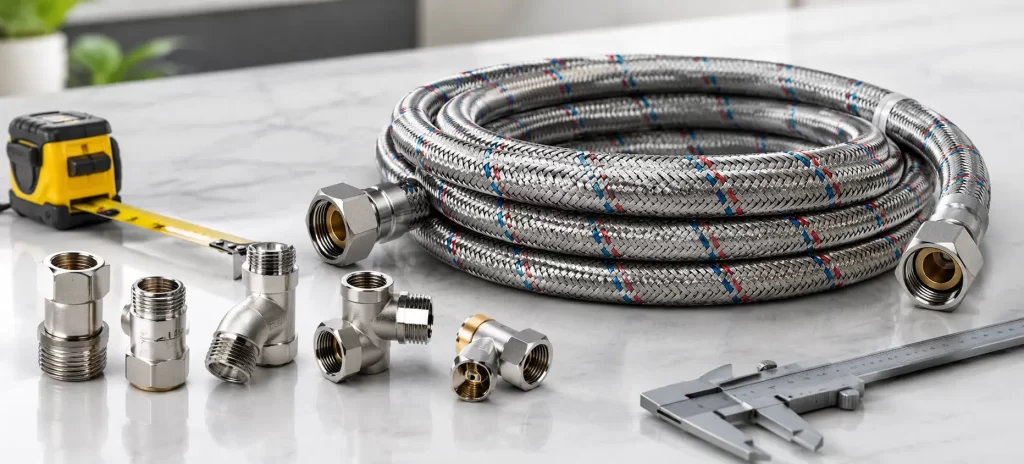
Wrong thread, wrong length, wrong end fitting: most braided hose problems start with the wrong choice, not a faulty product. This detailed guide from Anand Brass Components covers every size, thread, end type and material decision. It also takes you inside a braided hose factory, so you know what quality looks like.
⚡ Quick Answer
How do you choose the right flexible braided hose?
Choose a braided hose by matching six things. (1) Thread at each end. In Europe and the UK this is usually G1/2, G3/8 or G3/4 BSP parallel, or M10×1 for mixer taps. In the US it is usually 3/8″ compression and 1/2″ FIP. (2) End type: male or female, straight or elbow, swivel or fixed. (3) Length: measure the path and allow a gentle curve, then pick the next standard size up. (4) Bore, large enough for the appliance’s flow. (5) Pressure and temperature rating, for example up to 10 bar and 70 °C under EN 13618 for drinking water. (6) Materials: stainless-steel braid, a drinking-water-approved EPDM tube, and nickel-plated brass fittings in a lead-free alloy where regulations require it.
A braided flexible hose costs very little, yet a wrong choice can mean a leaking cabinet, a return to the merchant, or a burst connector months later. In our work making brass hose fittings at Anand Brass Components, we see the same handful of selection mistakes again and again, from installers, distributors and even hose brands specifying new ranges.
This guide is the reference we wish every buyer had. It covers how to identify threads, full size charts, end fittings, lengths, bore sizes, ratings and materials, and finishes with how braided hoses are actually manufactured and tested. If you sell into Europe, read it alongside our companion guide to EN 13618 and the EU Positive List for braided hoses.
🎯 Key takeaways
- Identify each end separately. Most hoses have different threads at each end.
- G (BSP parallel) ≠ NPT. They look similar but don’t seal together. Europe and the UK use G, the US uses NPT and compression.
- M10×1 is the standard tap tail on European monobloc mixers, and it seals on an O-ring.
- Never stretch or loop a hose. Pick the standard length that allows a gentle curve.
- Brass fittings carry most of the quality risk: thread accuracy, barb design, crimp and stress relief.
- Specify completely: thread, end type, length, bore, rating, materials, finish and approvals.
The 6 decisions behind every braided hose
| # | Decision | Typical options | Get it wrong and… |
|---|---|---|---|
| 1 | Thread (each end) | G3/8, G1/2, G3/4, M10×1, M8×1, 3/8″ comp., 1/2″ FIP, 1/2″ NPT | It won’t fit, or it fits and leaks |
| 2 | End type | Female swivel nut, male fixed, elbow, compression tail | It can’t connect, or it puts strain on the hose |
| 3 | Length | 20–100 cm (EU); 12–36 in (US); longer for appliances | Stretched crimps or kinked loops |
| 4 | Bore | Small (taps) to large (heaters, appliances) | Weak flow, noise, slow-filling appliances |
| 5 | Rating | Pressure and temperature class, approvals | Premature failure, non-compliance |
| 6 | Materials | Braid grade, tube compound, brass alloy, plating | Corrosion, early burst, failed approvals |
How to identify a thread in 4 steps
Male or female?
Male threads are on the outside of a fitting, like a tap tail. Female threads are on the inside, like the nut on a hose end.
Measure the diameter
On a male thread, measure the outside diameter across the crests. On a female thread, measure the inside diameter at the crests and add roughly one thread depth. Compare with the chart below.
Count the threads
Use a thread gauge, or count threads over 1 cm or 1 inch. G1/2 and NPT 1/2 both have 14 threads per inch, so pitch alone won’t tell them apart. M10×1 has a 1 mm pitch.
Check parallel vs tapered
A G (BSP parallel) thread has the same diameter along its length and seals on a washer or O-ring. NPT and R threads taper and seal on the thread itself with sealant. A tapered thread visibly narrows towards the end.
A G1/2 nut can start onto a 1/2″ NPT male thread because the pitch is the same. But the thread angles (55° vs 60°) and forms differ, so the joint won’t seal reliably. Don’t mix them. Use a proper adapter.
Braided hose thread size chart
European and UK threads
| Thread | Standard | Major diameter (approx.) | Pitch | Seals on | Typical use |
|---|---|---|---|---|---|
| G1/4 | EN ISO 228-1 | 13.16 mm | 19 TPI | Washer | Small appliances, filters |
| G3/8 | EN ISO 228-1 | 16.66 mm | 19 TPI | Washer | Angle valves, cistern valves, mixer hoses |
| G1/2 | EN ISO 228-1 | 20.96 mm | 14 TPI | Washer | Most common supply connection |
| G3/4 | EN ISO 228-1 | 26.44 mm | 14 TPI | Washer | Washing machines, heaters, boilers |
| G1 | EN ISO 228-1 | 33.25 mm | 11 TPI | Washer | Larger heaters, commercial |
| M10×1 | ISO metric fine | 10.0 mm | 1.0 mm | O-ring | Monobloc mixer tap tails |
| M8×1 | ISO metric fine | 8.0 mm | 1.0 mm | O-ring | Compact taps |
| R / Rp 1/2 | EN 10226-1 / ISO 7-1 | 20.96 mm | 14 TPI | Thread + sealant | Threaded pipework |
“G” sizes are nominal pipe sizes, not measurements. A G1/2 thread measures about 21 mm, not 12.7 mm, which is a common source of confusion.
US and North American threads
| Connection | Standard | Approx. size | Typical use |
|---|---|---|---|
| 3/8″ compression | Compression (3/8″ OD tube) | Sized for 3/8″ OD tube; sealed by a compression olive | Outlet of most US angle stop valves |
| 1/2″ FIP (female iron pipe) | NPSM straight thread | ≈ 0.84″ major diameter, 14 TPI | Faucet shanks |
| 7/8″ ballcock | Straight thread | 7/8″ nominal | Toilet fill valves |
| 1/2″ NPT | ASME B1.20.1 (tapered) | ≈ 0.84″ major, 14 TPI | Threaded pipe, water heaters |
| 3/4″ FIP / GHT | NPSM / garden hose thread | 3/4″ nominal | Water heaters, washing machines (GHT) |
For the full US picture, including NPSM, GHT and NPT differences, see our US brass hose and sanitary fitting size chart.
The most common braided hose end combinations
| Configuration | Market | Connects |
|---|---|---|
| M10×1 male × G3/8 female | Europe | Mixer tap to angle valve |
| M10×1 male × G1/2 female | Europe, UK | Mixer tap to supply |
| G3/8 female × G1/2 female | Europe | Angle valve to cistern or appliance |
| G1/2 female × G1/2 female | Europe, UK | Valve to heater, filter, appliance |
| G1/2 female × G1/2 male | Europe, UK | Extension or offset |
| G3/4 female × G3/4 female | Europe, UK | Washing machine, heater |
| 15 mm compression tail × G1/2 female | UK | Copper pipe to tap or appliance |
| 3/8″ compression × 1/2″ FIP | USA, Canada | Angle stop to faucet |
| 3/8″ compression × 7/8″ ballcock | USA, Canada | Angle stop to toilet |
| 3/4″ FIP × 3/4″ FIP | USA, Canada | Water heater connectors |
Braided hose end fittings explained
The end fittings are machined brass parts, and they decide fit, sealing and much of the hose’s durability. These are the main types Anand Brass Components manufactures for hose assemblers:
| Fitting | What it does | Key quality points |
|---|---|---|
| Swivel (female) nut | Rotates freely so the hose isn’t twisted when tightened | Thread accuracy, washer seat flatness, wall thickness, stress relief |
| Nipple / barbed insert | Goes inside the tube and anchors the crimp | Barb profile, bore, surface finish, lead-free alloy where wetted |
| Male fixed end | Screws into a female port | Thread form, sealing face or O-ring groove |
| M10×1 / M8×1 tap tail | Screws into a mixer tap body | Thread tolerance, O-ring groove, length |
| Elbow (90°) end | Turns the connection in tight spaces | Internal bore and flow, no thin walls at the bend |
| Compression tail | Plain tube end for a compression fitting | OD tolerance, smooth surface for the olive |
| Adapter | Converts one thread to another (e.g. G to NPT) | Concentricity, correct thread at each end |
| Sleeve / ferrule | Crimped over braid and nipple | Material, wall thickness, crimp geometry |
💡 Why swivel matters
A fixed nut forces the hose to twist as you tighten it, which stresses the crimp and can loosen the other end. Swivel female nuts are standard on good-quality hoses for this reason.
Explore our brass hose fittings, sanitary & plumbing fittings and brass turned parts.
Need braided hose end fittings made to drawing?
Swivel nuts, nipples, barbed inserts, M10×1 tails, elbows and adapters, made by Anand Brass Components to ±0.01 mm, with nickel or chrome finish and lead-free alloys available.
Choosing the right braided hose length
Length is the decision most often guessed. Too short and the crimps are under constant tension. Too long and the hose loops, kinks or rubs. Follow this method:
- Measure the path, not the straight line. Run a piece of string from the valve outlet to the appliance inlet along the route the hose will take.
- Add an allowance for a gentle curve, roughly 10–20% for a single bend. Hoses should never be pulled straight between two points.
- Round up to the next standard length. Avoid going more than one size up, because excess length creates loops.
- Check the bend radius. The hose shouldn’t bend sharply within a few centimetres of either fitting.
| Market | Common stock lengths | Typical use |
|---|---|---|
| Europe / UK (metric) | 20, 25, 30, 35, 40, 50, 60, 80, 100 cm (longer to order) | 30–50 cm most common for taps; 50–100 cm for appliances |
| USA / Canada (imperial) | 9, 12, 16, 20, 24, 30, 36 in | 12–20 in for faucets and toilets; 18–24 in for water heaters |
Stock lengths vary by brand. Custom lengths are common for OEM appliance and furniture applications.
Bore size and flow: why the inside matters
Two hoses with identical threads can deliver very different flow. Flow depends on the bore, meaning the inner diameter of the tube and especially of the brass nipple, which is usually the narrowest point.
| Application | Bore class | Why |
|---|---|---|
| Basin and kitchen mixer tails (M10×1) | Small | Limited by the tap body; small bore is adequate |
| Toilet cisterns | Small–medium | Refill time isn’t critical |
| Showers and thermostatic mixers | Medium | Need stable flow and pressure for temperature control |
| Water heaters and boilers | Medium–large | Higher flow demand; hot water |
| Washing machines and dishwashers | Medium | Fill-time sensitive |
| Commercial and multi-outlet supply | Large (G3/4–G1) | Several outlets at once |
Cheap hoses sometimes use a nipple with a much smaller bore than the tube, which cuts flow noticeably. When comparing suppliers, ask for the nipple bore, not just the hose ID. A well-designed brass insert keeps the bore as large as the crimp strength allows.
Pressure and temperature ratings
For domestic drinking water in Europe, EN 13618 sets a maximum allowable operating pressure of 1 MPa (10 bar) and a maximum operating temperature of 70 °C. Hose assemblies are tested well beyond normal service conditions, including hydrostatic pressure, pressure jumps, temperature cycling and ageing tests, to give a safety margin.
- Check the mains pressure. If static pressure exceeds the hose rating, fit a pressure-reducing valve.
- Check the water temperature. Boiler and heater outlets can exceed 70 °C, so use hoses rated for the actual temperature or use rigid connections.
- Consider pressure spikes. Fast-closing solenoid valves in appliances cause water hammer. Choose hoses tested for pressure jumps, and fit arrestors if needed.
- Steam, oil, gas and chemicals need different hose types entirely, so never adapt a water hose for them.
For regulatory details and approvals in each European country, see Flexible Braided Hoses & Brass Fittings for Europe.
Materials compared: braid, tube, brass and finish
Braid
| Braid | Strengths | Watch-outs | Best for |
|---|---|---|---|
| Stainless steel AISI 304 | Strong, abrasion-resistant, standard look | Chloride corrosion in harsh atmospheres | Most domestic hoses |
| Stainless steel AISI 316 | Better chloride and corrosion resistance | Higher cost | Coastal areas, pools, aggressive environments |
| Polyester / nylon | Light, flexible, colour options | Less abrasion protection | Appliance and decorative hoses |
| Galvanised steel (low cost) | Cheap | Rusts; not recommended for quality ranges | Avoid for drinking-water use |
Braid quality depends on wire diameter, number of carriers and coverage, not only grade. Industry comparisons show braid wire diameters ranging from about 0.15 mm to 0.23 mm between manufacturers, a meaningful difference in burst and abrasion resistance.
Inner tube
- EPDM: the standard for hot and cold drinking water. Use compounds approved for potable water in the target market.
- Silicone: used for some higher-temperature or specialist applications.
- PEX / thermoplastic liners: found in some modern designs.
Brass fittings
| Alloy | Type | Machinability | Use |
|---|---|---|---|
| CW614N / C36000 | Leaded free-cutting | Excellent | Non-potable, or where regulations allow |
| CW617N | Leaded forging brass | Very good | Forged nuts; EU drinking water only under national approvals until 2032 |
| CW724R / C69300 | Lead-free silicon brass | Good | EU Positive List; US NSF/ANSI 372 lead-free |
| CW510L / CW509L | Low-lead brass | Fair | EU Positive List options |
Read more in our lead-free brass guide and brass alloy selection for CNC machining.
Finish
- Nickel plating: the standard for nuts and visible parts, durable and attractive. See nickel plating on brass.
- Chrome plating: for visible tap tails and premium ranges.
- Natural brass: acceptable for hidden internal parts.
Recommended braided hose by application
| Application | Typical ends (EU/UK) | Typical ends (US) | Length | Notes |
|---|---|---|---|---|
| Basin mixer tap | M10×1 × G3/8 or G1/2 | Pre-fitted tails or 3/8″ comp. × 1/2″ FIP | 30–50 cm / 12–20 in | Hand-tighten tails; O-ring seal |
| Kitchen mixer tap | M10×1 × G1/2 | 3/8″ comp. × 1/2″ FIP | 40–60 cm / 16–24 in | Allow for pull-out spray movement |
| Toilet cistern | G3/8 or G1/2 female × G1/2 | 3/8″ comp. × 7/8″ ballcock | 20–40 cm / 9–16 in | Short and tidy |
| Electric water heater | G1/2 or G3/4 female × female | 3/4″ FIP × 3/4″ FIP | 30–60 cm / 12–24 in | Check temperature rating |
| Washing machine | G3/4 female × G3/4 female | 3/4″ GHT female × female | 100–150 cm / 4–6 ft | Consider leak-stop hoses |
| Water filter / RO unit | G1/2 or G3/8 | 3/8″ comp. | As needed | Check filter manufacturer’s spec |
| Thermostatic shower valve | G1/2 female × G1/2 | 1/2″ FIP | 30–50 cm | Medium bore for stable flow |
Inside the factory: how braided hoses are made
Understanding the process helps buyers judge quality and ask the right questions. A typical braided hose line has these stages:
Tube extrusion and curing
The EPDM compound is extruded into a continuous tube and cured (vulcanised) so it holds its shape and properties. Compound and wall thickness are checked against the specification.
Braiding
Braiding machines with multiple wire carriers weave stainless-steel wire over the tube at a set angle and coverage. Braid tension, angle and coverage determine burst strength and flexibility.
Cutting to length
Braided hose is cut to exact lengths, and braid ends are controlled to prevent fraying.
Brass fitting production
In parallel, brass nuts, nipples and tails are machined from rod or forged, threaded, deburred, stress-relieved and plated. This is where a fittings specialist such as Anand Brass Components comes in.
Assembly
The nipple or barbed insert is pushed into the tube, the swivel nut is fitted, and a sleeve or ferrule is positioned over the braid.
Crimping
A crimping machine compresses the sleeve to a controlled diameter, locking braid, tube and nipple together. Crimp diameter is the most critical process parameter.
100% leak testing
Every assembly should be pressure-tested, for example air under water or a pressure-decay test, before packing.
Sample destructive testing
Batches are sampled for burst pressure, pull-out strength, and hot and cold cycling to confirm the process stays in control.
Marking and packing
Hoses are marked for traceability (batch, standard, approvals) and fitted with washers. They are then bagged or carded for retail and trade.
For more on how brass parts move from drawing to production, read How Custom Brass Components Are Manufactured for OEMs and Brass Forging vs Casting.
Quality checks buyers should ask for
| Check | On | Why it matters |
|---|---|---|
| Alloy chemistry (OES) and MTC | Brass fittings | Confirms the correct grade and lead content |
| Thread gauging (go/no-go) | Nuts, tails, adapters | Ensures correct fit and sealing |
| Washer seat flatness | Swivel nuts | Prevents weeping leaks |
| Ammonia stress-corrosion test | Brass nuts | Detects residual stress that causes cracking |
| Plating thickness and adhesion | Plated fittings | Durability and appearance |
| Crimp diameter measurement | Assemblies | Controls pull-out strength |
| 100% leak test | Every assembly | Catches defects before shipment |
| Burst and pull-out tests (sampled) | Assemblies | Verifies safety margins |
| Hot/cold cycling and ageing (type tests) | Assemblies | Long-term reliability, approval compliance |
See Anand Brass Components’ testing capabilities on our quality & approvals page, and use our 12-point manufacturer audit checklist when qualifying a new supplier.
How to write a complete braided hose specification
Whether you’re ordering 500 hoses or launching a 50-SKU range, a complete specification avoids misunderstandings. Include:
| Field | Example |
|---|---|
| End A | M10×1 male, length 20 mm, O-ring EPDM |
| End B | G3/8 female swivel nut, with EPDM washer |
| Length | 400 mm ± 5 mm (overall) |
| Bore | Minimum nipple bore stated in mm |
| Braid | AISI 304, wire diameter and coverage stated |
| Tube | EPDM, drinking-water approved for target market |
| Brass alloy | CW724R (lead-free) for wetted parts |
| Finish | Nickel-plated, thickness stated |
| Rating | Working pressure and max temperature (e.g. 10 bar, 70 °C) |
| Standard / approvals | EN 13618; target national or EU certification |
| Testing | 100% leak test; batch burst and pull-out sampling |
| Marking & packing | Batch code, retail bag or card, barcode |
Braided hose vs other flexible connectors
Braided hoses aren’t the only way to make a flexible connection. Here’s how they compare:
| Connector | Flexibility | Durability | Install speed | Best for |
|---|---|---|---|---|
| Braided hose (EPDM + steel braid) | High | Good (5–10 yr typical) | Very fast | Taps, cisterns, appliances |
| Corrugated stainless-steel connector | Medium (bendable) | Very good | Fast | Water heaters; certified versions for gas |
| Rigid copper or chrome tail | None (bent to fit) | Excellent | Slow | Permanent, visible installations |
| PEX flexible connector | Medium | Good | Fast | Plastic pipe systems |
| Plain rubber or PVC hose | High | Poor under pressure | Fast | Low-pressure, non-potable uses only |
| Leak-stop / safety hose | High | Good, plus shut-off | Fast | Washing machines, unattended appliances |
Safety hoses include a valve that shuts off flow if the inner hose bursts or flow suddenly exceeds a set rate. They’re popular for washing machines and for buyers concerned about insurance. Their brass valve bodies and fittings need the same precision as standard hose ends.
Troubleshooting braided hose leaks
| Symptom | Likely cause | Fix |
|---|---|---|
| Drip at the swivel nut | Missing, damaged or reused washer; under-tightened; thread mismatch | Fit a new washer, tighten correctly, confirm the thread |
| Weeping where the tail enters the tap | Damaged O-ring or cross-threaded M10×1 tail | Remove, inspect, replace the hose and re-insert by hand |
| Leak at the crimp | Poor crimp, tube pulling off the nipple, age | Replace the hose; don’t attempt repair |
| Bulge in the braid | Inner tube failing; braid weakened by corrosion | Shut off and replace immediately, as burst is likely |
| Rust-coloured spots on braid | Corrosion from chlorine fumes or a poor braid grade | Replace; remove chemical sources; consider AISI 316 |
| Cracked nut | Stress-corrosion cracking or overtightening | Replace with a hose using stress-relieved brass |
| Leak only when an appliance shuts off | Water hammer pressure spikes | Fit an arrestor; choose pressure-jump-tested hoses |
For distributors and brands: building a braided hose range
If you’re a distributor or private-label brand, a well-planned range covers most installations with a manageable number of SKUs. A typical European core range might look like this:
| Family | Ends | Lengths | SKUs |
|---|---|---|---|
| Mixer tap hoses | M10×1 × G3/8; M10×1 × G1/2 | 30, 35, 40, 50 cm | 8 |
| Female × female | G3/8 × G1/2; G1/2 × G1/2 | 20, 30, 40, 50, 60 cm | 10 |
| Male × female | G1/2 × G1/2 | 30, 50 cm | 2 |
| Appliance hoses | G3/4 × G3/4 | 50, 100, 150 cm | 3 |
| Heater hoses | G1/2 × G1/2; G3/4 × G3/4 | 30, 50 cm | 4 |
Around 25–30 SKUs covers most domestic needs. When building or extending a range:
- Standardise the brass parts. Using the same nut, nipple and tail designs across many SKUs lowers cost and simplifies approvals.
- Plan the lead-free transition. Move wetted brass parts to Positive-List alloys before re-certification under the new EU scheme.
- Specify retail-ready packaging, with clear thread and length labelling, to cut returns.
- Dual-source critical fittings. A second qualified brass supplier protects you from disruption.
Anand Brass Components supplies hose brands with standardised brass fitting families, made to drawing in volume. See our OEM process.
Common braided hose selection mistakes
- Mixing G and NPT threads. Same pitch, different form, so the joint leaks.
- Choosing by “size” alone. “1/2 inch” can mean G1/2, 1/2″ NPT or 1/2″ FIP, and these are not the same.
- Using PTFE tape on washer seals. It stops the nut seating and can cause leaks.
- Stretching a short hose or looping a long one.
- Ignoring temperature. Heater outlets can exceed a standard hose rating.
- Overtightening M10×1 tails and damaging the tap body or O-ring.
- Buying on price alone. Thin braid, small-bore nipples and unrelieved brass nuts all cost less, and fail sooner.
- Overlooking regulations. Lead content and approvals matter for drinking-water use in Europe and the US.
Care, inspection and replacement
- Inspect regularly, roughly every two years, for rust spots, frayed braid, bulges, kinks or damp fittings.
- Keep cleaning chemicals sealed and away from hoses. Chlorine fumes corrode stainless braid.
- Replace at the first sign of damage, and plan replacement within about 5–10 years.
- Turn off the supply when you’re away for long periods, particularly to washing machines.
- Don’t reuse old washers. Fit new ones whenever you reconnect a hose.
Final word
Choosing a braided hose comes down to matching six things: thread, end type, length, bore, rating and materials. Behind every reliable hose is a set of accurate, well-made brass fittings. Get those right and a braided hose will give years of quiet, leak-free service.
If you make, brand or distribute braided hoses, Anand Brass Components can manufacture the brass end fittings to your drawings: swivel nuts, nipples, barbed inserts, M10×1 tails, elbows and adapters. We offer lead-free alloy options, nickel or chrome finishes and export documentation for Europe, the UK, the US and beyond.
Brass parts finished right from the factory
Anand Brass Components: in-house machining, polishing and plating coordination, ISO 9001 certified, exporting to 30+ countries since 1991.
Frequently Asked Questions
Related guides
Written by the Anand Brass Components Technical Team. Anand Brass Components is a brass parts manufacturer and exporter at Plot 4110-4111, H-Road, GIDC Phase-III, Jamnagar, Gujarat 361004, India. Founded in 1991, ISO 9001 certified, with in-house extrusion, forging, CNC machining and OES alloy testing. Contact: info@anandbrass.com · +91 78743 05684 · +91 81401 51497.
Disclaimer: Dimensions and ranges are typical and for guidance. Always follow the hose manufacturer’s specifications, local plumbing regulations and the applicable standards. References: EN ISO 228-1 (pipe threads where pressure-tight joints are not made on the threads); EN 10226-1 / ISO 7-1; ASME B1.20.1 (NPT); EN 13618 (flexible hose assemblies in drinking-water installations); EU Drinking Water Directive (EU) 2020/2184 and Positive List; NSF/ANSI 61 and 372; industry data on braid wire diameter and hose failures (Plumbing Connection / IAG).