
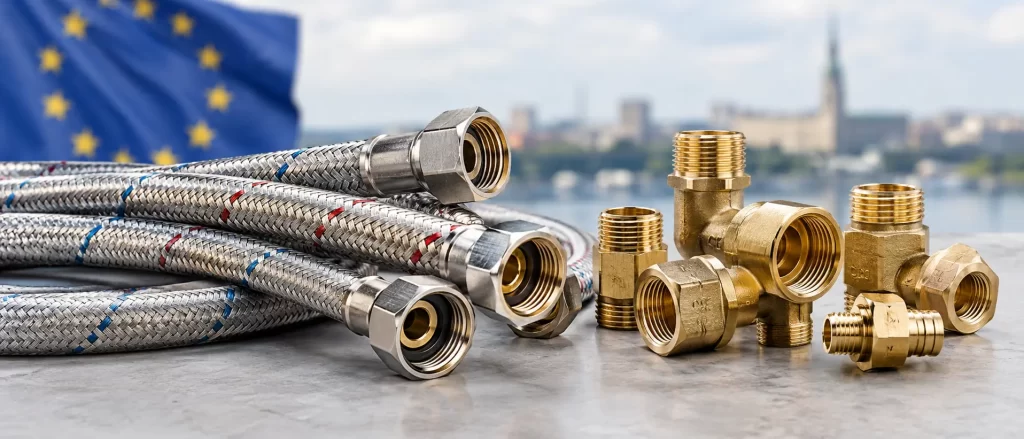
Braided flexible hoses connect almost every tap, toilet cistern, water heater and appliance in European homes. From 31 December 2026, the EU’s new drinking-water rules change which brass can be used in them. This guide from Anand Brass Components explains what European importers and hose assemblers need to know.
⚡ Quick Answer
What is a flexible braided hose, and what does Europe require?
A flexible braided hose is a flexible water connector made of an inner rubber tube (usually EPDM) wrapped in a stainless-steel or synthetic braid, with brass end fittings crimped on each end. It connects taps, cisterns, water heaters and appliances to the supply pipe. In Europe, drinking-water hose assemblies are covered by EN 13618 (maximum 10 bar, 70 °C) and by national approvals such as DVGW (Germany), WRAS (UK), ACS (France) and KIWA (Netherlands). The biggest change is the EU Drinking Water Directive (EU) 2020/2184. From 31 December 2026, new products in contact with drinking water must use materials on the European Positive List. For brass, that means lead-free or low-lead alloys such as CW724R, CW510L and CW509L. Leaded brasses like CW617N may only continue under existing national approvals until 31 December 2032.
Look under any kitchen sink or behind any toilet in Germany, Italy, France, Spain or Poland and you’ll almost certainly find a braided flexible hose. These small connectors replaced rigid copper tails decades ago. They’re quick to install, forgive minor misalignment and fit the compact tapware European homes prefer. They are high-volume consumer and trade products, and most of their value and reliability sits in the brass end fittings at each end.
At Anand Brass Components in Jamnagar, India, we manufacture precision brass hose fittings: swivel nuts, male nipples, barbed inserts, adapters and tap connectors, made to customer drawings for hose assemblers, importers and distributors. Europe is the region where demand for these parts is strongest, and where the rules are changing fastest. This guide brings together what we tell European buyers, with the regulatory dates and technical details that matter in 2026 and beyond.
🎯 Key takeaways
- EN 13618 is the European standard for flexible hose assemblies in drinking-water installations. It covers sanitary tapware, heaters and similar appliances, up to 1 MPa (10 bar) and 70 °C.
- The EU Positive List applies from 31 December 2026. New drinking-water products must use listed materials, and for brass that means lead-free or low-lead grades.
- CW617N and CW614N are not on the EU Positive List. They can be used only under national approvals until 31 December 2032.
- A new EU marking (“suitable for drinking water”, under Regulation (EU) 2024/371) replaces patchwork national marks over time. Certificates are valid for five years.
- Germany, Italy, France, the Netherlands and Poland are among the largest EU markets for flexible connectors. Imports, mainly from Asia, are estimated to cover 35–45% of EU demand.
- Most failures start at the fittings or braid: poor crimps, thin braid wire, over-tightening, or chlorine fumes from cleaning products.
- 10 barMax operating pressure, EN 13618
- 70 °CMax operating temperature, EN 13618
- 31 Dec 2026EU Positive List applies
- 5 µg/LNew EU lead limit in tap water
What is a flexible braided hose?
A flexible braided hose, also called a braided connector, flexi hose, tap connector or “flexible”, is a short, pre-assembled water connection. It joins a fixed supply pipe or isolation valve to a tap, mixer, toilet cistern, water heater, boiler, dishwasher, washing machine, water filter or other appliance.
Compared with rigid copper or steel pipe connections, braided hoses:
- Install in minutes without soldering, bending or cutting.
- Absorb misalignment and vibration between the pipe and the appliance.
- Fit tight spaces under basins and inside cabinets.
- Are easy to replace when the tap or appliance changes.
Their flexibility has a cost: a hose assembly is a pressurized rubber tube, and its reliability depends entirely on materials, manufacture and installation. That’s why Europe regulates them closely.
Anatomy of a braided hose assembly
EN 13618 describes a hose assembly as an internal hose, a braid, sleeves, fittings and seals. Each part has a job:
| Component | Function | Typical material (Europe) |
|---|---|---|
| Inner hose (tube) | Carries the water | EPDM rubber approved for drinking water (e.g. tested to German UBA/KTW and DVGW W 270 requirements); also PEX or silicone in some designs |
| Braid | Resists pressure; protects the tube from abrasion and kinking | Stainless-steel wire (commonly AISI 304); also polyester or nylon braid for some applications |
| Sleeve / ferrule | Crimped over braid and fitting to lock the assembly together | Stainless steel, aluminium or brass |
| Nipple / barbed insert | Inserted into the tube; carries water and anchors the crimp | Brass (lead-free grades for drinking water) |
| Swivel nut (female end) | Connects to the valve, tap or appliance | Brass, usually nickel-plated |
| Male thread end | Screws into a tap body (e.g. M10×1) or fitting | Brass, often nickel- or chrome-plated |
| Seal / washer | Makes the joint watertight | EPDM or fibre washer; O-rings on threaded tails |
The brass parts are machined from rod or forged and then plated. They are where dimensional accuracy, thread quality and alloy choice decide whether the hose passes its pressure tests, and whether it complies with the EU Positive List.
Types of braided hoses and where they’re used
| Type | Typical ends | Main use |
|---|---|---|
| Tap / mixer connector | M10×1 male (tap side) × G3/8 or G1/2 female | Kitchen and basin mixer taps |
| Female × female connector | G1/2 × G1/2, G3/8 × G1/2, G3/4 × G3/4 | Valves to appliances, water heaters |
| Male × female connector | G1/2 male × G1/2 female | General plumbing, filters |
| Toilet cistern connector | G3/8 or G1/2 female (cistern valve) × G1/2 | WC cisterns |
| Water heater / boiler connector | G1/2 or G3/4 female × female | Electric water heaters, boilers (check temperature rating) |
| Compression-end connector | Plain tail for 10, 12 or 15 mm compression fittings | Connection to copper pipe without threads |
| Elbow-end connector | 90° female elbow end | Tight spaces behind appliances |
| Appliance inlet hose | G3/4 female × G3/4 female | Washing machines, dishwashers (often under EN 61770 when part of the appliance) |
Braided water hoses must never be used for gas. Gas connections in Europe use specific approved products, such as corrugated stainless-steel connectors to gas standards, with their own certification. Anand Brass Components makes brass gas parts to separate specifications.
Why Europe is the key market for braided hoses and fittings
Braided flexible connectors are used worldwide, but Europe stands out for several reasons:
- Installation culture. European tapware, especially monobloc mixers with built-in M10×1 flexible tails, is designed around flexible connectors. Rigid tails are increasingly rare.
- Renovation volume. Europe’s large stock of older housing means constant bathroom and kitchen renovation, each using several new hoses.
- Replacement cycle. Hoses are wear items. Insurers and plumbers commonly advise inspecting them every couple of years and replacing them within roughly 5–10 years, which creates steady replacement demand.
- Large national markets. Market analysts identify Germany as the largest EU market for flexible connectors, followed by Italy, with France, the Netherlands and Poland also significant. The EU flexible-connector market is forecast to grow at roughly 3.5–4.5% a year between 2026 and 2035.
- Import dependence. Imports, mainly from Asia, are estimated to supply 35–45% of EU demand. China, India and Turkey are named as the main sources.
- The regulatory reset. The 2026 Positive List forces a large share of existing brass fittings to be re-specified in lead-free alloys. That opens the door for suppliers who can machine those alloys well.
Market estimates are based on IndexBox’s EU flexible connectors analysis (2026), which gives growth ranges and country rankings rather than absolute volumes.
Re-specifying hose fittings for the EU Positive List?
Anand Brass Components machines swivel nuts, nipples, barbed inserts and tap connectors to your drawings, including lead-free brass options, with OES-verified chemistry and an MTC with every shipment.
EN 13618 explained: the European standard for flexible hose assemblies
EN 13618 “Flexible hose assemblies in drinking water installations — Functional requirements and test methods” is the CEN standard for braided and non-braided hoses that connect sanitary tapware, heaters and similar appliances. Hoses that are an integral part of an electrical appliance fall under EN 61770 instead. National editions include BS EN 13618 in the UK, DIN EN 13618 in Germany, NF EN 13618 in France and NEN-EN 13618 in the Netherlands.
| Area | What it covers |
|---|---|
| Operating limits | Maximum allowable operating pressure 1 MPa (10 bar); maximum operating temperature 70 °C |
| Construction | Internal hose, braiding (stainless steel or synthetic), sleeves, fittings and seals |
| End fittings | Male and female threads to EN ISO 228-1 or ISO 7-1, metric male threads, compression biconical ends, plain tube ends, elbows and special fittings |
| Hose assembly tests | Flow rate, ageing by hot storage, tensile, hydrostatic pressure, hydraulic performance and durability, pressure jumps, temperature cycling, corrosion resistance, UV resistance, bending, frost resistance |
| Fitting tests | Dimensions and thread control, ammonium stress-corrosion test, tightening test, bending test |
| Water quality | Materials must not adversely affect water quality, taste or odour |
| Marking | Identification and marking for traceability |
The ammonium stress-corrosion test checks that brass fittings won’t crack under residual stress, the problem known as “season cracking”. It depends on the alloy, on forging and machining practice, and on stress-relief annealing. It is one of the most common reasons cheaply made brass nuts fail approval testing.
Always work to the current edition. Check with your national standards body, because the standard has been revised over time (2011, 2016) and remains under periodic review.
The EU Positive List and lead-free brass: the 2026 deadline
The recast Drinking Water Directive (EU) 2020/2184 introduced, for the first time, harmonised EU rules for materials and products in contact with drinking water. Three 2024 legal acts put it into practice:
- Implementing Decision (EU) 2024/367 sets the European Positive Lists of approved starting substances, compositions and constituents, including metallic materials.
- Implementing Decision (EU) 2024/368 covers test methods for materials.
- Regulation (EU) 2024/371 defines the new marking for products “suitable for drinking water”.
Key dates for brass hose fittings
| Date | What happens |
|---|---|
| 12 Jan 2021 | Directive (EU) 2020/2184 enters into force |
| Jan 2024 | Positive List and related acts published |
| 31 Dec 2026 | European Positive List applies to products in contact with drinking water |
| From 1 Jan 2027 | EU certificates under the new system can be issued (notified bodies, “1+” system, Module B plus C or D) |
| 12 Jan 2028 | Germany’s 5 µg/L lead limit takes effect (as reported by industry sources) |
| 31 Dec 2032 | End of transition: compositions approved nationally (13 Jul 2021 – 31 Dec 2026) and existing national certificates may be used until this date |
| Jan 2036 | EU-wide lead limit at the tap falls from 10 µg/L to 5 µg/L |
Which brass alloys are allowed?
| Alloy (EN) | Type | EU Positive List | Use for hose fittings |
|---|---|---|---|
| CW724R (CuZn21Si3P) | Lead-free silicon brass, DZR | Listed | Preferred for new drinking-water products |
| CW510L (CuZn42) | Low-lead brass (Pb ≤ 0.2%) | Listed | Lead-free option, slower to machine |
| CW509L (CuZn40) | Low-lead brass (Pb ≤ 0.2%) | Listed | Lead-free option, mainly hot-formed parts |
| CW511L, CW727R | Low-lead brasses | National approvals; expected EU evaluation | Check current status |
| CW617N (CuZn40Pb2) | Leaded forging brass | Not listed | Only under national approvals until 31 Dec 2032 |
| CW614N (CuZn39Pb3) | Leaded free-cutting brass | Not listed | Not for new drinking-water products |
| CW602N (CuZn36Pb2As) | Leaded DZR brass | Not listed | Being phased out for drinking water |
Summarised from industry guidance published by Wavin, FOMA, ICIM and Brassland. The Positive List can be amended, and some low-lead alloys are expected to be evaluated between 2027 and 2032. Always check the current consolidated list and your notified body’s position.
For a hose assembler, the practical consequence is clear. Brass nipples, inserts and nuts in contact with drinking water should move to Positive-List alloys for new products now, so certification under the new EU scheme isn’t delayed. Lead-free brasses machine more slowly and wear tools faster, so piece prices and lead times need to be re-planned. Our lead-free brass components guide covers the machining and cost implications.
The Positive List applies to materials in contact with drinking water. In a typical design, the nipple or insert is wetted and the outer swivel nut may not be. Some manufacturers still specify lead-free brass for all brass parts to simplify certification, avoid mix-ups and meet retailer requirements. Agree this with your notified body.
National approvals: DVGW, WRAS, ACS, KIWA and more
Until the new EU scheme is fully in place, and during the transition to 2032, national approvals remain the passport to most European markets:
| Country | Scheme / body | What it covers for hoses |
|---|---|---|
| Germany | DVGW (incl. W 543 for pressure-resistant flexible hoses in drinking-water installations); UBA evaluation criteria; W 270 for elastomers | Product certification, hygienic suitability of metals and elastomers |
| United Kingdom | WRAS approval (Water Supply (Water Fittings) Regulations 1999) | Product-specific approval, valid 5 years; verify in the WRAS directory. Note that the UK is outside the EU DWD |
| France | ACS (Attestation de Conformité Sanitaire) | Sanitary conformity of materials in contact with water |
| Netherlands | KIWA (KIWA/KOMO certification) | Product and material certification |
| Italy | DM 174/2004 (self-declaration until 31 Dec 2032 for unchanged products) | Materials in contact with drinking water |
| Belgium | Belgaqua | Product approvals |
| Nordics | Nordic certification schemes (e.g. Sweden, Denmark, Norway) | Product type approvals |
Under the new EU system, notified bodies will certify products to a single European procedure with a five-year certificate and the common “suitable for drinking water” marking. Products with valid national certificates on 31 December 2026 must move to the European procedure by 31 December 2032.
European threads and end-fitting dimensions
Thread errors are the most common reason hoses don’t fit. European hoses use metric and BSP-based standards, not US NPT:
| Thread | Standard | Typical use | Seal |
|---|---|---|---|
| G3/8 (≈ 16.7 mm OD) | EN ISO 228-1 (parallel) | Angle valves, cistern valves, mixer connectors | Flat washer |
| G1/2 (≈ 20.96 mm OD) | EN ISO 228-1 (parallel) | Most common supply connection in Europe | Flat washer |
| G3/4 (≈ 26.4 mm OD) | EN ISO 228-1 (parallel) | Appliances, water heaters, washing machines | Flat washer |
| M10×1 | Metric fine | Screw-in tails of monobloc mixer taps | O-ring |
| M8×1 | Metric fine | Smaller tap bodies | O-ring |
| R / Rp (tapered) | EN 10226 / ISO 7-1 | Threaded pipe joints sealed on the thread | Thread sealant |
| Compression ends 10/12/15 mm | EN 1254 series (fittings) | Direct connection to copper pipe | Olive / ferrule |
“G” threads seal on a washer, not on the thread. Never use PTFE tape on a washer-sealed G connection, because it can stop the nut seating fully.
If you also sell into the US, threads and standards differ entirely. See our US thread and size chart for brass hose and sanitary fittings.
Choosing materials: brass, braid, tube and finish
Brass fittings
- Alloy: use a Positive-List alloy such as CW724R or CW510L for new drinking-water products. Use CW617N or CW614N only for non-potable applications or under valid national approvals until 2032.
- Process: forged nuts give good strength and grain flow, while machined-from-bar nuts suit smaller volumes. Both need stress relief to pass the ammonia test. See brass forging vs casting.
- Plating: nickel plating is standard for appearance and corrosion protection, and chrome is used for visible tails. See nickel plating on brass and brass surface finishes.
- Barb and insert design: barb profile, length and wall thickness decide pull-out strength after crimping, so they must match the tube and sleeve.
Braid
- AISI 304 stainless steel is the norm. Wire diameter and braid coverage strongly affect burst pressure and corrosion life. Industry reports show braid wire thicknesses varying from about 0.15 mm to 0.23 mm between manufacturers, a significant difference in robustness.
- AISI 316 braid is worth considering in coastal or chemically aggressive environments.
Inner tube
- EPDM compounds approved for drinking water (meeting UBA elastomer guidelines and DVGW W 270 for microbial growth in Germany) are standard for cold and hot domestic water up to EN 13618’s 70 °C limit.
Seals
- Drinking-water-approved EPDM washers and O-rings, sized correctly for G-thread seats and M10×1 tails.
Why braided hoses fail, and how better fittings prevent it
Flexible hoses are a well-known source of household water damage. In Australia, insurer IAG reported that braided flexible hoses accounted for 22% of household water damage claims in 2016, and it advises inspection every two years with a typical life of five to ten years. The failure causes are the same in Europe:
| Failure mode | Cause | Prevention (manufacturer / installer) |
|---|---|---|
| Braid corrosion and burst | Chlorine fumes from cleaning products stored under sinks, which form corrosive acid in humid air | Better braid grade and wire diameter; keep cleaners sealed and away |
| Leak at the nut | Over- or under-tightening; damaged washer; PTFE tape on a G thread | Correct torque, quality washers, accurate nut threads |
| Cracked brass nut | Stress-corrosion cracking from residual stress plus ammonia exposure | Stress-relieved brass, passing the EN 13618 ammonia test |
| Tube pulls off the fitting | Poor crimp, wrong barb profile or sleeve | Controlled crimping, matched barb and sleeve design |
| Kinking or abrasion | Hose bent too tightly or twisted during install | Correct length; respect minimum bend radius; don’t twist |
| Ageing | Rubber degrades with heat, pressure and time | Quality EPDM; replacement every 5–10 years |
| Water hammer damage | Fast-closing valves causing pressure spikes | Pressure-jump-tested assemblies; arrestors where needed |
Several of these failures start at the brass parts, which is why European assemblers increasingly audit their fitting suppliers as closely as their hose suppliers. Use our 12-point brass manufacturer audit checklist. It was written for US importers, but it applies equally to European buyers.
Installation best practice for braided hoses
Choose the right length
The hose should reach without stretching or looping. Too short strains the crimps, and too long encourages kinks.
Check threads and washers
Confirm G size or M10×1. Make sure the washer or O-ring is present and undamaged, and don’t use PTFE tape on washer-sealed joints.
Screw in the tap tails by hand
M10×1 tails seal on an O-ring. Screw them into the tap body hand-tight only.
Tighten the nuts correctly
Hand-tight plus about a quarter turn with a spanner is a common guide. Follow the manufacturer’s instructions, and hold the hose to stop it twisting.
Respect the bend radius
Avoid sharp bends near the fittings, and keep the hose away from sharp edges.
Pressure-test and inspect
Open the supply slowly, check both ends for weeping, and recheck after 24 hours.
Plan inspection and replacement
Inspect every couple of years and replace within the manufacturer’s service life, typically 5–10 years.
Sourcing brass hose fittings from India for Europe
Many European hose brands assemble locally, or in nearby countries, using imported brass components. India’s Jamnagar cluster is one of the world’s main sources of precision brass parts. Here’s why European buyers source fittings there, and what to check:
- Precision at scale. Swiss-type CNC and multi-spindle automats produce nuts, nipples and inserts in high volumes to tight tolerances. Anand Brass Components machines to ±0.01 mm.
- Alloy control. Integrated plants melt and extrude their own rod, so they can supply Positive-List alloys with verified chemistry. Anand Brass Components runs in-house extrusion with OES testing.
- Plating in the supply chain. Nickel and chrome finishes to European appearance and corrosion standards.
- EU trade terms. Brass components from India enter the EU under standard MFN customs duties. India and the EU have been negotiating a free-trade agreement, so check current status and rates for your HS codes with your customs broker.
- Documentation. Material test certificates per lot, dimensional reports, RoHS and REACH declarations where needed, and support for notified-body testing samples.
- Logistics. Ocean freight from Mundra and Nhava Sheva (JNPT) to Rotterdam, Hamburg, Antwerp and Genoa, with ISPM-15 compliant packing.
For the buyer side of the process, see How Custom Brass Components Are Manufactured for OEMs and our brass hose fittings and sanitary & plumbing product pages.
European importer checklist for braided hose fittings
| Item | What to confirm |
|---|---|
| Alloy | Positive-List alloy (e.g. CW724R, CW510L) for wetted parts; grade on drawing and MTC |
| Threads | G (EN ISO 228-1) class, M10×1 tolerance, thread gauges used |
| Barb / insert geometry | Matches the tube ID and sleeve; pull-out tested after crimp |
| Stress relief | Annealing process; passes the ammonia stress-corrosion test |
| Plating | Nickel or chrome thickness, adhesion and salt-spray results |
| Approvals path | Which national or EU certification the finished hose will carry |
| Documentation | MTC per lot, dimensional report, RoHS/REACH declarations |
| Packing & logistics | Anti-tarnish packing, ISPM-15 pallets, Incoterm, port |
| Capacity & lead time | Monthly volumes, tooling time, repeat-order lead time |
Trends to watch in the European braided hose market
- The lead-free switch. 2026–2032 will see most European hose brands re-certify their brass parts in Positive-List alloys.
- A single EU marking. The “suitable for drinking water” marking under Regulation (EU) 2024/371 will gradually simplify multi-country sales.
- Leak protection. Insurers and building owners are pushing for longer-life hoses, safety connectors and leak-stop valves.
- Premiumisation. Analysts expect premium flexible connectors to grow faster than standard ones, at about 5–7% a year versus 2–3%.
- Supply diversification. European buyers are spreading sourcing across India, Turkey and Europe to reduce dependence on a single country.
- Sustainability data. Expect more requests for Environmental Product Declarations and recycled-content information on brass.
Final word
Braided flexible hoses look simple, but in Europe they sit at the meeting point of EN 13618 performance testing, national approvals and a once-in-a-generation change in drinking-water material rules. For hose brands and importers, the brass end fittings are where most of the risk, and most of the compliance work, sits. Getting alloy, threads, barb design and stress relief right from the start makes certification smoother and keeps hoses out of insurance claim statistics.
Anand Brass Components has manufactured precision brass parts in Jamnagar since 1991 and supplies hose and plumbing fittings to buyers across Europe, the UK, the USA and the Middle East. If you are re-specifying fittings for the EU Positive List, or looking for a second source, send us your drawings.
Brass hose fittings for European hose assemblers
Swivel nuts, nipples, barbed inserts, M10×1 tails and adapters. Made to drawing, ISO 9001 certified, exporting to 30+ countries.
Frequently Asked Questions
Related guides from Anand Brass Components
Written by the Anand Brass Components Export Desk. Anand Brass Components is a brass parts manufacturer and exporter at Plot 4110-4111, H-Road, GIDC Phase-III, Jamnagar, Gujarat 361004, India. Founded in 1991, ISO 9001 certified, with in-house casting, extrusion, forging, CNC machining and OES alloy testing. Contact: info@anandbrass.com · +91 78743 05684 · +91 81401 51497.
Disclaimer: This article is general guidance as of 26 October 2026, not legal or certification advice. Standards, the EU Positive List and national rules are revised periodically, so confirm requirements with your notified body or certification provider. References: EN 13618 (CEN; national editions BS/DIN/NF/NEN); Directive (EU) 2020/2184; Implementing Decisions (EU) 2024/367 and 2024/368; Regulation (EU) 2024/371; industry guidance from Wavin, FOMA, ICIM and Brassland; DVGW W 543; IndexBox EU flexible connectors market analysis (2026); Plumbing Connection / IAG data on flexible hose claims.