
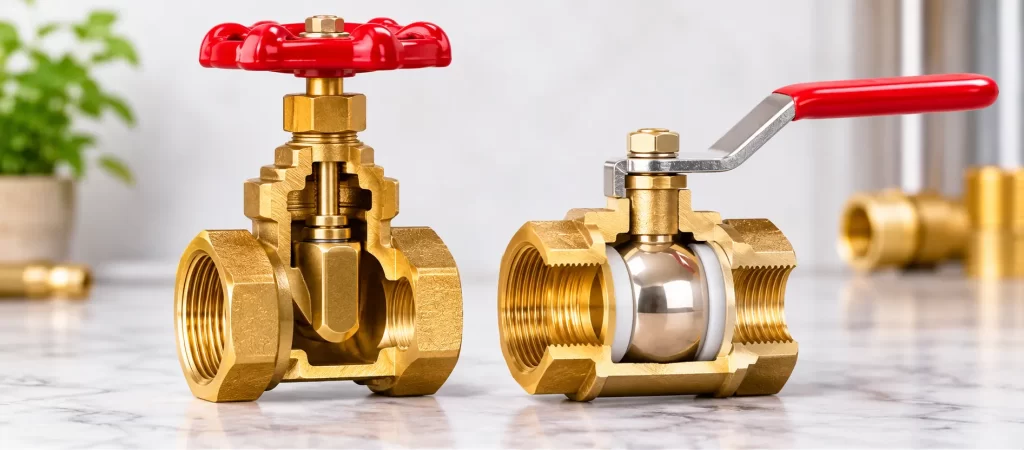
Gate valves and ball valves both stop the flow in a pipe, but they work very differently, last differently and suit different jobs. This guide from Anand Brass Components, a manufacturer of brass concealed and gate valves in Jamnagar, compares them side by side and explains how plumbers and buyers in India and the USA typically choose.
⚡ Quick Answer
What are the main types of pipe fittings?
A gate valve lifts a flat or wedge-shaped gate out of the flow by turning a handwheel several times; it gives straight-through flow when fully open but is slow to operate and shouldn’t be used part-open. A ball valve rotates a ball with a hole through it by a quarter turn; it shuts off instantly, seals tighter (usually on PTFE seats) and is more reliable after long periods unused. For most water, gas and air lines up to about 2″, a ball valve is the better choice. Gate valves still suit large mains, slurries and low-cost isolation where operation is rare.
🎯 Key takeaways
- Gate valve: multi-turn, full flow, not for throttling, can stick over time.
- Ball valve: quarter-turn, tight shut-off, handle shows open/closed at a glance.
- Full port ball valves match gate valves for low flow restriction.
- In India, concealed valves are standard behind bathroom walls; in the US, ball valves dominate main shut-offs.
- Drinking water valves must be lead-free in the US (NSF/ANSI 61 & 372).
- 90°Turn to close a ball valve
- Multi-turnHandwheel on a gate valve
- ≤0.25%Weighted lead limit, US potable
- 1991Brass valves since
How a gate valve works
Inside a gate valve is a gate (or wedge) attached to a threaded stem. Turning the handwheel raises the gate out of the waterway or lowers it to seal against two seats. When fully open, the gate sits completely out of the flow path, so pressure loss is very low.
- Rising stem gate valves show their position by how far the stem sticks out.
- Non-rising stem gate valves save height and are common in compact brass designs.
- Solid wedge, split wedge and flexible wedge designs suit different temperatures and pressures.
A part-open gate vibrates in the flow (“chatter”), and the fast-moving water erodes the gate edge and seats, so the valve stops sealing.
How a ball valve works
A ball valve contains a ball with a hole (bore) through it, held between two seats, usually PTFE. A quarter turn of the lever lines the bore up with the pipe (open) or turns it across the pipe (closed). The lever position shows the valve state: in line with the pipe means open.
- Two-piece and three-piece bodies (three-piece can be serviced in line).
- Floating ball designs are standard in small brass valves; trunnion designs are used in large, high-pressure lines.
- Options include lever or T-handle, lockable handles, drain (waste) ports and multi-port (3-way) balls.
Gate valve vs ball valve: comparison chart
| Feature | Gate valve | Ball valve |
|---|---|---|
| Operation | Multi-turn handwheel | Quarter-turn lever |
| Shut-off speed | Slow (reduces water hammer) | Fast (can cause water hammer if snapped shut) |
| Sealing | Metal-to-metal, may weep with age | Soft PTFE seats, very tight (bubble-tight) |
| Flow when open | Full, straight through | Full (full port) or slightly reduced (standard port) |
| Throttling | Not suitable | Not ideal; acceptable briefly in some designs |
| Position visible? | Only on rising stem | Yes, from lever |
| Reliability after years unused | Often sticks or won’t fully seal | Usually operates reliably |
| Space needed | Taller (handwheel and stem) | Compact, needs swing room for lever |
| Best for | Large mains, slurries, rare isolation | Water, gas, air, oil shut-off up to ~2″ and beyond |
| Cost (small brass sizes) | Similar or lower | Similar; full port costs more |
Full port vs standard port ball valves
A full port (full bore) ball valve has a bore equal to the pipe’s inside diameter, so it flows like a gate valve. A standard port (reduced bore) valve’s bore is roughly one pipe size smaller. Standard port valves are cheaper and fine for most branch lines; specify full port for main shut-offs, long runs and anywhere a pipeline pig or full flow is needed.
Concealed valves: the Indian bathroom standard
In most Indian homes, hotels and apartments, the stop valves for showers, taps and flush tanks are concealed valves: a brass valve body built into the wall, with only the spindle, handle and chrome flange visible. They are typically available as:
- Concealed stop cock / concealed valve (screw-down, ceramic disc or quarter-turn cartridge).
- Concealed diverters (2-way or 3-way) to switch between shower, hand shower and spout.
- Angle valves (angle cocks) under basins and for WC connections.
Because the body is plastered into the wall, quality matters more than usual: forged brass bodies, accurate threads, pressure testing and a long-life cartridge prevent hidden leaks. In the US, the equivalent is usually an in-wall shower valve or rough-in valve, while stop valves under sinks are exposed angle stops.
Looking for a brass valve manufacturer?
Anand Brass Components makes forged brass concealed valves, gate valves and valve parts for sanitaryware brands and plumbing distributors in India, the USA and the Middle East.
Pressure ratings and valve markings
| Marking | Meaning |
|---|---|
| WOG (e.g. 600 WOG) | Pressure rating in psi for water, oil and gas at ambient temperature |
| CWP | Cold working pressure (similar meaning to WOG) |
| WSP / SWP (e.g. 125 WSP) | Working steam pressure rating |
| PN (e.g. PN16, PN25) | Nominal pressure in bar, used in India and Europe |
| NSF-61 / NSF-372, “LF” | Certified for US drinking water / lead-free |
| UL / CSA marks | Listed for gas, fire or other specific service |
| ISI mark | Certified to the relevant Indian Standard by BIS |
India vs USA: how valves are specified
🇮🇳 India
- BSP threads (IS 554) are standard on plumbing valves.
- IS 778 covers copper alloy gate, globe and check valves for water works.
- Concealed valves and diverters dominate bathrooms; gate and ball valves are used on risers, tank outlets and pump lines.
- Ratings are usually expressed as PN (bar).
- Hard water and borewell supply make good seats and DZR brass worthwhile in many regions.
🇺🇸 USA
- NPT threads and sweat (solder) ends are standard; press and PEX ends are growing.
- MSS SP-110 covers ball valves; MSS SP-80 covers bronze gate, globe and check valves.
- Potable water valves must be lead-free under the Safe Drinking Water Act and certified to NSF/ANSI 61 and 372.
- Full port brass ball valves are the usual main water shut-off in new and remodelled homes.
- Gas valves need the appropriate listing for fuel gas.
See our lead-free brass guide (NSF 61 & 372) and brass fittings for gas lines for the US rules.
Which one should you use?
| Application | Usually best | Why |
|---|---|---|
| Home main water shut-off | Full port ball valve | Reliable in an emergency, full flow |
| Bathroom shower / tap isolation (India) | Concealed valve | Clean wall finish, standard practice |
| Under-sink and WC supply | Angle valve / angle stop | Compact isolation at the fixture |
| Overhead tank outlet, pump lines | Ball or gate valve | Ball for frequent use; gate for large sizes |
| Water heater and boiler isolation | Full port ball valve | Tight shut-off for servicing |
| Gas appliance shut-off | Listed gas ball valve | Quarter turn, required listings |
| Large municipal or irrigation mains | Gate valve (often iron) | Cost and size; slow closing limits surge |
| Flow control / throttling | Globe or needle valve | Designed for regulation |
Valve body materials
Forged brass is the standard for small valves because it’s dense, pressure-tight, machines into precise threads and resists corrosion. Lead-free brass is required for US drinking water, and DZR brass resists dezincification in aggressive water (see DZR vs standard brass). Bronze is used for larger cast valves and marine service; stainless steel for chemicals and food plants; ductile iron for large mains. On why forging beats casting for valve bodies, read brass forging vs casting.
Buying checklist for brass valves
- Valve type: gate, ball (full or standard port), concealed, angle, check.
- Size and end connection: BSP, NPT, sweat, compression, PEX, press.
- Medium: drinking water, hot water, gas, air, oil.
- Pressure and temperature: PN or WOG rating, maximum temperature.
- Material: standard, lead-free or DZR brass; seat material (PTFE, reinforced PTFE).
- Certifications: ISI/BIS for India; NSF/ANSI 61 & 372, UL/CSA for the US.
- Finish: natural, nickel or chrome plated.
- Testing: 100% pressure/leak testing and material (OES) reports from the supplier.
Frequently Asked Questions
Related guides
Written by the Anand Brass Components Technical Team. Anand Brass Components is a brass parts manufacturer and exporter at Plot 4110-4111, H-Road, GIDC Phase-III, Jamnagar, Gujarat 361004, India. Founded in 1991, ISO 9001 certified. Contact: info@anandbrass.com · +91 78743 05684.
Note: General reference information as of 28 November 2026. Always follow local plumbing and gas codes and the valve manufacturer’s ratings. References: IS 778; IS 554; MSS SP-110; MSS SP-80; NSF/ANSI/CAN 61 & 372; US Safe Drinking Water Act Section 1417.