
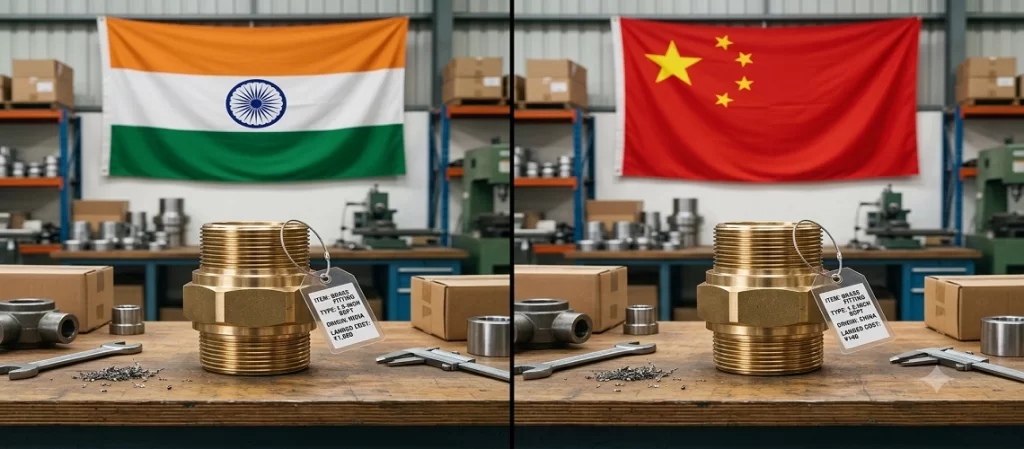
A Chinese brass fitting can be 10% cheaper at the factory gate and still cost more once it clears US customs. This guide from Anand Brass Components compares both countries line by line: tariffs, landed cost, quality, lead time, compliance risk and supplier fit.
⚡ Quick Answer
Is it cheaper to source brass components from India or China in 2026?
For US buyers, India usually wins on landed cost in 2026, even when China quotes a lower FOB price. Both countries pay the 50% Section 232 copper tariff on Chapter 74 brass articles such as fittings, fasteners and rods. Chinese goods also carry legacy Section 301 tariffs, typically 25% for listed products, which stack on top. For brass parts outside Chapter 74, such as valves and terminals, India pays a 10% Section 301 tariff, while China pays 12.5% plus any legacy Section 301 duty. In our worked example, a Chinese quote had to be about 13% cheaper on Chapter 74 fittings, and about 18% cheaper on other brass parts, just to break even. China still leads on scale, automation and West Coast transit time. India leads on tariff exposure, forced-labor compliance risk, and flexible custom and small-batch production.
For twenty years, “source it from China” was the default answer for brass valves, fittings and turned parts. That default no longer holds. By 2026 the two countries no longer compete on price alone. They compete on the duty stack, customs scrutiny and how much supply-chain risk a buyer will accept.
We are Anand Brass Components, a brass manufacturer in Jamnagar, India, so we have a side in this comparison. We have tried to write it the way we explain it to buyers who are weighing their options. That means being candid about where China is still the stronger choice, and showing the arithmetic behind every claim so you can plug in your own numbers.
🎯 Key takeaways
- Section 232 is the same for both countries. The 50% copper tariff on Chapter 74 brass applies to every origin, so it doesn’t decide India vs China on its own.
- Legacy Section 301 is the swing factor. Many Chinese metal products carry an extra 25% from the 2018–2019 lists. Indian products do not.
- The forced-labor tariff is 12.5% for China and 10% for India, and it is waived for goods already covered by Section 232.
- UFLPA adds risk to Chinese copper. DHS named copper a high-priority enforcement sector in August 2025, so detentions are possible without full traceability.
- China wins on scale and speed to the West Coast. India wins on custom work, smaller MOQs and English-speaking engineering support.
- Always compare landed cost per piece, never FOB price.
India vs China for brass components at a glance
This is the summary table most buyers ask for first. Each row is explained in detail further down.
| Factor | India | China | Edge |
|---|---|---|---|
| US tariff on Chapter 74 brass (e.g. fittings) | MFN + 50% Sec. 232 | MFN + 50% Sec. 232 + legacy Sec. 301 (often 25%) | India |
| US tariff on non-Chapter 74 brass (e.g. valves) | MFN + 10% Sec. 301 | MFN + 12.5% Sec. 301 + legacy Sec. 301 if listed | India |
| Factory-gate (FOB) price, high volume | Competitive | Often lower at very high volumes | China |
| Landed cost per piece (US) | Usually lower in 2026 | Usually higher in 2026 | India |
| Scale & automation | Strong, mostly SME clusters | Very large, highly automated | China |
| Custom / small-batch work | Very flexible, low MOQs | Best for large, repeat runs | India |
| Ocean transit to US West Coast | ~30–40 days | ~14–20 days | China |
| Ocean transit to US East Coast | ~25–35 days | ~30–40 days | Comparable |
| Forced-labor (UFLPA) exposure | Not applicable | Copper is a high-priority sector | India |
| Communication & documentation | English-speaking engineering teams | Varies; often via agents | India |
| Supply-chain diversification value | High (China+1) | Concentration risk | India |
Transit times are typical port-to-port ranges and vary by carrier, routing and season. Tariff rows assume the product is not excluded from the relevant action. Verify your exact HTS code with a licensed customs broker.
Tariff stacks compared: why the same part pays different duty
Four separate tariff layers decide what a brass part pays at the US border. The key point is that two layers are the same for India and China, and two are not.
Layers that treat India and China the same
MFN duty. Neither country has a US free-trade agreement, so both pay the Column 1 General rate. Brass pipe fittings under HTS 7412.20.00, for example, pay 3% from either origin.
Section 232 copper. Since 6 April 2026, articles in Annex I-A of Proclamation 11021 pay 50% of their full customs value, whatever their origin. That annex covers brass rods, wire, sheet, tubes, pipe fittings, fasteners, sanitary ware and “other articles of copper” in Chapter 74. For more detail, see our guide to 2026 US tariffs on brass components from India.
Layers that differ
Legacy Section 301 (China only). The 2018–2019 Section 301 action against China placed thousands of product lines on Lists 1–3 at 25%, and on List 4A at 7.5%. Those tariffs were not part of the IEEPA program the Supreme Court struck down in February 2026, so they remain in force. Many copper and brass articles are on these lists, and the legacy China Section 301 duty stacks on top of Section 232. Indian goods have never been subject to these lists.
Forced-labor Section 301 (both, at different rates). Since 24 July 2026, USTR’s forced-labor action adds 10% for India and 12.5% for China. The notice expressly exempts “all articles and parts of articles subject to tariffs under Section 232.” A Chapter 74 brass fitting therefore pays Section 232 instead, while a brass valve outside Chapter 74 pays the forced-labor rate.
| Layer | India — brass fitting (Ch. 74) | China — brass fitting (Ch. 74) | India — brass valve (Ch. 84) | China — brass valve (Ch. 84) |
|---|---|---|---|---|
| MFN | 3% | 3% | 3% | 3% |
| Section 232 copper | 50% | 50% | — | — |
| Legacy Section 301 (China lists) | — | 25%* | — | 25%* |
| Forced-labor Section 301 | Exempt | Exempt | 10% | 12.5% |
| Total ad valorem | 53% | 78% | 13% | 40.5% |
*If the specific HTS line is on Section 301 Lists 1–3 and no exclusion applies. List 4A lines pay 7.5%, and unlisted lines pay 0%. Check your 8-digit HTS code against USTR’s lists. The valve MFN rate is assumed for illustration, so look up the actual rate in the HTSUS.
The current US–China trade truce, including extended Section 301 exclusions, runs to 10 November 2026. If it lapses without renewal, some exclusions that lower Chinese duty today could disappear. Build that risk into any contract that runs past November.
Landed cost: India vs China, worked examples
Tariff percentages only matter once you apply them to a real order. In both examples below, the Chinese supplier quotes 10% lower FOB than the Indian supplier ($36,000 vs $40,000) for the same brass parts. Freight from China is also cheaper. Watch what happens anyway.
| Cost line | India (Anand Brass Components) | China |
|---|---|---|
| FOB value | $40,000.00 | $36,000.00 |
| Ocean freight + insurance (illustrative) | $3,200.00 | $2,600.00 |
| MFN duty (3%) | $1,200.00 | $1,080.00 |
| Section 232 copper (50%) | $20,000.00 | $18,000.00 |
| Legacy Section 301 (25%) | — | $9,000.00 |
| Forced-labor Section 301 | Exempt | Exempt |
| MPF (0.3464%) + HMF (0.125%) | $188.56 | $169.70 |
| Brokerage + drayage (illustrative) | $1,350.00 | $1,350.00 |
| Total landed cost | $65,938.56 | $68,199.70 |
| Cost line | India (Anand Brass Components) | China |
|---|---|---|
| FOB value | $40,000.00 | $36,000.00 |
| Ocean freight + insurance (illustrative) | $3,200.00 | $2,600.00 |
| MFN duty (3%) | $1,200.00 | $1,080.00 |
| Legacy Section 301 (25%) | — | $9,000.00 |
| Forced-labor Section 301 (10% / 12.5%) | $4,000.00 | $4,500.00 |
| MPF + HMF | $188.56 | $169.70 |
| Brokerage + drayage (illustrative) | $1,350.00 | $1,350.00 |
| Total landed cost | $49,938.56 | $54,699.70 |
Illustrative only. Assumes the Chinese HTS lines are on Section 301 List 3 at 25% with no exclusion, and that customs value equals FOB. Freight and service costs vary, so use your forwarder’s quotes.
What the numbers say: in these examples, the Chinese supplier must be roughly 13% cheaper on FOB for Chapter 74 fittings, and about 18% cheaper for valves, just to match India’s landed cost. That is before counting inventory carrying cost, UFLPA detention risk or tooling transfer costs. If a Chinese part is not on a legacy Section 301 list, the gap narrows sharply, and China can win on a lower FOB. That is why checking the 8-digit HTS code is the first step in any India-vs-China decision.
Put three numbers side by side for each part: landed cost per piece, total duty per piece, and days of inventory in transit. Buyers who compare only unit price consistently pick the wrong country in 2026.
Send us your Chinese quote. We’ll show you the landed-cost comparison.
Share your drawing and current price. Anand Brass Components replies within 24 hours with an FOB quote, a suggested HTS heading and a like-for-like landed-cost comparison.
Quality and alloys: is Indian brass as good as Chinese brass?
The honest answer is that quality depends on the factory, not the country. Both countries have world-class brass manufacturers and both have workshops you should avoid. What differs is how each industry is structured, and that shapes how you find the good suppliers.
How China’s brass industry is structured
China’s copper-processing sector is huge and highly consolidated at the top. Companies such as Ningbo-based Jintian Copper process more than a million tonnes of copper a year. Zhejiang province, including Ningbo and Yuhuan, is a major center for brass valves and plumbing products. Large Chinese plants excel at high-volume, highly automated production of standard catalog items: ball valves, standard fittings, stamped parts.
How India’s brass industry is structured
India’s brass-parts industry is concentrated in Jamnagar, Gujarat. Thousands of small and mid-sized units there specialize in turned parts, inserts, fittings, electrical components and custom drawings. The strongest Jamnagar manufacturers are vertically integrated, meaning they control casting, extrusion, forging, CNC machining and finishing in-house. That gives them control over alloy chemistry from melt to finished part. Anand Brass Components, for example, runs an in-house extrusion line and verifies alloy composition by OES before machining.
| Requirement | India | China |
|---|---|---|
| Free-cutting brass | IS 319, CW614N, C36000 equivalents | HPb59-1, H59 (GB/T), C36000 equivalents |
| Lead-free brass for US potable water | C69300, CW724R and similar, NSF/ANSI 61 & 372 | Widely available, NSF/ANSI 61 & 372 |
| DZR brass (Europe, Australia) | CW602N available | Available |
| Threads | BSP, NPT, metric, UNC/UNF | BSP, NPT, metric, UNC/UNF |
| Quality systems | ISO 9001 common among exporters | ISO 9001 common among exporters |
Either way, verify alloy chemistry yourself. Ask for a material test certificate with every lot, and for lead-free parts, ask for NSF certification tied to the specific product. Our lead-free brass guide explains what to check, and our CNC alloy selection guide covers grade choice.
Where tolerance matters most, such as sealing faces, threads and insert knurls, run a first-article inspection with CMM data before you approve mass production from any new supplier in either country. Quality problems cost the same to fix whichever port they ship from.
Lead time and logistics
China has a real advantage on the Pacific route. If your warehouse is in California or the Pacific Northwest, Chinese ocean freight typically arrives one to three weeks sooner. For East Coast and Gulf buyers the gap mostly disappears. Indian cargo from Mundra and Nhava Sheva (JNPT) moves west through Suez or around Africa to the US East Coast in roughly 25–35 days.
| Stage | India (Anand Brass Components) | China (typical) |
|---|---|---|
| Quotation | Within 24 hours | 1–3 days |
| Samples by express courier | 3–5 days | 3–7 days |
| New tooling + first production | 3–5 weeks | 3–6 weeks |
| Repeat orders | 2–3 weeks | 2–4 weeks |
| Ocean to US East Coast | 25–35 days | 30–40 days |
| Ocean to US West Coast | 30–40 days | 14–20 days |
| Air freight | 5–7 days | 3–7 days |
You can offset the longer Pacific transit with planning. Blanket purchase orders with scheduled releases, and consolidated sailings, turn a longer transit into a predictable pipeline. When a buyer switches from China to India, we usually agree a rolling 90-day forecast so that production is ready before each sailing.
Compliance and supply-chain risk
UFLPA: why copper is now a risk for Chinese sourcing
The Uyghur Forced Labor Prevention Act presumes that goods made wholly or partly in Xinjiang, or by listed entities, were made with forced labor, and it bars them from entry. In its August 2025 strategy update, DHS added copper, steel, lithium, caustic soda and jujubes as new high-priority enforcement sectors. In July 2026 it added 43 companies to the UFLPA Entity List, its largest expansion so far. For Chinese brass, the importer must be able to trace copper back through the supply chain. A detention can hold a container for weeks, even if the importer eventually wins release.
Indian brass is not subject to UFLPA. India does sit in the forced-labor Section 301 program, but in the lower 10% tier. Chapter 74 goods are exempt because they already pay Section 232.
Smelt-and-cast reporting
CBP now requires copper smelt-and-cast country data on covered copper entries, and ACE rejects entry summaries that are missing it. Ask any supplier, in either country, to provide this before shipment.
Concentration risk
If one country supplies every critical brass part, a single tariff announcement can reprice your whole bill of materials overnight. 2025 and 2026 proved that. Keeping at least one qualified supplier in a second country is now standard practice for OEMs, and India is the most common second source for brass.
MOQ, customization and communication
Price and tariffs decide most deals, but the day-to-day relationship decides whether a supply program lasts.
- Minimum order quantities. Large Chinese plants are built for long runs of catalog parts and often set high MOQs for custom work. Jamnagar’s structure suits mid-volume custom parts. Anand Brass Components takes drawings from prototype to mass production. See our walkthrough of how custom brass components are manufactured for OEMs.
- Engineering communication. Indian exporters generally work directly in English with buyers’ engineers, which reduces drawing misreads and back-and-forth on revisions.
- Private label and packaging. Both countries offer it. Check ISPM-15 compliance for wooden packaging and barcode or retail packaging requirements for distributors.
- Surface finishes. Both can supply nickel, chrome, tin and natural finishes. Plating quality varies by plant, so ask for salt-spray results. Our brass surface finishes guide explains the options.
Qualify India as your second source for brass parts
Anand Brass Components: ISO 9001 certified, vertically integrated, exporting to the USA since 2012. MTC with every shipment.
Contact our team for customized brass components manufactured to your required specifications, dimensions, materials, and application requirements.
Which brass parts suit India, and which still suit China?
An honest comparison has to say where China still makes sense. Here is how we advise buyers:
| Part type | Usually better from | Why |
|---|---|---|
| Brass inserts for CPVC, UPVC, PPR and moulding | India | Jamnagar specialty; custom knurls and threads; lower tariff stack |
| Custom turned & CNC parts to drawing | India | Flexible MOQs, direct engineering contact, no legacy Section 301 |
| Brass fittings (Ch. 74) | India | 53% vs up to 78% stack |
| Electrical terminals & connectors | India | 10% vs 12.5% plus legacy Section 301 for China |
| Cable glands | India | Strong Jamnagar base; the answer depends on HTS classification |
| Pool anchors & drop anchors | India | Established US export line from Jamnagar |
| High-volume standard ball valves | Compare both | China’s automation can offset the tariff gap at very high volumes |
| Parts on no legacy Section 301 list | Compare both | Tariff gap shrinks to 2.5 points; FOB price decides |
China+1: how to move brass parts from China to India
Switching supplier countries is a project, not a purchase order. This is the sequence that works for our US customers:
-
Rank your parts by tariff savings
List each part with its HTS code, annual volume and current landed cost. Parts with legacy Section 301 exposure and high volume go first, because they have the biggest savings.
-
Send complete technical packages
Send drawings, 3D models, current samples, alloy specifications, finish and thread standards. The more complete the package, the faster and more accurate the quote.
-
Audit the Indian manufacturer
Check certifications, in-house processes, testing equipment and export references. Our 12-point audit checklist covers each item.
-
Run samples and a first-article inspection
Approve dimensions, chemistry and finish against your existing Chinese part, and record the results as your new baseline.
-
Run a pilot order alongside China
Keep the Chinese supply running while the first Indian lot ships and is used on your line. Overlapping the two protects you from a stock-out.
-
Update customs data
Change the country of origin, confirm the HTS classification with your broker, and collect smelt-and-cast data from the new supplier.
-
Scale with a forecast
Move to blanket orders with a rolling forecast to cover the transit time, then ramp the Indian share up as each part qualifies.
For the full logistics side of your first shipment, including Incoterms, ports, ISF and documents, read How to Import Brass Components from India to the USA.
Common mistakes when comparing India and China
- Comparing FOB prices. A 10% FOB advantage disappears under a 25-point tariff gap.
- Assuming Section 232 favors one country. It doesn’t. The copper tariff is origin-neutral, apart from reduced UK rates.
- Forgetting legacy Section 301. Many costing sheets were rebuilt after the IEEPA ruling and accidentally dropped the 2018–2019 China lists, which still apply.
- Double-counting the forced-labor tariff on Section 232 goods. Chapter 74 brass is exempt from it in both countries.
- Ignoring the truce expiry. Chinese duty assumptions after 10 November 2026 are uncertain.
- Skipping supplier verification when switching. A cheap, unaudited supplier in either country is the most expensive choice you can make.
- Treating transshipment as a tariff strategy. Routing Chinese brass through a third country without substantial transformation is evasion, and CBP pursues it actively.
Trends to watch (late 2026 – 2027)
- US–China truce renewal (10 November 2026). The outcome will reset Chinese duty assumptions for 2027 contracts.
- Forced-labor Section 301 litigation. Court challenges could change the 10% and 12.5% tiers or open refund claims.
- US–India trade negotiations. A deal could move India’s tier or add product exemptions.
- Refined copper tariffs. A proposed US duty on refined copper (reported as 15% from 2027, 30% from 2028) would raise US domestic brass costs and make imports relatively more attractive.
- Traceability expectations. Smelt-and-cast reporting and UFLPA enforcement point to stricter metal-origin documentation for every supplier.
- Greener production. Buyers increasingly ask about the energy mix. Anand Brass Components runs a 1 MW solar plant, and details are on our infrastructure page.
Final verdict: India or China for brass components?
For most US buyers of brass fittings, inserts, fasteners, terminals and custom turned parts, India is the lower-landed-cost and lower-risk choice in 2026. The reasons are the legacy Section 301 tariffs that apply only to Chinese goods, the higher forced-labor tier for China, and UFLPA exposure on Chinese copper. China remains a strong option for very high-volume standard catalog parts, parts that aren’t on any Section 301 list, and West Coast buyers who need the shortest transit.
The smartest programs don’t choose one country forever. They qualify both, compare landed cost per piece every quarter, and move volume as rules change. If India is not yet in your supplier base, Anand Brass Components can help you qualify it, drawing by drawing. We have manufactured in Jamnagar since 1991 and exported to the US since 2012, and we quote within 24 hours.
Frequently Asked Questions
Section 232 duties, but Chinese goods often carry an extra 25% legacy Section 301 tariff and a higher
forced-labor tier (12.5% vs 10%). A Chinese quote typically needs to be 13–18% lower on FOB just to break even.
a China Section 301 list at 25%, Chinese fittings pay about 78% in total, compared with 53% for Indian fittings.
50% of full customs value for Annex I-A goods since 6 April 2026. The United Kingdom receives reduced rates.
tariffs on China (Lists 1–3 at 25%, List 4A at 7.5%) remain in force and stack with Section 232.
goods, on top of MFN. Articles subject to Section 232 are exempt from this action.
C36000, CW614N and lead-free NSF-compliant brass. Verify any supplier with material test certificates,
first-article inspection and a factory audit.
West Coast, China is faster at roughly 14–20 days, compared with 30–40 days from India.
high-priority enforcement sector in August 2025, so Chinese brass shipments face higher detention risk unless
the importer can trace the copper supply chain. Indian brass is not subject to UFLPA.
risk. India, particularly the Jamnagar brass cluster, is the most common second source for brass fittings,
inserts and turned parts.
any Section 301 list, and for West Coast buyers who need the shortest transit time.
from prototypes to mass production. Large Chinese plants often prefer long runs of standard items.
samples with first-article inspection, run a pilot order alongside China, update customs data, then scale with a
rolling forecast.
and is treated as tariff evasion. Legitimate savings come from sourcing genuinely manufactured goods from
another country, such as India.
where thousands of units manufacture fittings, inserts, turned parts, electrical parts and custom components for
export.
Related guides from Anand Brass Components
- Tariffs US Tariffs on Brass Components from India (2026)
- Sourcing>How to Import Brass Components from India to the USA
- Supplier audit12-Point Audit Checklist for Jamnagar Brass Manufacturers
- IndustryWhy Jamnagar Leads Global Brass Manufacturing
- MarketHow India Supplies the USA Plumbing Market
- OEM10 Advantages of OEM Brass Parts Manufacturing
References
- ISO 9001 Quality Management Standards – https://www.iso.org/iso-9001-quality-management.html
- ASTM International – https://www.astm.org/
- Copper Development Association – https://copperalliance.org/
Written by the Anand Brass Components Export Desk. Anand Brass Components is a brass parts manufacturer and exporter based at Plot 4110-4111, H-Road, GIDC Phase-III, Jamnagar, Gujarat 361004, India. Founded in 1991, ISO 9001 certified, with in-house casting, extrusion, forging, CNC machining and finishing, exporting to 30+ countries. Contact: info@anandbrass.com · +91 78743 05684 · +91 81401 51497.
Disclosure & disclaimer: Anand Brass Components is an Indian manufacturer and publishes this comparison. Figures are illustrative and reflect US tariff rules as of 26 September 2026. This is general information, not legal or customs advice. Confirm classification, Section 301 list status and duty with a licensed US customs broker. References: White House Proclamation 11021 annexes (April 2026); USTR forced-labor Section 301 final action (July 2026); USTR China Section 301 tariff actions; DHS UFLPA Strategy 2025 update; DHS UFLPA Entity List additions (July 2026); CBP Dec. 25-10 (FY2026 user fees); USITC Harmonized Tariff Schedule.