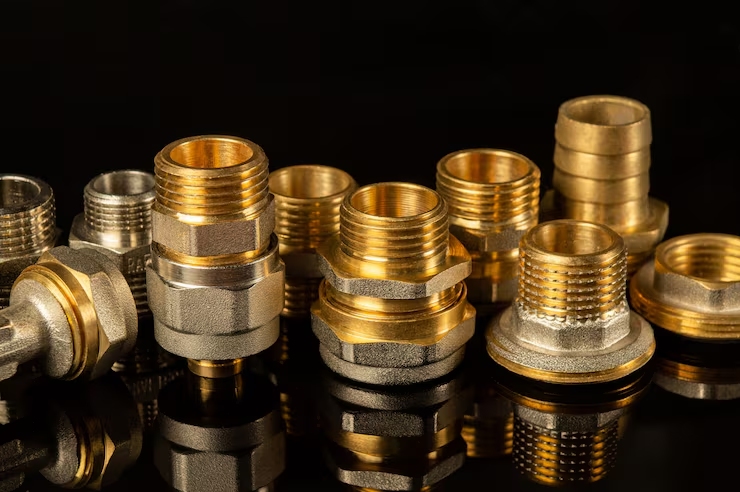
Brass components form the backbone of countless industrial systems across the globe. From plumbing fixtures in residential buildings to precision-engineered parts in aerospace equipment, brass alloys deliver a unique combination of durability, corrosion resistance, and machinability that few other metals can match. With the global brass market projected to grow significantly through 2030, understanding the fundamentals of brass components has become essential for procurement managers, engineers, and business owners who rely on these versatile metal parts.
This comprehensive guide covers everything you need to know about brass components — from the metallurgy behind different brass alloys to the manufacturing processes that shape raw material into precision parts. Whether you are sourcing components for electrical systems, plumbing infrastructure, or automotive applications, this resource will help you make informed decisions and identify the right manufacturing partner.
What Are Brass Components?
Brass components are machined, forged, cast, or extruded parts made from brass — an alloy primarily composed of copper and zinc. The ratio of copper to zinc determines the specific properties of each brass grade, including its tensile strength, ductility, and resistance to corrosion. Common brass alloys used in component manufacturing include CZ121 (free-cutting brass), CZ112 (naval brass), and C36000 (free-machining brass), each suited to different industrial demands.
The versatility of brass makes it an ideal material for producing threaded fittings, inserts, electrical terminals, fasteners, turned parts, cable glands, valves, and hundreds of other specialized components. Unlike steel or aluminum, brass does not generate sparks upon impact, making it safe for use in explosive environments. Additionally, brass exhibits excellent thermal and electrical conductivity, which is why it remains the preferred choice for electrical connectors and heat exchangers worldwide.
Brass Alloy Composition & Common Grades
All brass alloys contain copper and zinc as the primary elements. However, the exact ratio — along with trace additions of lead, tin, aluminum, silicon, or nickel — determines the alloy's grade and suitability for specific applications.
How Alloy Composition Affects Performance
Increasing the copper content improves corrosion resistance and electrical conductivity but reduces strength. Adding more zinc improves tensile strength and hardness but can make the alloy more brittle. Small additions of lead (0.5–3.5%) dramatically improve machinability — this is why "free-cutting brass" is the most popular grade for precision turned components.
| Brass Grade | Composition | Key Properties | Common Uses |
|---|---|---|---|
| C36000 (Free-Cutting) | 61.5% Cu, 35.5% Zn, 3% Pb | Best machinability, good strength | Screw-machine parts, fittings, valves |
| C26000 (Cartridge Brass) | 70% Cu, 30% Zn | Excellent ductility, cold working | Cartridge cases, radiator cores, hardware |
| C28000 (Muntz Metal) | 60% Cu, 40% Zn | High strength, hot workable | Architecture, marine hardware |
| C46400 (Naval Brass) | 60% Cu, 39.25% Zn, 0.75% Sn | Superior seawater corrosion resistance | Marine shafts, turnbuckles |
| C38500 (Architectural Bronze) | 57% Cu, 40% Zn, 3% Pb | Good hot forging, decorative finish | Hinges, lock hardware, door fittings |
| C23000 (Red Brass) | 85% Cu, 15% Zn | High corrosion resistance, reddish tone | Plumbing pipe, fire sprinklers |
Key Types of Brass Components
Brass Turned Parts
Precision brass turned parts are manufactured using CNC lathes and automatic screw machines. These include pins, bushings, couplings, adapters, and connectors. Turned parts require tight tolerances, often within plus or minus 0.01 mm, and are used extensively in electrical, automotive, and instrumentation industries.
Brass Fittings and Hose Fittings
Brass fittings encompass a broad family of connectors, including elbows, tees, couplings, nipples, and hose barbs. Hose fittings specifically connect flexible hoses to rigid pipe systems and are critical in hydraulic, pneumatic, and fluid transfer applications. Their resistance to dezincification ensures long service life even in aggressive water conditions.
Brass Cable Glands
Cable glands are mechanical devices that attach and secure the end of an electrical cable to equipment. Brass cable glands provide excellent EMI/RFI shielding, IP-rated ingress protection, and are available in metric, PG, and NPT thread configurations. Industries such as oil and gas, marine, and telecommunications rely heavily on these components.
Brass Fasteners
Brass fasteners include screws, bolts, nuts, washers, and threaded rods. They are preferred in applications requiring non-magnetic properties, aesthetic appeal, or corrosion resistance. The electrical and electronics industries consume large volumes of brass fasteners for panel assembly and terminal connections.
Brass Inserts
Molding inserts, CPVC inserts, and PPR inserts are embedded into plastic housings to provide durable internal threads. These inserts eliminate the cracking and stripping problems associated with threading directly into plastic. Brass inserts are indispensable in the plumbing, HVAC, and consumer electronics sectors.
Manufacturing Processes for Brass Components
The production of brass components involves multiple specialized processes. The choice of process depends on the complexity of the part, the production volume, and the required tolerances.
-
Extrusion: Brass billets are heated and forced through a die to create rods, bars, and profiles of various cross-sections. Extrusion provides excellent dimensional consistency and is the starting point for most turned components.
-
CNC Machining: Computer Numerical Control machines remove material from extruded rods or forgings to create precise geometries. Multi-axis CNC turning centers can produce complex parts with minimal human intervention.
-
Forging: Hot or cold forging shapes brass into near-net-shape components using compressive forces. Forged brass parts exhibit superior grain structure and mechanical strength compared to cast alternatives.
-
Casting: Sand casting and die casting are used for larger or more complex components where machining alone would be inefficient.
-
Stamping and Pressing: Sheet brass is stamped into flat or three-dimensional shapes for electrical terminals, contact strips, and decorative hardware.
Industrial Applications of Brass Components
-
Electrical and Electronics: Brass pins, sockets, terminals, and connectors ensure reliable current flow in switchgear, distribution boards, and consumer electronics.
-
Plumbing and HVAC: Valves, fittings, and inserts made from dezincification-resistant brass alloys withstand years of exposure to water and chemical treatments.
-
Automotive and Aerospace: Precision-turned brass parts serve as bushings, sensor housings, and fluid connectors in engines, transmissions, and avionics systems.
-
Oil and Gas: Explosion-proof cable glands, flanges, and valve components made from brass ensure safety in hazardous zone installations.
-
Telecommunications: Brass connectors and grounding components maintain signal integrity in data infrastructure and antenna systems.
How to Choose the Right Brass Component Manufacturer
-
In-House Capabilities: Manufacturers with integrated casting, extrusion, forging, and CNC machining can control quality at every stage and respond quickly to custom orders.
-
Quality Certifications: ISO 9001:2015 certification indicates a robust quality management system. Additional certifications such as IATF 16949 for automotive add further assurance.
-
Material Traceability: Reputable manufacturers maintain complete traceability from raw brass ingots through finished parts, providing mill test certificates and material composition reports.
-
Export Experience: Manufacturers with documented export experience understand packaging, documentation, and logistics requirements for global shipments.
-
Capacity and Lead Times: Facilities with multiple CNC machines and high extrusion capacity can handle both prototype and bulk orders efficiently.
Why Jamnagar Is the Global Hub for Brass Components
Jamnagar, located in Gujarat, India, has earned the title of the Brass City of the World. The city hosts over 5,000 brass manufacturing units that collectively produce a significant share of the world's brass components. Leading manufacturers in Jamnagar, such as Anand Brass Components, operate integrated facilities that encompass casting, extrusion, forging, machining, and coating under one roof.
Anand Brass Components, established in 1991, serves clients across India, the USA, the UK, and other international markets from its 15,000 sq ft GIDC Phase-III facility. With in-house extrusion capacity of 2 tons per day for rod diameters from 2 mm to 50 mm, the company offers complete control over the manufacturing process from raw material to finished product.
Frequently Asked Questions
Q: What makes brass better than steel for certain components?
Brass offers superior corrosion resistance, better machinability, non-sparking properties, and excellent electrical conductivity compared to steel. It is preferred where these properties outweigh the need for higher tensile strength.
Q: What is the typical lead time for custom brass components?
Standard turned parts can be produced in 2-4 weeks, while complex forged or custom-designed components may require 6-8 weeks including tooling development.
Q: How do I verify quality from overseas manufacturers?
Request ISO certification, material test certificates (EN or ASTM), and consider third-party inspection services such as SGS or Bureau Veritas before shipment.
Q: What brass alloys are most commonly used?
CZ121 free-cutting brass, C36000 free-machining brass, CZ112 naval brass, and C27200 yellow brass are the most commonly used alloys.
Q: Can brass components be customized to specific drawings?
Yes, most manufacturers offer full custom CNC machining from CAD drawings with tolerances as tight as plus or minus 0.005 mm.
