
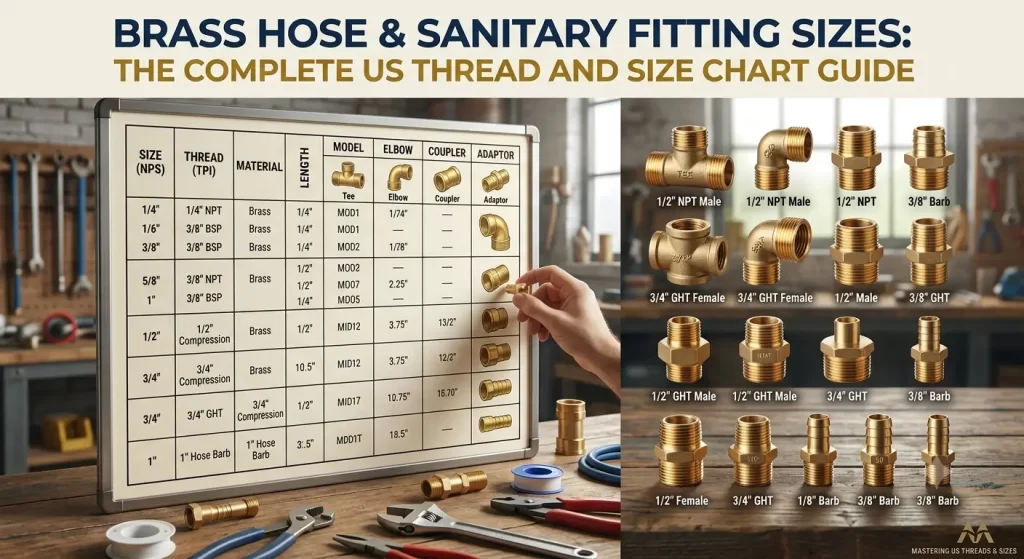
Brass Hose & Sanitary Fitting Sizes: The Complete US Thread and Size Chart Guide
💡 Quick Answer
Brass hose and sanitary fittings sold in the United States use five thread systems that look similar but do not interchange: NPT (tapered pipe thread, ASME B1.20.1), NPSM/NPSH (straight pipe threads sealed by gasket), GHT/NH (garden hose thread, 3/4–11.5NH per ASME B1.20.7), NST/NH (fire hose thread) and SAE 45° flare (UNF threads per SAE J512/J513).
The most expensive mistake in the trade is assuming 3/4″ garden hose thread and 3/4″ NPT are the same. They are not: GHT is straight with a 1.0625″ major diameter at 11.5 TPI and seals on a rubber washer, while 3/4″ NPT is tapered with a 1.050″ outside diameter at 14 TPI and seals on the threads themselves. This guide gives the full size charts, an identification method for unknown fittings, and the sizing rules for hose barbs and compression ends.
Table of Contents
- Why Fitting Sizes Cause So Many Problems
- The Five Thread Systems on US Brass Fittings
- NPT Size Chart (ASME B1.20.1)
- Garden Hose Thread (GHT/NH) Explained
- NPSH and NST: The Hose Threads People Confuse
- SAE 45° Flare Size Chart
- Sizing Hose Barbs and Compression Ends
- How to Identify an Unknown Brass Fitting
- Five Sizing Mistakes That Cost US Buyers Money
- How Anand Brass Components Supports US Buyers
- Frequently Asked Questions
Why Fitting Sizes Cause So Many Problems
Brass fitting sizing is counter-intuitive by design. A “1/2 inch” NPT fitting does not measure half an inch anywhere on the part — its outside diameter is 0.840″. A “3/4 inch” garden hose fitting is a completely different thread from a “3/4 inch” pipe fitting. And a hose barb marked 3/8″ refers to the inside diameter of the hose it fits, not the thread on the other end.
These conventions are historical rather than logical, but they are firmly fixed in American practice, and every distributor, contractor and OEM buyer works within them. At Anand Brass Components we machine to all of these systems for US customers, and the single most common cause of a rejected first article is a thread specified by nominal name alone without the standard behind it.
This guide is the reference we wish every enquiry arrived with.
The Five Thread Systems on US Brass Fittings
- NPT (ASME B1.20.1) : Tapered pipe thread. Seals on thread flank interference, usually with PTFE tape or pipe dope. The US default for plumbing, gas and industrial fittings.
- NPSM / NPSH : Straight pipe threads with the same pitch as NPT of the same nominal size. They do not seal on the thread — a gasket or O-ring does the work.
- GHT / NH (ASME B1.20.7) : Garden hose thread. Straight, coarse, sealed by the rubber washer inside the female coupling.
- NST / NH : National Standard fire hose thread. Straight, gasket-sealed, and deliberately non-interchangeable with pipe thread.
- SAE 45° Flare (J512 / J513) : UNF straight threads with a 45-degree flared tube seat. Standard in refrigeration, gas appliance and automotive fluid lines.
The BSP trap. India, the UK, Europe and most of Asia use BSP threads (ISO 228 / ISO 7). At 1/2″ and 3/4″ the two systems share the same 14 TPI, so a BSP male will start into an NPT female — but the 55° Whitworth form against NPT’s 60° means the joint will never seal properly. Always state NPT or BSP explicitly on the drawing — never just “1/2 inch thread”.
NPT Size Chart (ASME B1.20.1)
NPT sizes are named after an obsolete iron pipe bore, so the nominal size never matches a measurable dimension. Measure the outside diameter of the male thread and match it to this table.
| Nominal Size | Male Thread OD (in) | Threads Per Inch | Typical Use |
|---|---|---|---|
| 1/8″ | 0.405 | 27 | Gauges, instrumentation, small ports |
| 1/4″ | 0.540 | 18 | Air lines, small hose barbs, valves |
| 3/8″ | 0.675 | 18 | Fuel and coolant lines, adapters |
| 1/2″ | 0.840 | 14 | General plumbing, supply connectors |
| 3/4″ | 1.050 | 14 | Hose bibbs, main supply, irrigation |
| 1″ | 1.315 | 11.5 | Service lines, larger valve bodies |
| 1-1/4″ | 1.660 | 11.5 | Commercial supply and distribution |
| 1-1/2″ | 1.900 | 11.5 | Pump and tank connections |
| 2″ | 2.375 | 11.5 | Industrial and municipal lines |
Garden Hose Thread (GHT/NH) Explained
GHT — formally 3/4–11.5NH under ASME B1.20.7 — is the thread on every domestic garden hose, spigot, sprinkler and washdown coupling in the United States. It is a single dominant size, straight rather than tapered, and it seals on the rubber washer sitting in the female end.
| Property | GHT (3/4–11.5NH) | 3/4″ NPT |
|---|---|---|
| Thread form | Straight (parallel) | Tapered 1:16 |
| Major diameter | 1.0625″ (1-1/16″) | 1.050″ |
| Threads per inch | 11.5 | 14 |
| Sealing method | Rubber washer | Thread interference + sealant |
| Hand-tight? | Yes, by design | No, requires a wrench |
GHT and 3/4″ NPT are not compatible. The major diameters differ by only 0.0125″ and both are called “three-quarter inch”, which is why they get mixed up constantly. Count the threads over one inch: 11.5 means garden hose, 14 means pipe. Use a GHT×NPT adapter to cross between them.
NPSH and NST: The Hose Threads People Confuse
Two more straight hose threads appear on US brass fittings, and both are regularly mistaken for NPT.
NPSH — National Pipe Straight Hose
NPSH carries the same threads per inch as NPT of the same nominal size but is straight, and it seals on a gasket. The compatibility is asymmetric and worth memorising: a female NPSH coupling will accept both NPSH and NPT male threads, but a male NPSH will not thread into a female NPT. It appears on washing machine connections, pump ports and industrial washdown hose.
NST / NH — National Standard Fire Hose Thread
NST is the fire service thread used on hydrants, fire hose and fire department connections. It is straight, gasket-sealed, and intentionally incompatible with pipe thread so that emergency equipment cannot be cross-connected by mistake. If a fitting is 1-1/2″ or 2-1/2″ with a very coarse straight thread, suspect NST before NPT.
SAE 45° Flare Size Chart
SAE 45-degree flare fittings seal metal-to-metal on a flared tube end rather than on the thread. They are named by tube outside diameter, not by thread size, which is another common source of ordering errors.
| Tube OD | Dash Size | Thread (UNF) | Male Thread OD (in) |
|---|---|---|---|
| 1/8″ | -2 | 5/16–24 | 0.31 |
| 3/16″ | -3 | 3/8–24 | 0.38 |
| 1/4″ | -4 | 7/16–20 | 0.44 |
| 5/16″ | -5 | 1/2–20 | 0.50 |
| 3/8″ | -6 | 5/8–18 | 0.63 |
| 1/2″ | -8 | 3/4–16 | 0.75 |
| 5/8″ | -10 | 7/8–14 | 0.88 |
| 3/4″ | -12 | 1-1/16–14 | 1.06 |
| 1″ | -16 | 1-3/8–12 | 1.38 |
Note the collision at 1-1/16″: a 3/4″ SAE flare male and a GHT male share almost the same major diameter. The thread pitch separates them — 14 TPI for the flare, 11.5 TPI for garden hose.
Sizing Hose Barbs and Compression Ends
Hose Barbs Are Sized by Hose Inside Diameter
A 3/8″ brass hose barb is designed to be pushed into hose with a 3/8″ inside diameter. The barb’s own outside diameter is deliberately slightly larger so the hose stretches over the ridges and grips. The pipe thread on the opposite end is a separate specification and does not have to match — a 3/8″ barb with 1/4″ NPT is a perfectly normal part.
Always secure a barbed joint with a clamp sized to the hose outside diameter. Worm-drive clamps suit low-pressure water; ear or crimp clamps give a more even, tamper-resistant seal on higher-pressure lines.
Compression Fittings Are Sized by Tube Outside Diameter
A “1/2 inch” compression fitting accepts tube with a 1/2″ outside diameter. The ferrule crushes onto the tube wall as the nut is tightened, which means the tube must be cut square, deburred and fully bottomed in the fitting before tightening. Compression ends are common on angle stops, supply connectors and instrument lines.
Specify both ends. Most brass hose and sanitary fittings are adapters, so a complete part call-out needs both connections: for example “3/8″ hose barb × 1/4″ NPT male, lead-free brass, natural finish.” Naming only one end is the fastest route to a wrong shipment.
How to Identify an Unknown Brass Fitting
When a sample arrives without a drawing, work through these five steps in order.
- Step 1 — Straight or tapered? : Lay a straight edge along the thread crests. Visible taper means NPT or BSPT; parallel crests mean NPSM, NPSH, GHT, NST or a flare thread.
- Step 2 — Measure the major diameter : Use calipers across the thread crests on a male, or across the roots on a female. Record to three decimal places.
- Step 3 — Count the threads per inch : A thread pitch gauge is fastest, but counting crests across a measured inch works. This is what separates GHT from NPT at the same nominal size.
- Step 4 — Check the seat : A 45-degree cone means SAE flare. A flat face with a groove means a gasket seal, so NPSH or NST. No seat at all points to a tapered thread seal.
- Step 5 — Match against the charts above : Diameter plus TPI plus seat type identifies the thread uniquely in almost every case.
Five Sizing Mistakes That Cost US Buyers Money
- Ordering “3/4 inch” without a standard : The supplier may cut 3/4″ NPT, 3/4″ BSP or 3/4″ GHT. All three are legitimate readings of the same words.
- Assuming barb size equals thread size : They are independent. State both ends of every adapter.
- Confusing tube OD with pipe nominal size : A 1/2″ compression fitting and a 1/2″ NPT fitting share nothing dimensionally.
- Sealing a straight thread with tape : PTFE tape will not rescue an NPSH or GHT joint. Those need the correct washer or gasket.
- Skipping the first article : Test-fit against your own mating parts before authorising bulk production. It is the cheapest insurance in the process.
How Anand Brass Components Supports US Buyers
Anand Brass Components manufactures and exports precision brass hose fittings and brass plumbing fittings from Jamnagar, Gujarat, cut and gauged to American thread standards rather than converted from BSP tooling.
- Calibrated US Thread Gauges : Traceable NPT and GHT ring and plug gauges on every production run.
- Custom CNC Machining : Adapters, barbs, couplings and sanitary fittings to your drawing and thread class.
- Lead-Free Alloy Capability : Segregated production for potable-water parts — see our lead-free brass guide.
- Documented Inspection : Dimensional reports, gauge certificates and quality approvals with every shipment.
- First Article Samples : Supplied and test-fitted before any bulk run is authorised.
Send us a drawing, a sample or simply the two end specifications and we will confirm the thread before quoting. Contact Anand Brass Components or request a custom quotation.
📌 Key Takeaways
- NPT nominal sizes never match a measurable dimension — always work from OD and TPI.
- GHT is 3/4–11.5NH, straight, 1.0625″ major diameter, and seals on a rubber washer.
- 3/4″ NPT is 1.050″ at 14 TPI and is not interchangeable with garden hose thread.
- Female NPSH accepts NPT male, but male NPSH will not enter a female NPT.
- NST fire hose thread is intentionally incompatible with pipe thread.
- SAE 45° flare fittings are named by tube OD, not by thread size.
- Hose barbs are sized by hose ID; compression fittings by tube OD.
- Every adapter call-out needs both ends specified, plus the standard by name.
Industry Standards & Resources
The primary standards referenced in this guide:
- ASME B1.20.1 — Pipe Threads, General Purpose (Inch)
The defining standard for NPT and NPSM threads. - ASME B1.20.7 — Hose Coupling Screw Threads
Covers hose coupling threads including garden hose thread, 1/2″ to 4″. - SAE Standards — J512 and J513
Automotive and refrigeration tube fitting specifications for 45-degree flare. - NSF — Safe Drinking Water Act Requirements
The 0.25% lead-free rule that applies to any potable-water fitting sold in the US.
Frequently Asked Questions
Need Brass Hose or Sanitary Fittings Cut to US Threads?
Anand Brass Components manufactures and exports precision brass hose fittings, sanitary fittings and adapters from Jamnagar, India — machined to NPT, GHT, NPSH and SAE flare standards, with lead-free alloy capability, calibrated thread gauging and documented inspection on every order.
Contact Anand Brass Components → Explore Brass Hose Fittings
Related Articles
- Lead-Free Brass Components: Complete Guide to NSF 61, NSF 372 & Drinking Water Standards
- DZR Brass vs Standard Brass: Choosing the Best Plumbing Material
- How to Import Brass Components from India to the USA: 2026 Sourcing Guide
- 7 Key Differences Between Brass Forging and Brass Casting
- Precision and Durability: Why Our Brass Hose Fittings Are the Best in the USA
- Anand Brass Components — Brass Parts Manufacturer & Exporter, Jamnagar