
💡 Quick Answer
To verify a brass manufacturer in Jamnagar, check four things in order: legal identity (IEC on the DGFT portal, GSTIN on the GST portal, company or Udyam registration), factory reality (a live unscripted video walkthrough, a machine list, and an address that matches the GST record), technical capability (calibrated thread gauges, alloy mill test certificates, in-house or documented plating and testing) and commercial structure (staged payment terms, clear Incoterms, and an approved first article sample before bulk).
All the legal checks are free and take about twenty minutes on Indian government portals. The single most valuable question you can ask is one a trading house cannot answer: “which machine will run this part, and what is its bar capacity?”
Table of Contents
- Why Verification Matters in Jamnagar
- Manufacturer or Trading House?
- The 12-Point Verification Checklist
- Verify the Paperwork Yourself (Free)
- What a Real Factory Walkthrough Shows
- Red Flags That Should Stop the Order
- Payment Terms and Incoterms That Protect You
- Third-Party Inspection: When It Pays
- How Anand Brass Components Meets This Checklist
- Frequently Asked Questions
Why Verification Matters in Jamnagar
Jamnagar’s strength is also the thing that makes it confusing to buy from. The city holds thousands of brass units across foundries, extrusion plants, machine shops and electroplating lines, and that fragmentation is exactly what gives Indian brass its price and flexibility advantage. But it also means the entity quoting you may be three steps removed from the machine that will actually cut your part.
That is not automatically a problem. Good trading houses exist and add real value in consolidation and logistics. The problem is not knowing which one you are dealing with — because when a tolerance dispute arises, the party who cannot change the machine setting also cannot fix your problem.
This checklist is written from the manufacturing side. Anand Brass Components has been manufacturing in Jamnagar since 1991, and these are the questions we would want a serious US buyer to ask us.
Manufacturer or Trading House?
Most disputes trace back to one early mismatch: the buyer thought they were purchasing from the factory and were actually purchasing from a middleman. Four questions separate them quickly, and none of them are confrontational.
- “Which machine will run this part?” : A manufacturer names the machine type and bar capacity without hesitation. A trader changes the subject to price.
- “Can we do a live video call from the shop floor now?” : Real factories can walk outside and turn on a camera. Scheduling difficulties that stretch across weeks are informative.
- “What is your cycle time for this part?” : Cycle time is the language of a machine shop. A trader quotes only a delivery date.
- “Is plating in-house or subcontracted, and to whom?” : Either answer is acceptable. A refusal to answer is not.
A note on honesty. Plenty of legitimate Jamnagar manufacturers subcontract forging, plating or heat treatment — the cluster is built that way. What matters is whether the supplier tells you plainly and can name the subcontractor, not whether every operation sits under one roof.
The 12-Point Verification Checklist
Stage 1 — Legal Identity (free, about 20 minutes)
- 1. IEC verified on the DGFT portal : A ten-digit Importer Exporter Code issued by the Directorate General of Foreign Trade, and it must show as Active. Exporters must reconfirm their IEC profile every year between April and June or it is deactivated automatically.
- 2. GSTIN verified and matching : A fifteen-character code. Digits 1–2 are the state code — Gujarat is 24 — digits 3–12 are the PAN, and the rest are entity, a fixed “Z” and a checksum.
- 3. Company or Udyam registration : Private limited companies and LLPs appear on the MCA portal; smaller manufacturers register under Udyam as MSMEs.
- 4. Names match everywhere : The legal name on the IEC, the GSTIN, the invoice and the bank account must be the same entity. This one check prevents most payment fraud.
Stage 2 — Factory Reality
- 5. Live, unscripted video walkthrough : Not an edited showreel. Ask them to walk the floor while you watch.
- 6. Machine list with capacities : Number of CNC turning centres, multi-spindle automats, forging presses and their bar or tonnage capacity.
- 7. Address matches the GST record : Compare the address on the GST certificate with the one on the quotation and on satellite imagery.
- 8. Realistic monthly capacity : Ask for pieces per month on a part like yours, then sanity-check it against the machine count they just gave you.
Stage 3 — Technical Capability
- 9. Calibrated gauges and instruments : For US orders, traceable NPT and hose thread ring and plug gauges with current calibration certificates — see our brass hose fittings thread standards for why this matters.
- 10. Material traceability : Mill test certificates per lot, retained against the batch, plus segregated stock if you are ordering lead-free.
- 11. Documented inspection : A written plan covering dimensions, thread gauging, plating thickness and leak testing, with sample reports you can review before ordering.
Stage 4 — Commercial Structure
- 12. First article before bulk : An approved sample, physically test-fitted against your own mating parts, with written sign-off before the bulk run is authorised. Nothing else on this list matters if you skip it.
Verify the Paperwork Yourself (Free)
You do not need an agent for the legal checks. Indian government portals are public and free.
| What to Check | Where | What You Need | What Confirms It |
|---|---|---|---|
| IEC (export licence) | DGFT portal — Services > View Any IEC Details | IEC number + first three letters of the firm name | Status shows Active |
| GSTIN (tax registration) | GST portal — Search Taxpayer | 15-character GSTIN | Legal name, address and Active status |
| Company registration | MCA portal | Company or LLP name / CIN | Incorporation date and directors |
| MSME status | Udyam Registration portal | Udyam registration number | Enterprise type and activity |
Twenty minutes of checking is the cheapest insurance in the transaction. Every one of these portals is free, and a supplier who hesitates to share the numbers that appear on their own export invoices has told you something important.
What a Real Factory Walkthrough Shows
When you get the live call, look past the machines. These details are hard to stage.
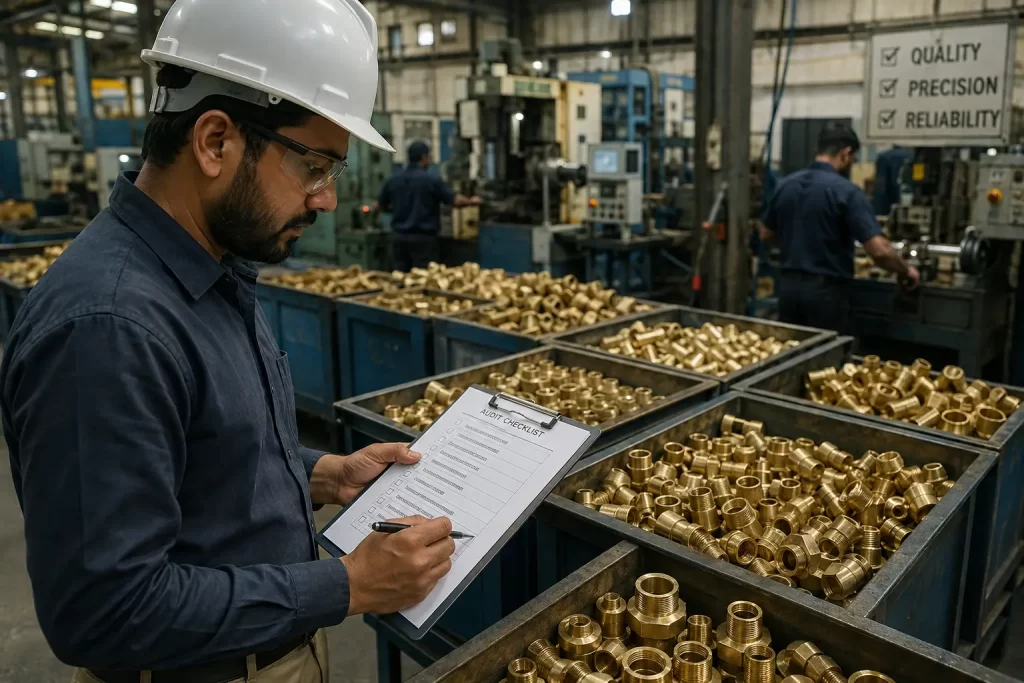
- Work in progress on the floor : Bins of half-finished parts, job cards, batch tags. An empty spotless shop mid-week is a warning, not a boast.
- The inspection area : Ask to see the gauges and the calibration stickers with dates. Ask them to gauge a part while you watch.
- Raw material storage : Brass rod bundles should carry heat or lot tags. For lead-free work, ask to see how that stock is kept separate.
- The plating line or the loading dock : If plating is subcontracted, ask them to show the outbound crates and name the plater.
- People : Operators at machines, a supervisor who knows the job numbers. Ask an unrehearsed question of someone other than your sales contact.
Red Flags That Should Stop the Order
- Bank account in a different name : Payment to any entity other than the verified legal name. This is the highest-severity flag on the list.
- Urgency pressure : “Copper is moving, confirm today”, “only one production slot left”. Metal prices do move — but a real factory will still be there next week.
- Pricing far below the market : Brass is a commodity with a transparent copper base. A quote well under everyone else usually signals a different alloy, thinner plating or an undeliverable promise.
- Free email and personal phones only : No company domain, no landline, no verifiable office.
- Refusal of a live video call : Recorded footage instead of a live floor walk, repeatedly.
- Evasive answers on subcontracting : Not the subcontracting itself — the evasiveness.
- No written inspection plan : “We check everything” is not a plan.
Payment Terms and Incoterms That Protect You
Structure the commercial terms so that neither side carries all the risk. Common arrangements in the Jamnagar brass trade look like this.
| Arrangement | How It Works | Best For |
|---|---|---|
| Staged TT | Advance on order confirmation, balance against a copy of the bill of lading | Established relationships, mid-size orders |
| Letter of Credit at sight | Bank releases payment against compliant shipping documents | Large first orders; bank fees are the trade-off |
| Payment after inspection | Balance released after a third-party inspection report is accepted | First orders with a new supplier |
| Small trial order first | A low-value run before committing to volume | Every new supplier relationship |
On Incoterms, be explicit. FOB Mundra or Nhava Sheva puts the goods on the vessel and hands you control of the freight; CIF includes freight and insurance to your port; DDP places customs clearance and the US import duty on the seller. Given the 18% reciprocal tariff rate set by the February 2026 India–US interim trade agreement, whoever carries the duty needs to have priced it — so name the Incoterm and the HTS classification in the purchase order rather than assuming.
Third-Party Inspection: When It Pays
An independent pre-shipment inspection typically costs a few hundred dollars per man-day — trivial against a container of unusable parts, and unnecessary overhead on a repeat order from a supplier you have audited yourself.
Use it when the order value is high, when it is your first shipment from a new supplier, when the parts are safety- or code-critical such as potable-water fittings, or when you cannot travel to inspect personally. Once a supplier has delivered several conforming shipments and you hold their documented inspection reports, most buyers step down to periodic spot checks.
How Anand Brass Components Meets This Checklist
Anand Brass Components has manufactured precision brass components in Jamnagar, Gujarat since 1991, exporting to customers across North America, Europe, the Middle East and Asia-Pacific.
- Verifiable Registration : IEC, GSTIN and company records available on request for independent verification.
- Live Factory Access : Video walkthroughs of the machine shop, inspection area and material store on request.
- In-House CNC Capability : Turning and machining centres with documented capacities — see our infrastructure.
- Documented Quality System : Inspection plans, gauge calibration and material traceability under our quality and approvals process.
- First Article Protocol : Samples supplied and approved in writing before any bulk run.
- Full Product Range : Sanitary and plumbing, hose fittings, inserts, cable glands, transformer parts and custom CNC components.
Run this checklist on us. Contact Anand Brass Components or request a quotation and ask for the documents in Stage 1 — we will send them.
📌 Key Takeaways
- Establish first whether you are dealing with a factory or a trading house — both are valid, but you must know which.
- IEC, GSTIN, MCA and Udyam checks are free, public and take about twenty minutes.
- Gujarat GSTINs begin with 24; the legal name must match the bank account exactly.
- “Which machine will run this part?” is the question a middleman cannot answer.
- Insist on a live, unscripted video walkthrough rather than edited footage.
- Subcontracting is normal in the Jamnagar cluster; evasiveness about it is not.
- Name the Incoterm and the HTS classification in the purchase order, not after shipment.
- Third-party inspection is worth it on first and high-value orders, less so once a record exists.
- Approve a first article against your own mating parts before authorising bulk production.
Industry Standards & Resources
Official portals and references for independent verification:
- DGFT Portal — View Any IEC Details
Verify an Indian exporter’s Importer Exporter Code and its active status. - GST Portal — Search Taxpayer
Confirm GSTIN, registered legal name, address and registration status. - MCA Portal — Company Master Data
Incorporation details for private limited companies and LLPs. - Udyam Registration Portal
MSME registration verification for smaller manufacturing units.
Frequently Asked Questions
Ready to Audit a Jamnagar Brass Manufacturer?
Anand Brass Components has manufactured and exported precision brass components from Jamnagar since 1991 — sanitary and plumbing fittings, hose fittings, inserts, cable glands, transformer parts and custom CNC components. Run the checklist on us: ask for the registrations, the machine list and a live factory walkthrough.
Related Articles
- Brass Manufacturers in Jamnagar: Why India’s Brass Capital Leads Global Manufacturing
- Top 10 Brass Industries in Jamnagar – Complete List of Leading Manufacturers 2026
- How to Import Brass Components from India to the USA: 2026 Sourcing Guide
- Jamnagar Brass Parts: Quality, Innovation and Global Supply Chain Excellence
- Best Brass Turned Parts from Jamnagar: The Complete Buyer’s Guide
- Anand Brass Components — Brass Parts Manufacturer & Exporter, Jamnagar