
⚡ Quick Answer
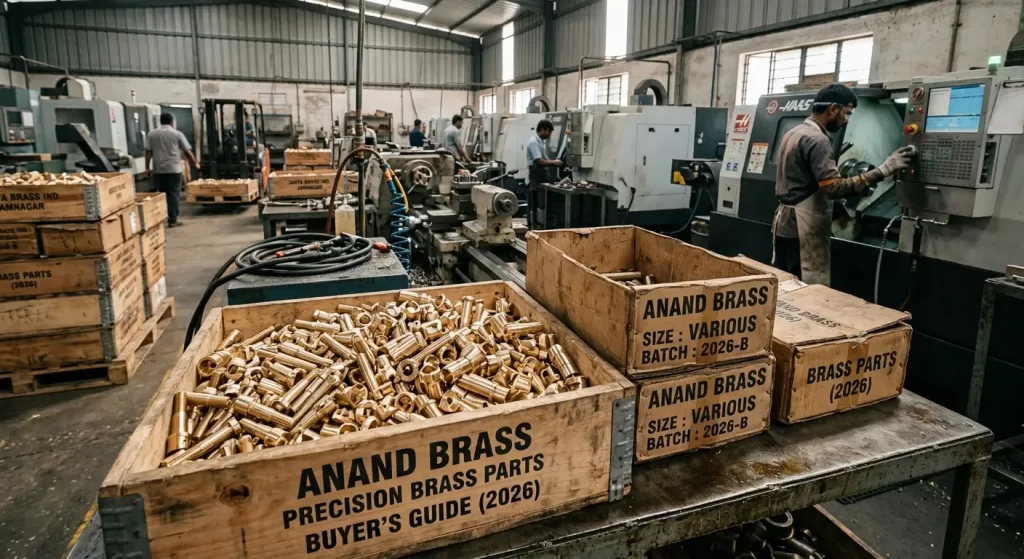
Brass turned parts are precision components made by rotating brass bar stock against cutting tools on a lathe to create cylindrical, threaded, or profiled shapes such as bushings, pins, inserts, connectors, and fittings. The world’s largest cluster for producing them is Jamnagar, India’s “Brass City,” where manufacturers like Anand Brass Components machine free-cutting alloys (CW614N / C36000 and lead-free grades) on CNC, Swiss-type, and multi-spindle lathes to tolerances as tight as ±0.01 mm. Sourcing Jamnagar brass parts gives buyers in the USA and worldwide a rare mix of precision, customization, and competitive pricing from a single integrated supply base.
If your product contains a small, precise brass component, a threaded insert, a connector pin, a valve part, a bushing, there is a very good chance it began as a length of brass bar on a lathe in Jamnagar. Brass turned parts are the quiet workhorses of modern manufacturing, and few places make them better or more cost-effectively than India’s brass capital. This guide explains what they are, how they are made, and how to source Jamnagar brass parts with confidence in 2026.
What Are Brass Turned Parts?
Brass turned parts, also called brass turned components or brass CNC-turned parts, are metal components produced by turning: holding a brass workpiece in a rotating lathe chuck or collet and feeding it against fixed cutting tools to remove material and form the desired shape. The result is a precise cylindrical, conical, threaded, or profiled component.
Typical brass turned parts include bushings, sleeves, spacers, standoffs, ferrules, pins, shafts, threaded inserts, connector terminals, nozzles, adaptors, and sensor housings. They range from miniature electronic contacts a millimeter wide to substantial fittings, and they are valued because brass combines excellent machinability, corrosion resistance, electrical conductivity, and an attractive finish in one material.
Turning is different from forging or casting. Forging shapes hot brass under pressure and suits high-strength, high-volume parts; casting pours molten brass into molds for complex geometries. Turning, by contrast, is the route to tight-tolerance round and threaded features with an excellent surface finish straight off the machine. Many finished components actually combine processes, a forged or cast blank that is then precision-turned, which is why an integrated manufacturer that does all three has a real advantage.
Why Jamnagar Leads in Brass Parts
Jamnagar, in the Indian state of Gujarat, is known worldwide as the “Brass City” and is home to the largest concentration of brass machining capacity on the planet. For anyone sourcing brass turned parts, Jamnagar is almost always the answer, and it is worth understanding why the city dominates:
- An Unmatched Cluster : Thousands of interconnected units, foundries, extrusion plants, CNC and Swiss machining shops, platers, and testing labs, sit side by side. That density means faster turnaround and deeper capability than isolated factories elsewhere.
- Generational Expertise : Decades of brass craftsmanship, now fused with modern CNC precision and metallurgy, give Jamnagar an engineering depth that is hard to replicate.
- Cost Efficiency : Shared infrastructure, local raw-material access, and scale keep Jamnagar brass parts competitively priced without cutting quality.
- Export Readiness : The leading manufacturers ship to the USA, Europe, and 30-plus countries every day, so compliance, documentation, and logistics are well understood.
Among the top brass industries in the city, Anand Brass Components is a vertically integrated, ISO 9001 certified manufacturer that turns this local advantage into reliable, export-ready components for buyers around the world.
Brass Alloys Used for Turned Parts
The alloy is the most important technical choice, because it determines machinability, strength, corrosion resistance, and regulatory compliance. The common grades for turned parts:
- CW614N / C36000 (The Workhorse) : Free-cutting leaded brass (CuZn39Pb3). Machinability rating of 100, the benchmark all metals are measured against. Fastest cutting, best finish, lowest cost. Ideal for high-volume screw-machine parts, electrical components, and inserts.
- CW617N (Higher Strength) : CuZn40Pb2, slightly higher zinc for stronger extruded or forged bar. Preferred for valve bodies, gas components, and parts needing extra mechanical strength.
- Naval Brass / C46400 (Marine Grade) : Better corrosion and dezincification resistance for marine and aggressive-water environments. Tougher to machine than free-cutting brass, but far more durable where it counts.
- Lead-Free Grades e.g. C69300 (Drinking Water) : Low-lead and lead-free alloys that meet NSF/ANSI 61 and 372 and California AB1953 for potable-water parts. Slightly harder to machine, but essential for US plumbing compliance.
Note that the popular Indian standard IS 319 corresponds to these free-cutting grades, and CW614N, CZ121 (UK), and C36000 (US) are functionally equivalent designations for essentially the same benchmark alloy. A good manufacturer will recommend the right grade for your application and supply certified material either way.
The Turning Process & Machines
Precision brass turning is done on three main platforms, chosen by part complexity and batch size:
- CNC Turning Centres : With live tooling, they handle complex, multi-feature parts and small-to-medium batches with full programmability.
- Swiss-Type (Sliding-Head) Lathes : The go-to for tiny, slender, ultra-precise components, common in electronics and instrumentation.
- Multi-Spindle Automatic Lathes : Deliver very high-volume production of simpler parts at low cost per piece.
A typical production flow runs: raw bar receipt and verification, CNC or Swiss machining, secondary operations (threading, drilling, milling, knurling), deburring and cleaning, optional plating, inspection (often CMM), and export packing. Brass’s clean chip-breaking behavior makes it faster and more forgiving than steel or stainless, which is a big part of why turned brass parts are so cost-effective.
That machinability advantage is not a small thing. Free-cutting brass cuts markedly faster than steel, produces short, easily cleared chips, and extends tool life, all of which lower the cost per part and improve consistency across long production runs. On multi-spindle automatics, a single machine can turn out finished parts in seconds, which is how Jamnagar keeps unit pricing competitive even on complex components.
Tolerances, Finishes & Quality
Precision is the whole point of a turned part. Here is what quality manufacturers routinely deliver:
- ±0.01 mm : Typical turned tolerance.
- 1–150 mm : Diameter range.
- Ra 0.8 : Achievable surface finish.
For even tighter needs, parts can be centreless- or cylindrically-ground after turning, reaching diameter tolerances near ±0.002 mm for critical fits like valve stems and gauging pins. Surface finishes and plating options include nickel, chrome, tin, zinc, and silver, plus polishing or clear lacquer. If parts are plated, it is important to specify whether tolerances apply before or after plating, since the coating adds thickness.
Quality comes from process discipline: first-piece inspection, in-process gauging, and final inspection, backed by material traceability and mill test certificates on every lot. That documentation is exactly what OEM and export buyers should insist on.
Applications & Industries
Brass turned parts appear in nearly every sector. The most common:
- Electrical & Electronics : Terminals, connector pins, contacts, threaded inserts, sensor housings.
- Plumbing & Sanitary : Fittings, adaptors, valve components, compression parts (lead-free where potable).
- Automotive : Fuel and brake fittings, bushings, sleeves, connectors.
- Pneumatics & Hydraulics : Ferrules, nozzles, spool components, couplings.
- Instrumentation & HVAC : Precision pins, standoffs, adaptors, fittings.
Because these parts are small, precise, and produced in volume, the reliability of the supplier compounds across thousands of pieces. One inconsistent lot can stop an assembly line, which is why sourcing from a proven Jamnagar manufacturer matters so much.
How to Source Jamnagar Brass Parts
Buying brass turned parts from Jamnagar is straightforward when you vet suppliers on the right criteria. Before placing an order, confirm:
- Certification and Traceability : ISO 9001 quality systems, mill test certificates, and RoHS/REACH or NSF lead-free documentation where the application needs it.
- In-House Machining : A manufacturer that owns its CNC, Swiss, and multi-spindle capacity, not a trader outsourcing your work.
- Engineering Support : The ability to take your 2D or 3D drawings and advise on alloy, tolerances, and finishing.
- Samples First : Pre-production samples approved before any bulk run.
- Export Experience : Proven shipping to your country with complete documentation and export-grade, ISPM-15 packaging.
US buyers should also confirm the correct HTS classification and current duties. For the full walkthrough on that, see our guide on how to import brass components from India to the USA.
On pricing, remember that the unit cost of a turned part is driven by its diameter and length, the alloy, the number of machining operations and secondary features, the tightness of tolerances, the finish or plating, and the order quantity. Sharing a clear drawing and a realistic annual volume upfront lets a manufacturer quote accurately and often unlock better pricing through blanket orders with scheduled call-offs.
Why Choose Anand Brass Components
Among the top brass industries in the city, Anand Brass Components checks every box this guide recommends for sourcing Jamnagar brass parts:
- Vertically Integrated Production : Casting, extrusion, forging, CNC and Swiss machining, and finishing under one roof in Jamnagar, for consistency and control.
- Full Alloy Range : From free-cutting CW614N / C36000 to lead-free NSF-compliant grades, matched to your application.
- Precision to ±0.01 mm : With multiple surface-finish and plating options, and grinding for critical fits.
- ISO 9001 Quality : With first-piece and in-process inspection, CMM verification, and mill certs on every lot.
- Custom Manufacturing : From your drawings, in low or high volume, with responsive engineering support.
- Proven Export Delivery : To the USA and 30-plus countries, with complete documentation and export-grade packaging.
The result is precision brass turned parts, made in the heart of India’s brass capital, delivered through one dependable partner who already understands global compliance.
Industry Standards & Resources
Understanding brass turning standards can help buyers make informed decisions when sourcing Jamnagar brass parts.
- Review free-cutting brass rod specifications at
ASTM International (ASTM B16) - Learn about copper alloy data through
Copper Development Association - Check lead-free certification requirements from
NSF International
🎯 Key Takeaways
- Turning Is a Subtractive Process : Brass bar is rotated against a tool to cut precise round, threaded, or profiled parts.
- Alloy Drives Everything : Free-cutting CW614N / C36000 machines fastest; lead-free grades meet drinking-water rules.
- Jamnagar Is the Global Hub : The densest cluster of brass machining capacity on earth, and the reason for its cost and lead-time edge.
- Precision Is Routine : CNC and Swiss lathes hold tolerances to ±0.01 mm with excellent surface finish.
- Supplier Quality Matters Most : Look for ISO 9001, mill certs, and export experience when buying brass turned parts Jamnagar.
Frequently Asked Questions
This article is general technical and sourcing information, not engineering or compliance advice. Alloy selection, tolerances, and regulatory requirements (such as lead-free drinking-water standards) depend on your specific application. Confirm material grades and certifications with your manufacturer, and verify any US import classification and duties with a licensed customs broker before ordering.
Need Precision Brass Turned Parts From Jamnagar?
Send us your drawing or sample. Anand Brass Components will recommend the right alloy, machine your parts to spec, and deliver export-ready to the USA and worldwide.
Related Articles
- How to Import Brass Components from India to the USA (2026) — anandbrass.com/import-brass-components-from-india-to-usa
- Brass Components: The Complete Guide to Types & Applications — anandbrass.com/brass-components-the-complete-guide-to-types-applications-and-manufacturing-excellence
- Why Anand Brass Is a Leading Brass Manufacturer & Exporter — anandbrass.com/why-anand-brass-components-are-leading-brass-manufacturer-exporter