
⚡ Quick Answer
US Brass Fitting Thread Standards are the critical specifications that determine whether two hose fittings, connectors, or adapters will safely join. Five distinct thread systems dominate the American market: NPT (National Pipe Thread, tapered), NPSM/NPSH (straight pipe threads sealed by gasket), GHT/NH (garden hose thread), NST/NH (fire hose thread), and SAE 45° flare (automotive and refrigeration fittings).
The most costly mistake in brass fitting specification is assuming that 3/4″ garden hose thread and 3/4″ NPT are interchangeable. They are not. GHT is a straight thread with a 1.0625″ major diameter at 11.5 TPI that seals on a rubber washer, while 3/4″ NPT is a tapered thread with a 1.050″ outside diameter at 14 TPI that seals on the threads themselves. This guide provides complete size charts for all five systems, practical identification methods for unknown fittings, and the correct sizing rules for hose barbs and compression ends.
Why Fitting Sizes Cause So Many Problems
Brass hose fittings, adapters, and sanitary connectors are manufactured to five entirely different thread specifications in North America. While they may look similar at a glance, they do not interchange. A 3/4″ NPT male fitting will not enter a 3/4″ GHT female port without breaking one or both pieces.
The confusion occurs because nominal sizes (1/4″, 3/8″, 1/2″, 3/4″, etc.) are used across multiple systems, but they do not represent the same actual dimensions. In NPT, the nominal size is entirely decorative—it does not predict any measurable part of the thread or the overall diameter. This leads buyers to assume all 3/4″ brass fittings are equivalent.
The result is costly: threaded adapters are purchased and found not to fit, designs must be revised, components are scrapped, shipments are delayed, and trust in suppliers erodes.
Understanding which of the five systems applies to your application, verifying the exact dimensions of unknown fittings, and always specifying both ends of an adapter by standard name and dimension are the three practices that prevent these errors.
The Five US Thread Systems Explained
Each of these five systems was developed to solve a specific problem in plumbing, hydraulics, fire protection, or refrigeration. Each uses different thread angles, pitch, sealing methods, and purpose-built components.
1. NPT (National Pipe Thread) – ASME B1.20.1
NPT is the most common tapered thread standard for plumbing and low-pressure hydraulic applications. The thread tapers at a standard rate of 1 inch per 16 inches of length (0.0625 inches per inch). As the male fitting is screwed into the female, the thread flanks compress and create a seal directly on the thread surfaces.
NPT nominal sizes are not real dimensions. A “1/2 inch NPT” male thread does not have a 1/2 inch major diameter. The actual outside diameter of a 1/2″ NPT male is 0.840 inches at the first complete thread, measured 0.0625 inches below the thread crest. The pitch is 14 threads per inch for sizes 1/8″ through 1 inch.
NPT requires PTFE (thread seal) tape, pipe dope, or both to create a reliable seal. The threads cut into the male fitting are the sealing surfaces—no gasket or washer is used.
2. GHT (Garden Hose Thread) – ASME B1.20.7
Garden hose thread is the standard for 3/4″ hose couplers, spigot fittings, sprinkler adapters, and nozzles throughout North America. GHT is a straight thread (not tapered) with a pitch of 11.5 threads per inch. The 3/4″ GHT standard calls for a major diameter of 1.0625 inches.
GHT seals on a rubber washer seated inside the female port, not on the threads themselves. No PTFE tape or dope is required and should not be used—tape prevents the washer from seating properly and creates leaks.
GHT is available in sizes 1/2″, 3/4″, 1″, 1.25″, 1.5″, 2″, and 4″, each with its own major diameter and thread count per ASME B1.20.7. The 3/4″ size is by far the most common and is often referred to simply as “garden hose thread” or “3/4 NH.”
3. NPSM and NPSH (Straight Pipe Threads)
NPSM (Straight Pipe Thread, Mechanical) and NPSH (Straight Pipe Thread for Hydraulic) are straight-thread alternatives to tapered NPT. Both use the same pitch as NPT but are cut straight (parallel) rather than tapered. The difference between NPSM and NPSH is negligible for practical purposes—NPSH is slightly more refined for high-pressure hydraulic work.
Straight pipe threads seal on a gasket, O-ring, or flat face seated inside the fitting port. PTFE tape should not be used on straight threads.
A critical compatibility rule: A female NPSH port will accept a male NPT fitting because the taper on the male NPT will bite into the straight female and create a seal. However, a male NPSM or NPSH fitting will not enter a female NPT port—the straight male cannot generate the compression seal that tapered threads require.
4. NST and Fire Hose Thread
NST (National Standard Thread) is used exclusively for fire hose couplers and standpipes. The thread pitch is 7.5 TPI (threads per inch), and the thread angle is non-standard. NST threads are intentionally incompatible with NPT to prevent confusion on emergency equipment.
Fire hose couplers seal with a rubber gasket and require a tight, hand-tight fit. Over-tightening can damage the gasket and create leaks.
5. SAE 45° Flare Fittings – SAE J512 and J513
SAE 45° flare fittings are named by the outside diameter of the tubing they accept, not by thread size. A 1/4″ SAE flare fitting couples to tubing with a 1/4″ outside diameter (OD). The sealing surface is a 45-degree cone on the tube end, not a thread.
SAE flare fittings are common in automotive fuel systems, refrigeration, and low-pressure hydraulic lines. They are inherently leak-resistant and are easy to disassemble, making them popular in applications where periodic service is needed.
NPT Size Chart and Specifications
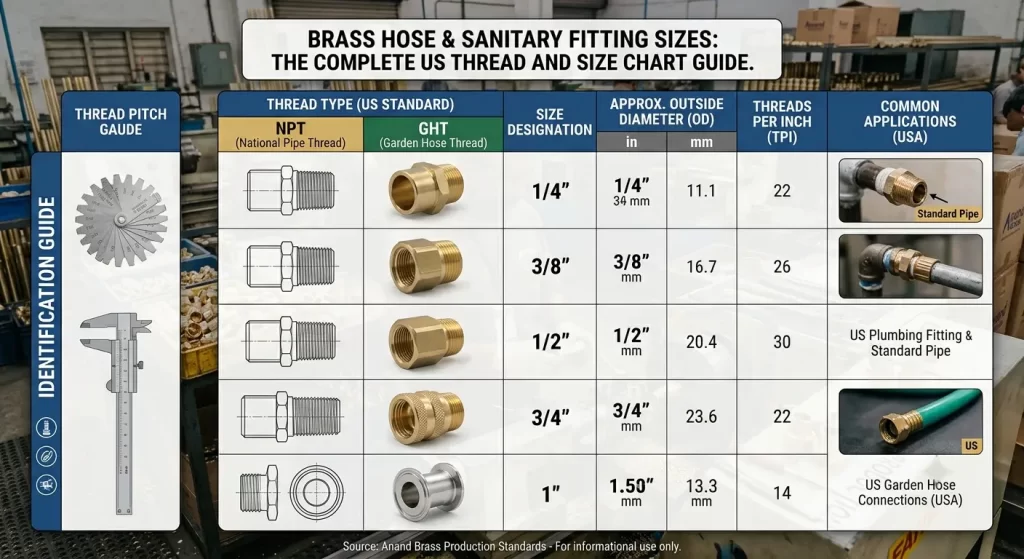
This chart shows the five most common NPT sizes. The “nominal” size (1/4″, 1/2″, etc.) is listed first, but always work from the actual measured OD and TPI when verifying or ordering fittings.
| Nominal Size | OD at 1st Thread (inches) | TPI | Pitch (inches) | Seal Method |
|---|---|---|---|---|
| 1/8″ | 0.405 | 27 | 0.037 | Thread compression + tape/dope |
| 1/4″ | 0.540 | 18 | 0.056 | Thread compression + tape/dope |
| 3/8″ | 0.675 | 18 | 0.056 | Thread compression + tape/dope |
| 1/2″ | 0.840 | 14 | 0.071 | Thread compression + tape/dope |
| 3/4″ | 1.050 | 14 | 0.071 | Thread compression + tape/dope |
| 1″ | 1.315 | 11.5 | 0.087 | Thread compression + tape/dope |
Key points for NPT: Nominal size is meaningless—always specify by actual OD. The thread is tapered at 1:16 (0.0625 per inch), so threads near the port entrance are larger in diameter. The pitch (distance between threads) varies by size, so never assume you can interchange sizes based on TPI alone.
Garden Hose Thread (GHT) Size Chart
Garden hose thread, also called hose coupling thread or NH (National Hose thread), is standardized by ASME B1.20.7. All sizes use straight threads and seal on a rubber washer.
| Size Designation | Major Diameter (inches) | TPI | Common Applications |
|---|---|---|---|
| 1/2″–11NH | 0.8438 | 11 | Small diameter hoses, sprinkler systems |
| 3/4″–11.5NH | 1.0625 | 11.5 | Standard garden hoses, spigots, nozzles (universal in North America) |
| 1″–11.5NH | 1.3438 | 11.5 | Large diameter hoses, industrial applications |
| 1.25″–11.5NH | 1.6563 | 11.5 | Irrigation, fire suppression, agricultural use |
| 1.5″–11.5NH | 1.8750 | 11.5 | Large bore irrigation, fire trucks |
| 2″–11.5NH | 2.3750 | 11.5 | Industrial hose, high-flow applications |
Key points for GHT: The 3/4″ GHT standard is universal on garden hoses throughout the United States and Canada. Do not use PTFE tape on GHT—it prevents the washer from seating and causes leaks. Always hand-tighten the coupler to finger-tight plus one half-turn; over-tightening damages the rubber washer.
NPSM and NPSH: Straight Pipe Threads
Straight pipe threads eliminate the confusion that tapered NPT can create in applications where a gasket or O-ring provides the seal. NPSM (Straight Pipe Thread Mechanical) and NPSH (Straight Pipe Thread Hydraulic) use the same thread pitch as their tapered equivalents but are cut parallel to the fitting axis.
Common applications for NPSM include:
- Manifold Connections : Hydraulic and pneumatic manifolds often use NPSM straight ports to accept threaded adapters sealed by internal gaskets.
- Instrument Ports : Pressure gauges and transducers use NPSM ports with gaskets.
- High-Pressure Hydraulic Lines : NPSH is used for systems above 2000 PSI where straight sealing surfaces are preferred.
- Flat-Face Couplers : Quick-disconnect couplers often use NPSM threads.
Critical Compatibility Rules
Female NPSH accepts male NPT. The tapered NPT male fits into the straight female port, and the taper creates compression as it advances, sealing against the internal gasket.
Male NPSM or NPSH will not fit female NPT. A straight male thread cannot generate the compression seal required by a tapered female port.
Always verify that both ends of an assembly use compatible sealing methods: tapered thread to tapered thread, or straight thread with gasket to straight thread with gasket.
NST and Fire Hose Thread Standards
NST (National Standard Thread) is used exclusively on fire hose couplers and fire department equipment to prevent dangerous misconnections. The pitch is 7.5 TPI, and the thread angle is non-standard, making NST incompatible with NPT or any other thread system.
Fire hose couplers typically have a female NST port on the swivel body and accept a male NST nipple on the hose end. The connection seals with a rubber gasket inside the female port.
NST Sizing and Specifications
NST is available in seven standard sizes:
- 1.5″ NST : Commonly called “1.5 double female” for 1.5-inch hose
- 2.5″ NST : The industry standard for fire hose, standpipes, and hydrants
- 3.5″ NST : Large-bore industrial fire systems
- 4.5″ NST : Ultra-large bore applications
NST connections must be hand-tight or wrench-tight with the correct NST adapter key. Over-tightening crushes the gasket and creates leaks. Always use genuine fire hose couplers certified to NFPA 1963 or later.
SAE 45° Flare Fittings – SAE J512 and J513
SAE 45° flare fittings are fundamentally different from threaded connections because they seal on a conical surface rather than on threads. The fitting is named by the outside diameter of the tubing it accepts, not by thread size.
How SAE Flare Fittings Work
The end of a piece of tubing is inserted into a flaring tool that spreads the tube wall at a 45-degree angle. This creates a flare cone on the end of the tube. When the fitting nut is tightened, the flare cone is pressed against a 45-degree cone inside the fitting body, creating a bubble-tight seal.
SAE flare fittings are inherently reusable because the seal surface is the copper or brass tube, not consumable gaskets or thread compression.
SAE Flare Size Chart
| Tube OD (inches) | Common Uses | Thread Size on Fitting Nut |
|---|---|---|
| 1/4″ | Automotive fuel lines, small refrigeration systems | 9/16″ (UNF) |
| 5/16″ | Automotive brake lines (some models) | 5/8″ (UNF) |
| 3/8″ | Common automotive and refrigeration sizes | 9/16″ (UNF) |
| 1/2″ | Larger refrigeration, aircraft hydraulics | 3/4″ (UNF) |
| 5/8″ | Industrial hydraulic lines | 7/8″ (UNF) |
| 3/4″ | Large industrial and aircraft systems | 1 1/8″ (UNF) |
Key points for SAE flare: Always specify by tube OD, never by thread size. The thread on the fitting nut is a UNF (Unified National Fine) thread, not an NPT or GHT. Genuine SAE flare tubing and fittings certified to SAE J512 or J513 must be used to ensure bubble-tight seals.
How to Size Hose Barbs and Compression Fittings
Hose barbs and compression fittings follow different sizing conventions from threaded ports. Confusion between these conventions leads to the wrong size being ordered and products that do not fit.
Hose Barbs Are Sized by Hose Inside Diameter (ID)
A hose barb fitting is specified by the inside diameter of the hose that slides over it, not by thread size or nominal pipe. A 3/8″ barb is designed to accept 3/8″ ID hose. The barb itself measures approximately 0.375 inches in diameter at its widest point, allowing the hose to slide over it with slight interference and seal.
Common hose barb sizes include 1/4″, 5/16″, 3/8″, 1/2″, 5/8″, 3/4″, and 1″.
When specifying a hose barb adapter, always state both ends of the component:
Example: “3/8 inch hose barb × 1/4 inch NPT male”
This tells the manufacturer that the barb end accepts 3/8″ ID hose and the other end has a 1/4″ NPT male thread for connection to a port or another fitting.
Compression Fittings Are Sized by Tube Outside Diameter (OD)
A compression fitting is specified by the outside diameter of the tube that fits inside it, not by nominal pipe size or hose size. A 1/2″ compression fitting accepts tubing with a 1/2″ outside diameter.
This is different from NPT, which uses nominal sizes that don’t match any real dimension. When ordering compression fittings, always verify the tube OD with a caliper before specifying size.
Common compression fitting sizes include 1/4″, 5/16″, 3/8″, 1/2″, 5/8″, 3/4″, and 1″.
Example: “1/2 inch compression tee × 1/4 inch NPT female on the run”
This specifies that the tube connection is 1/2″ OD and the branch port accepts a 1/4″ NPT female component.
How to Identify an Unknown Fitting
If you have an old or unmarked brass fitting and need to determine which thread standard it uses, follow these steps:
Step 1: Measure Threads Per Inch (TPI)
Place a ruler on the fitting and count the number of thread crests in 1 inch. Common counts are:
- 27 TPI : 1/8″ NPT
- 18 TPI : 1/4″ or 3/8″ NPT
- 14 TPI : 1/2″, 3/4″, or larger NPT
- 11.5 TPI : 3/4″ GHT, or 1″ NPT
- 11 TPI : 1/2″ GHT
- 7.5 TPI : NST fire hose thread
Step 2: Measure the Outer Diameter (OD)
Use a caliper or micrometer to measure the outside diameter of the thread at its widest point. Cross-reference this measurement with the size charts in this guide.
Step 3: Check if the Thread Is Tapered or Straight
Hold the fitting up to a light source and look along the thread axis. A tapered thread (NPT) gets visibly wider as you move from the end toward the body. A straight thread (GHT, NPSM, NPSH) is parallel throughout.
Step 4: Identify by Process of Elimination
Combine TPI, OD, and taper characteristics to identify the thread:
- 14 TPI + 1.050″ OD + tapered : 3/4″ NPT
- 11.5 TPI + 1.0625″ OD + straight : 3/4″ GHT
- 14 TPI + 1.050″ OD + straight : 3/4″ NPSH
- 7.5 TPI + straight : NST fire hose thread
If the thread is on a conical tube end at 45 degrees, it is an SAE flare fitting. Measure the tube OD to determine the size.
Common Plumbing and Industrial Applications
Understanding which thread standard applies to your application is the first step toward selecting the right brass fitting.
Residential Plumbing
Residential plumbing primarily uses NPT for all copper and brass pipe fittings, manifolds, valves, and adapters. Water supply lines use NPT connections throughout the house. Drain waste and vent (DWV) systems also use NPT in brass and copper fittings.
Garden and Irrigation
Garden and landscape irrigation systems use GHT (3/4″ NH) as the industry standard. Hose connectors, spigots, sprinkler adapters, and nozzles all use 3/4″ GHT. Larger irrigation systems (1″, 1.25″, 1.5″, 2″) also use GHT at the appropriate size per ASME B1.20.7.
Fire Protection and Fire Suppression
Fire protection systems use NST for fire hose couplers, standpipes, and equipment. The 2.5″ NST is the North American standard for fire hose connections. Adapters from NST to NPT are available but require manual connection—they are never installed in fixed piping.
Automotive and Refrigeration
Automotive fuel and refrigeration systems use SAE 45° flare fittings. The 1/4″ and 3/8″ sizes are most common. These systems require flare tubing and genuine SAE fittings to maintain bubble-tight seals.
Industrial Hydraulics
Industrial hydraulic systems use NPT at pressures below 2000 PSI and NPSH (straight threads) at higher pressures. The straight NPSH allows for internal gaskets and eliminates the risk of thread damage during assembly and disassembly in high-vibration environments.
Sanitary and Food Processing
Food-grade and sanitary plumbing use NPT brass fittings with lead-free alloy certification. Many applications also use sanitary tri-clover couplers, which have quick-disconnect female connections sealed by replaceable gaskets.
Why DZR Brass Matters for Fitting Standards Compliance
Selecting the correct thread standard is only half the story. The brass material itself must resist dezincification and maintain integrity under water exposure.
DZR Brass (Dezincification Resistant Brass) is the preferred material for all potable water fittings in the United States, whether the fittings use NPT, GHT, or other standards. DZR Brass resists the selective removal of zinc that can weaken conventional brass over time, particularly in water systems with higher pH or chloramine content.
When specifying a brass fitting, always verify that it is manufactured from DZR Brass alloy and complies with NSF 61 (Drinking Water System Components) or NSF 372 (Lead-Free Metal Fittings) for any application involving potable water.
Best Practices for Specifying Brass Fittings
Use this checklist before ordering any brass hose, sanitary, or plumbing fitting:
- Identify the thread system : NPT, GHT, NPSM, NPSH, NST, or SAE flare. Never assume from nominal size alone.
- Verify actual dimensions : Measure OD and TPI of unknown fittings. Do not rely on nominal sizes.
- Specify both ends of adapters : State the standard name and dimension for every port. Example: “3/8 inch hose barb × 1/2 inch NPT male.”
- Check material certification : For potable water applications, confirm DZR Brass and NSF 61/NSF 372 certification on the specification sheet.
- Request first article samples : For critical applications, ask the manufacturer to supply a pre-production sample for fit verification before placing a bulk order.
- Confirm thread gauging : Verify that the manufacturer uses calibrated NPT or GHT ring gauges, not BSP tooling or conversion charts.
Why Choose Anand Brass Components for US Thread Standards?
With over 30 years of precision brass manufacturing experience, Anand Brass Components has become a trusted supplier of brass hose fittings, sanitary connectors, and plumbing adapters cut to exact US thread standards—not converted from BSP or other metric systems.
Our capabilities for US thread manufacturing include:
- Dedicated US Thread Tooling : NPT and GHT-specific cutting tools and gauges, not metric conversions.
- Calibrated Thread Inspection : Every component is inspected using ASME B1.20.1 (NPT) and ASME B1.20.7 (GHT) ring and plug gauges.
- Lead-Free DZR Brass : NSF 61 and NSF 372 certified brass for all potable water applications.
- Standard and Custom Configurations : Hose barbs, compression ends, flare fittings, sanitary tees, crosses, and full custom designs to your drawing.
- First Article Samples : Test-fit samples supplied before bulk production to confirm dimensional accuracy and thread compatibility.
- Dimensional Inspection Reports : Gauge certificates and CMM (coordinate measuring machine) reports on every shipment.
- Fast, Reliable Global Shipping : Export-ready packaging and on-time delivery to US distributors, OEM buyers, and plumbing contractors.
Send us a drawing, a sample fitting, or simply both end specifications and we will confirm the thread, provide a quote, and deliver a first article sample for your approval.
Need Brass Hose or Sanitary Fittings Cut to US Threads?
Anand Brass Components manufactures precision brass hose fittings, sanitary adapters, and connectors from Jamnagar, India—machined to NPT, GHT, NPSH, NST, and SAE flare standards with lead-free alloy capability, calibrated thread gauging, and documented inspection on every order.
Contact Anand Brass Components → Explore Brass Hose Fittings
🎯 Key Takeaways
- Nominal sizes are not real dimensions : A “3/4 inch” fitting in NPT system does not have any dimension that actually measures 3/4 inch. Always work from measured OD and threads per inch.
- The five US thread systems do not interchange : NPT, GHT, NPSM, NST, and SAE flare are fundamentally different. Assuming 3/4″ GHT and 3/4″ NPT are the same is the costliest mistake in brass fitting specification.
- Garden hose thread seals on a washer : Do not use PTFE tape on GHT. It prevents the rubber washer from seating and creates leaks.
- Hose barbs are sized by hose ID; compression fittings by tube OD : Barb size and compression size refer to different measurements and are not interchangeable.
- Always specify both ends of an adapter : “1/4 inch NPT male” and “3/8 inch hose barb” are separate dimensions. Specify both in every quotation.
- DZR Brass is essential for potable water : All brass fittings in contact with drinking water must be DZR Brass with NSF 61 or NSF 372 certification.
- Thread gauging must be done with the correct standard : Calibrated ASME B1.20.1 (NPT) or ASME B1.20.7 (GHT) gauges are required. Conversion from metric tooling produces out-of-spec parts.
Frequently Asked Questions
Industry Standards & Resources
The primary standards referenced throughout this guide provide the technical foundation for brass fitting manufacturing and quality verification:
- ASME B1.20.1 : Pipe Threads, General Purpose (Inch) — The defining standard for NPT and NPSM threads.
- ASME B1.20.7 : Hose Coupling Screw Threads — Covers hose coupling threads including garden hose thread, 1/2″ to 4″.
- SAE J512 & J513 : Automotive and refrigeration tube fitting specifications for 45-degree flare fittings.
- NSF 61 & NSF 372 : Drinking Water System Components and Lead-Free Metal Fittings — The 0.25% lead maximum rule for potable water fittings.
- NFPA 1963 : Fire Hose Connections — Standard for NST fire hose couplers and standpipe fittings.
Related Articles
- Lead-Free Brass Components: Complete Guide to NSF 61, NSF 372 & Drinking Water Standards — Understanding lead-free compliance for brass fittings in potable water applications.
- DZR Brass vs Standard Brass: Choosing the Best Plumbing Material — Dezincification resistance and long-term durability in water systems.
- How to Import Brass Components from India to the USA: 2026 Sourcing Guide — Sourcing, compliance, and logistics for brass fitting imports.
- 7 Key Differences Between Brass Forging and Brass Casting — Manufacturing methods and when to use each process.
- Precision and Durability: Why Our Brass Hose Fittings Are the Best in the USA — Quality assurance and performance standards for domestic and export markets.