
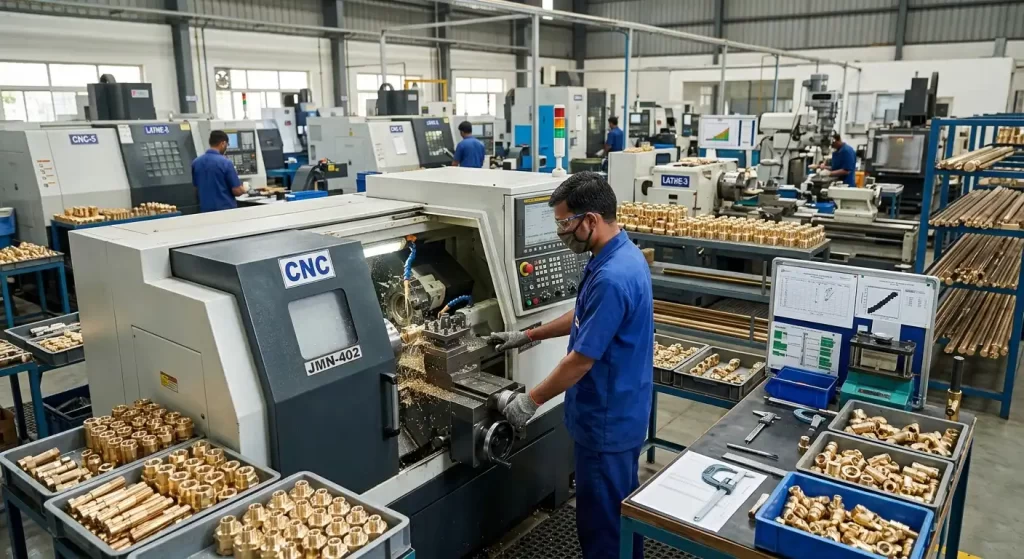
Jamnagar’s brass component manufacturers have earned global recognition not merely through low pricing but through a potent combination of vertical integration, engineering expertise, and relentless quality improvement. For buyers in the USA, Europe, and the Middle East seeking reliable OEM and custom brass parts, understanding what differentiates Jamnagar’s leading manufacturers is essential for making sound procurement decisions
This guide examines the core capabilities that define world-class brass component manufacturers in Jamnagar, the evaluation criteria buyers should apply, and the product categories these manufacturers serve across global industries
What Defines a World-Class Brass Manufacturer?
- Vertical Integration : Control from raw material (casting and extrusion) through finished machining, plating, and packaging ensures quality at every stage.
- Advanced Machinery : Investment in multi-axis CNC turning centers, Swiss-type lathes, and automated inspection equipment
- Certified Quality Systems : ISO 9001:2015 as baseline, with many holding IATF 16949 (automotive) or AS9100 (aerospace).
- Material Expertise : In-house spectrometer testing to verify alloy composition for every production batch.
- Export Proficiency : Smooth handling of international documentation, packaging standards, and shipping logistics
Key Manufacturing Capabilities
In-House Brass Extrusion
Top manufacturers operate their own extrusion lines, converting brass billets into rod stock with controlled alloy composition and grain structure. This capability ensures consistent machinability across production runs and eliminates dependence on external rod suppliers.
Precision CNC Machining
Modern CNC turning centers with sub-spindle, live tooling, and bar feeding systems produce complex multi-feature parts in single setups. Leading facilities operate 20 or more CNC machines running three shifts to meet high-volume demand.
Hot Forging
Forging produces near-net-shape parts with superior grain flow and mechanical properties. Components like valve bodies, T-fittings, and heavy-duty connectors benefit from forging before final machining.
Surface Treatment and Finishing
In-house nickel plating, chrome plating, tin plating, and passivation lines allow manufacturers to deliver fully finished parts ready for assembly. This eliminates the need for buyers to manage separate plating vendors.
Product Categories Served
Jamnagar’s brass component manufacturers collectively serve virtually every industry that uses brass. Major product categories include precision turned parts for electrical and electronics applications, plumbing fittings and inserts for CPVC, PPR, and copper pipe systems, cable glands for power distribution and hazardous area installations, fasteners for construction, marine, and industrial applications, automotive components for OEM and aftermarket supply chains, and forged components for heavy-duty industrial use.
How to Evaluate Jamnagar Manufacturers
- Review certifications : ISO 9001:2015 minimum, industry-specific certifications as bonus.
- Visit or audit the facility : Assess machine condition, housekeeping, material storage, and quality lab equipment.
- Request capability presentation : Production capacity, machine list, client references, and export history.
- Evaluate communication : Responsiveness, English proficiency, and technical understanding during the quoting process.
- Test with trial orders : Start small to validate quality, packaging, and delivery performance.
Anand Brass Components: A Jamnagar Manufacturing Leader
Since 1991, Anand Brass Components has exemplified the vertically integrated manufacturing model that distinguishes top-tier Jamnagar manufacturers. Their 15,000 sq ft GIDC Phase-III facility integrates casting, extrusion, forging, CNC machining, and coating. With 2 tons per day extrusion capacity and a product range spanning 16+ categories, the company has served over 550 clients and completed more than 10,000 orders. Their reverse production planning methodology ensures consistent on-time delivery.