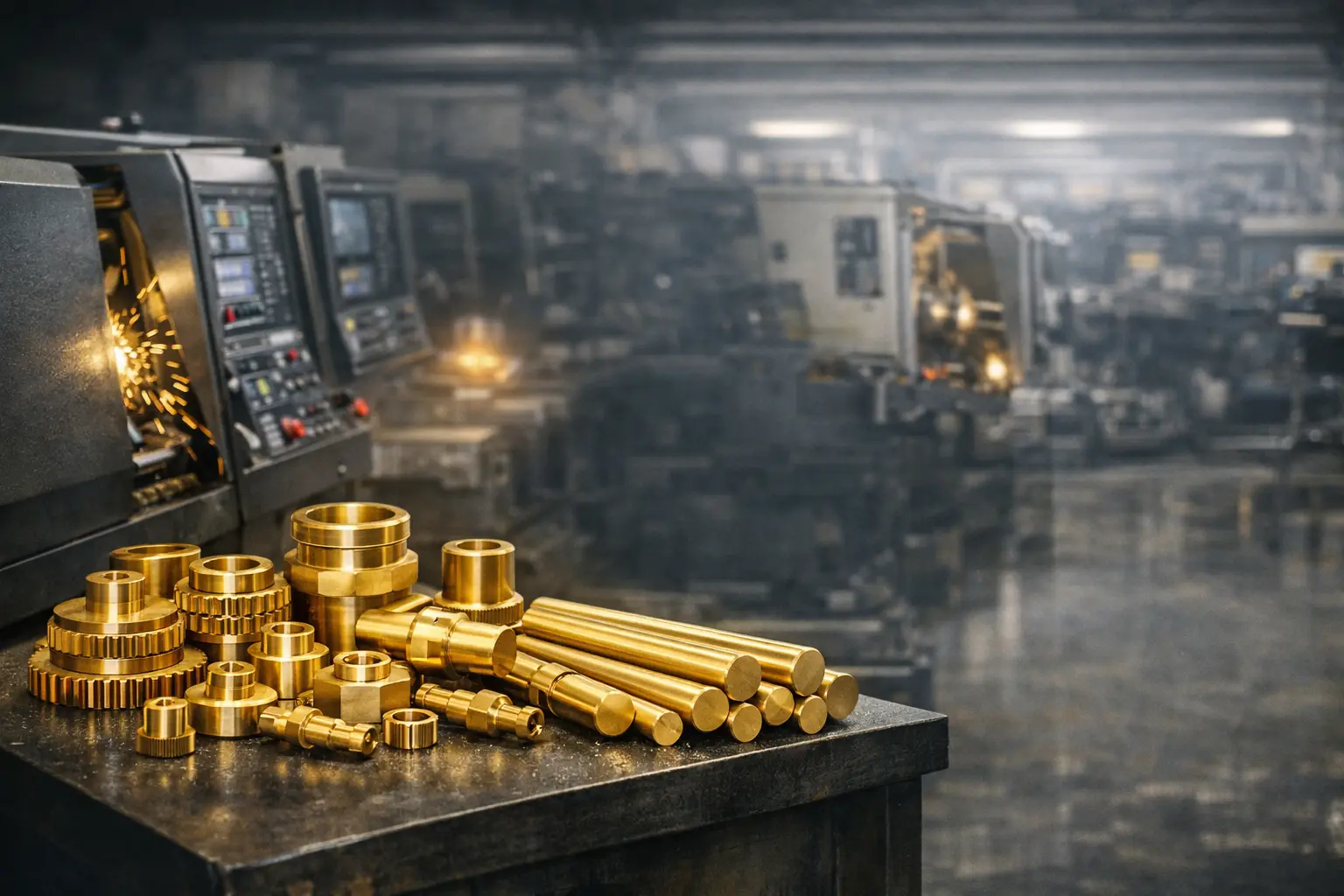
Precision brass turned parts represent the highest-value segment of the global brass component industry. Produced on CNC lathes, automatic screw machines, and Swiss-type turning centers, these components serve as critical building blocks in electrical systems, automotive assemblies, plumbing infrastructure, telecommunications, and medical devices. With tolerances within plus or minus 0.01 mm and surface finishes as fine as Ra 0.4 micrometers, precision brass turning demands metallurgical knowledge, machining expertise, and quality rigor.
What Are Brass Turned Parts?
Components manufactured by removing material from brass rod or bar stock using rotating cutting tools on lathes. Examples include pins, sockets, bushings, adapters, couplings, nipples, connectors, valve stems, and inserts. The precision qualifier indicates tight tolerances, controlled surface finishes, and multiple inspection stages.
Manufacturing Processes
CNC Turning
Modern CNC lathes with live tooling perform turning, drilling, milling, tapping, and grooving in a single setup. Multi-axis centers (3 to 7 axis) enable complex geometries that would require multiple setups on conventional equipment.
Automatic Screw Machines
Cam-operated machines (Traub, Tornos, Index) produce tens of thousands of identical parts per shift. Less flexible than CNC but offer lower per-piece costs for high-volume standard components.
Swiss-Type CNC Turning
Sliding headstock design supports workpieces close to the cutting point, minimizing deflection. Essential for long, slender parts — electrical pins, probe tips, medical instrument shafts — where precision on small diameters is critical.
Secondary Operations
Cross-drilling, knurling, slotting, deburring, tumbling, and surface treatment (nickel, chrome, tin plating). Manufacturers with in-house secondary capabilities deliver fully finished parts.
Alloy Selection
-
CZ121/C36000: Default for most turned parts. 2-3% lead for chip-breaking and high-speed machining.
-
CZ131/DZR Brass: Required for potable water contact. Slightly harder to machine.
-
CZ108/C26000 (Cartridge Brass): Lead-free, 70% copper. High ductility.
-
CZ112 (Naval Brass): 1% tin for seawater corrosion resistance.
-
Lead-Free Alloys: Bismuth or silicon replace lead for RoHS compliance.
Tolerances and Quality
-
Diameter: plus/minus 0.01-0.05 mm depending on size.
-
Length: plus/minus 0.05-0.15 mm for standard parts.
-
Thread: 6g/6H general purpose; 4g/4H precision.
-
Surface Finish: Ra 0.8-3.2 um functional; Ra 0.4 um sealing surfaces.
-
Concentricity: plus/minus 0.02 mm TIR for precision assemblies.
Industrial Applications
-
Electrical: Pins, sockets, terminals, connector housings, switch contacts for distribution boards.
-
Automotive: Sensor housings, fuel injector parts, brake fittings, coolant connectors.
-
Plumbing/HVAC: Valve stems, cartridge bodies, compression inserts, manifold components.
-
Telecommunications: Coaxial connectors, antenna feedthrough, grounding hardware for 4G/5G.
-
Medical Devices: Instrument shafts, connector pins, valve bodies, pneumatic fittings.
Choosing a Manufacturer
-
Machine Park: Diverse CNC turning centers, auto screw machines, and Swiss-type lathes.
-
In-House Extrusion: Controls material composition and ensures consistent machinability.
-
Quality Infrastructure: ISO 9001:2015, spectrometer testing, CMM inspection, SPC monitoring.
-
Prototype to Production: Validation before full tooling commitment.
Anand Brass Components
Manufacturing precision turned parts since 1991 from a 15,000 sq ft GIDC Phase-III facility. In-house extrusion at 2 tons/day producing 2-50 mm rod stock. CNC and automatic screw machines serve electrical, plumbing, automotive, and telecom sectors. Over 550 clients across 16 industry types in India, the USA, and UK.
Frequently Asked Questions
Q: What is the MOQ for brass turned parts?
5,000-10,000 pieces for standard auto-turned parts; 500-2,000 for CNC custom parts.
Q: How long does production take?
2-4 weeks standard; 4-8 weeks custom with tooling development.
Q: Can parts be plated or coated?
Yes — nickel, chrome, tin, silver, and gold plating are common options.
Q: What file formats for custom drawings?
PDF/DXF for 2D; STEP, IGES, SolidWorks for 3D models.
