
⚡ Quick Answer
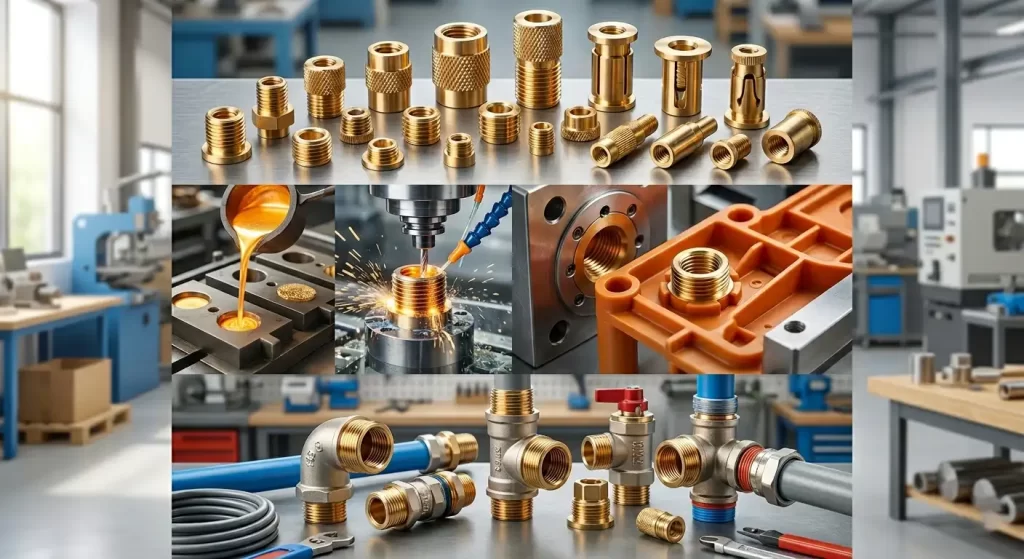
Brass inserts are small, threaded metal components embedded into plastic parts to provide strong, reusable metal threads. They are installed via heat-setting, press-fitting, ultrasonic welding, or molding-in during injection. Used extensively in CPVC, UPVC, and PPR pipe fittings, as well as electronic enclosures, automotive assemblies, and 3D-printed parts. The most common material is C36000 free-cutting brass.
Plastic is lightweight, cost-effective, and versatile — but it’s terrible at holding threads. Screws driven directly into plastic loosen over time, strip with repeated assembly, and crack under load. Brass inserts solve this problem by embedding permanent, precision metal threads inside plastic components.
This guide covers every aspect of brass inserts: the different types available, how they’re manufactured, how they’re installed, and where they’re used across pipe fitting, electronics, automotive, and additive manufacturing applications.
What Are Brass Inserts?
A brass insert is a small cylindrical component — typically 3mm to 25mm in diameter — with internal threads (to receive a screw or bolt) and an externally textured surface (to grip the surrounding plastic). The external texture is usually a knurled diamond pattern, straight knurl, or barbed profile designed to prevent rotation and pull-out after installation.
Brass inserts serve as the interface between metal fasteners and plastic housings. They transform a weak plastic-to-metal connection into a reliable, repeatable metal-to-metal thread engagement that can withstand hundreds of assembly-disassembly cycles without degradation.
Brass inserts can withstand 10–50x more assembly cycles than self-tapping screws in plastic. For any product that needs field repair, battery replacement, or modular assembly, inserts are not optional — they’re essential.
Why Brass Is the Ideal Insert Material
While inserts can technically be made from stainless steel or aluminum, brass dominates the market for several compelling reasons:
- Superior Machinability : C36000 brass has a machinability rating of 100, enabling the fine threading, precise knurling, and tight tolerances inserts require — at high production speeds.
- Thermal Compatibility : Brass’s thermal conductivity (115 W/m·K) makes it ideal for heat-set installation — it absorbs and distributes heat from the installation tool efficiently, creating a uniform melt zone in the surrounding plastic.
- Corrosion Resistance : Brass naturally resists the moisture, chemicals, and cleaning agents that plastic assemblies encounter in plumbing, medical, and outdoor applications.
- Cost Efficiency : The combination of fast machining, low tool wear, and high material yield makes brass the most cost-effective insert material by a significant margin.
- Optimal Hardness : Brass is hard enough to provide durable threads but soft enough to avoid cracking the plastic during installation — a balance steel inserts struggle to achieve.
Types of Brass Inserts
Knurled Threaded Inserts
The most common type. Feature a diamond or straight knurl pattern on the outer surface that bites into the surrounding plastic. Available in standard metric (M2–M12) and imperial (4-40 to 3/8-16) thread sizes. Used across all installation methods.
Heat-Set (Thermal) Inserts
Designed specifically for installation with a heated tip (soldering iron or dedicated heat-set tool). The insert is pressed into a slightly undersized hole while the heated brass melts the surrounding plastic, which re-solidifies to lock the insert. Provides excellent pull-out strength and alignment.
Press-Fit (Cold Press) Inserts
Installed using mechanical force alone — typically an arbor press or automated insertion machine. The hole must be precisely sized. Faster to install than heat-set but generally provides lower pull-out strength. Best for softer thermoplastics and applications with moderate loads.
Ultrasonic Inserts
Installed using an ultrasonic horn that generates high-frequency vibrations. The friction melts a thin layer of plastic around the insert. Extremely fast (under 1 second per insert) and produces very consistent results. Common in high-volume electronics and automotive production.
Molded-In Inserts
Placed into the mold cavity before plastic injection, so the plastic forms directly around the insert during the molding cycle. Provides the highest pull-out strength of any installation method because the plastic completely encapsulates the external features. Requires compatible mold design.
Expansion Inserts
Feature a slotted body that expands when a screw is driven in, creating a wedging action against the plastic hole wall. Simple to install but suitable only for lighter-duty applications.
Self-Tapping Inserts
Have an external thread that cuts its own path into the plastic during installation. Provide a balance between ease of installation and retention strength. No pre-heating or special tooling required.
Installation Methods Compared
| Method | Speed | Pull-Out Strength | Tooling Required | Best For |
|---|---|---|---|---|
| Heat-Set | 2–5 sec/insert | High | Heated tip / soldering iron | Prototyping, 3D prints, medium-volume |
| Press-Fit | 1–2 sec/insert | Medium | Arbor press / automated press | High-volume, soft plastics |
| Ultrasonic | <1 sec/insert | High | Ultrasonic welder | High-volume production lines |
| Molded-In | Part of mold cycle | Highest | Compatible injection mold | Maximum strength, critical assemblies |
| Expansion | Manual, variable | Low-Medium | None (screw-driven) | Light-duty, field installation |
| Self-Tapping | 2–4 sec/insert | Medium | Drill / driver | Retrofit, maintenance applications |
For the best balance of pull-out strength, installation speed, and cost — heat-set inserts are the most versatile choice for volumes under 100,000 units/year. For higher volumes, ultrasonic inserts reduce cycle time to under 1 second per insert with highly consistent results.
How Brass Inserts Are Manufactured
Brass insert manufacturing is a precision machining operation that transforms extruded brass rod into finished components through multiple automated steps.
Step 1: Raw Material — Brass Rod
The process starts with C36000 free-cutting brass extruded rods, typically 3mm to 25mm in diameter. At Anand Brass Components, these rods are produced in-house through the company’s casting and extrusion facility — ensuring alloy composition is controlled from the melt stage.
Step 2: CNC Turning
Rods are fed into CNC lathes or multi-spindle automatic machines. The machine performs outer diameter turning to achieve the precise body dimensions and forms any required features such as shoulders, chamfers, or tapers.
Step 3: Internal Threading
The internal thread is cut using single-point threading, tapping, or thread milling depending on thread size and tolerance requirements. Standard threads (M3, M4, M5, M6, M8) are the most common, with tolerances per ISO 965 (6H class).
Step 4: External Knurling
The outer surface is knurled — either diamond knurl, straight knurl, or a combination pattern. Knurling is performed on the CNC lathe using knurling tools or on a dedicated knurling machine. The knurl depth and pattern are critical to pull-out performance.
Step 5: Deburring & Cleaning
Inserts are tumbled in vibratory deburring machines to remove any sharp edges and machining burrs. They are then cleaned and dried to remove cutting fluid residue.
Step 6: Surface Treatment (Optional)
Depending on the application, inserts may receive nickel plating (for enhanced corrosion resistance), tin plating (for solderability), or passivation. For standard pipe fitting applications, unplated brass is typically sufficient.
Step 7: Inspection & Packaging
Thread gauging (go/no-go), dimensional checks, and visual inspection are performed. Inserts are packaged in counted quantities or bulk — with material test certificates available per customer requirements.
Brass Inserts in CPVC, UPVC & PPR Pipe Fittings
One of the largest application segments for brass inserts is the plumbing industry, specifically in plastic pipe fitting systems. These inserts create the threaded metal interface that allows plastic fittings to connect to metal pipes, valves, and fixtures.
CPVC Pipe Fittings
Chlorinated Polyvinyl Chloride (CPVC) pipe systems are used for hot and cold water supply in residential and commercial buildings. Brass inserts are molded into CPVC fittings during injection to provide BSP or NPT threaded connections. The thermal stability of brass matches well with CPVC’s higher operating temperature range (up to 93°C).
UPVC Pipe Fittings
Unplasticized PVC systems are used in cold water supply, drainage, and industrial piping. Brass inserts in UPVC fittings enable transition from plastic to metal plumbing — for example, connecting a UPVC distribution pipe to a metal tap or valve.
PPR Pipe Fittings
Polypropylene Random Copolymer (PPR) is popular in Europe, the Middle East, and Asia for both hot and cold water systems. Brass inserts for PPR fittings are typically designed with deeper knurl patterns to account for PPR’s higher thermal expansion coefficient — ensuring the insert remains locked even through thermal cycling.
Anand Brass Components manufactures a complete range of brass inserts for CPVC & UPVC pipe fittings, PPR pipe fittings, and plastic injection molding — all produced in-house from casting through CNC finishing at their Jamnagar facility.
Brass Inserts in Plastic Injection Molding
Beyond plumbing, brass inserts are used in virtually every industry that assembles products using plastic housings with screw-fastened components.
Electronics & Telecom
Circuit board standoffs, enclosure fastening points, connector mounting, and display panel assemblies. Inserts provide the repeated assembly/disassembly capability needed for repair and maintenance.
Automotive
Dashboard assemblies, sensor housings, connector blocks, interior trim panels, and under-hood component enclosures. Automotive inserts must withstand vibration, thermal cycling, and chemical exposure.
Medical Devices
Instrument housings, monitor enclosures, and disposable device assemblies. Medical applications often require nickel-free or biocompatible plating on the insert.
Consumer Appliances
Washing machine panels, kitchen appliance housings, power tool bodies, and furniture hardware. Consumer products benefit from the cost-effectiveness of brass inserts over more complex fastening methods.
Brass Inserts in Plastic Injection Molding
The rise of additive manufacturing has created a new and rapidly growing market for brass inserts. 3D-printed parts — whether prototypes or end-use components — have inherently weak layer-to-layer bonding that makes direct threading unreliable.
Heat-set brass inserts solve this completely. A soldering iron with a tapered tip heats the insert to 200–260°C, and the insert is pressed into a pre-sized hole in the printed part. The heat melts a thin layer of surrounding plastic (PLA, ABS, PETG, or Nylon), which re-solidifies around the insert’s knurl pattern to create a strong mechanical bond.
Common sizes for 3D printing are M2, M2.5, M3, M4, and M5. The 3D printing community has standardized on short-body inserts (4–6mm length) with aggressive diamond knurl for maximum grip in printed parts.
How to Specify the Right Insert
When ordering brass inserts, specify these critical parameters:
- Internal Thread Size & Standard : Metric (M3, M4, M5, etc.) or Imperial. BSP or NPT for pipe fittings. Include class/tolerance (e.g., 6H for ISO metric).
- Outer Diameter & Length : These determine the hole size in the plastic part and the thread engagement depth.
- Knurl Pattern : Diamond knurl (best all-around grip), straight knurl (easier press-fit), or barbed (maximum pull-out resistance).
- Installation Method : Heat-set, press-fit, ultrasonic, or molded-in — each requires slightly different insert geometry.
- Host Plastic Material : ABS, CPVC, PPR, Nylon, Polycarbonate — each has different thermal and mechanical characteristics that affect insert design.
- Lead-Free Requirement : For potable water applications, specify C69300 or equivalent lead-free grade.
- Surface Finish : Unplated, nickel plated, tin plated, or chrome plated.
🎯 Key Takeaways
- Brass inserts provide permanent metal threads in plastic — enabling 10–50x more assembly cycles than self-tapping screws.
- Heat-set inserts offer the best versatility — span pull-out, simple tooling, and work with most thermoplastics and 3D prints.
- Molded-in inserts provide the highest strength — plastic encapsulates the insert during injection for maximum retention.
- C36000 brass is the standard material — machinability rating 100 enables the precise threading and knurling inserts require.
- CPVC, UPVC, and PPR pipe fittings are the largest market — inserts create metal-to-plastic transition connections in plumbing systems worldwide.
- Specify all 7 parameters — thread size, OD/length, knurl pattern, installation method, host plastic, lead-free status, and surface finish.
Frequently Asked Questions
Need Custom Brass Inserts?
From standard knurled inserts to custom-designed molded-in variants, Anand Brass Components produces inserts for CPVC, UPVC, PPR, and injection molding — manufactured in-house from casting through CNC.
References
- ISO 965 — ISO General Purpose Metric Screw Threads — Tolerances — iso.org
- Copper Development Association — Alloy C36000 Data Sheet — copper.org
- ASTM D638 — Standard Test Method for Tensile Properties of Plastics — astm.org