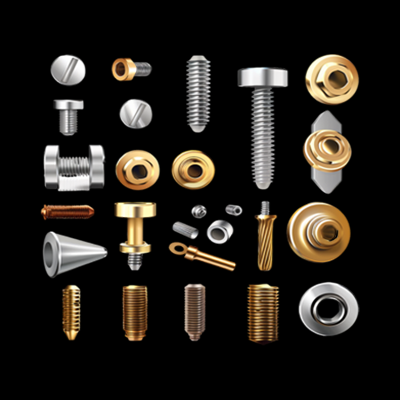
Brass fasteners occupy an essential position in the global fastener market, serving applications where corrosion resistance, non-magnetic properties, electrical conductivity, aesthetic appearance, or non-sparking characteristics are required. Understanding the types, material grades, mechanical properties, and application considerations enables specification of the right fastener for each critical joint.
Types of Brass Fasteners
Brass Machine Screws
Pan head, flat head, round head, and cheese head styles in M2-M12 metric and #2-1/2 inch imperial. Primary applications include electrical terminals, panel assemblies, and instrumentation.
Brass Bolts
Hex bolts (DIN 931/933), carriage bolts, and flange bolts for structural and mechanical assemblies. Used in marine hardware, outdoor furniture, and electrical bus bar connections.
Brass Nuts
Hex nuts, lock nuts, wing nuts, and coupling nuts per DIN 934 and DIN 985. Specified for corrosion resistance and conductivity.
Brass Washers
Flat, spring, and lock washers distributing loads and ensuring low-resistance connections for electrical grounding.
Brass Anchors
Drop-in, expansion, and pool anchors for concrete and masonry. Resist corrosion in swimming pools, fountains, and coastal structures.
Brass Threaded Rod and Studs
Provide adjustable connections and through-bolting for electrical switchgear, transformer assemblies, and marine applications.
Why Choose Brass Fasteners?
-
Corrosion Resistance: Ideal for marine, coastal, and outdoor applications where steel would rust.
-
Non-Magnetic Properties: Critical in MRI rooms, sensitive electronics, and magnetic-interference-free environments.
-
Electrical Conductivity: Effective grounding and bonding hardware in electrical systems.
-
Non-Sparking: Mandatory in explosive atmospheres — oil refineries, chemical plants, ammunition storage.
-
Aesthetic Appeal: Warm golden color for architectural, decorative, and furniture applications. Machinability: Complex thread forms and custom designs produced efficiently and economically.
-
Machinability: Complex thread forms and custom designs produced efficiently and economically.
Alloy Grades for Fasteners
-
CZ121/CW614N: Most common. 57-59% copper, 2-3% lead for machinability.
-
CZ131/DZR Brass: Dezincification-resistant for aggressive water conditions.
-
C36000: American equivalent of CZ121 with 61.5% copper and 3% lead.
-
Lead-Free Brass: CW510L, C27450 for potable water and RoHS compliance.
Standards and Specifications
-
DIN: 84 (cheese head screws), 931/933 (hex bolts), 934 (hex nuts), 125 (washers).
-
ISO: 4762 (socket head), 7380 (button head), 4032 (hex nuts).
-
ASTM: B16 (free-cutting brass rod), B455 (fittings).
Applications Across Industries
-
Electrical: Terminal screws, grounding bolts, panel mounting hardware.
-
Marine: Deck hardware, hull fittings, dock cleats, underwater structural connections.
-
Architecture: Decorative screws, hinge pins, door hardware, furniture fittings.
-
Plumbing/HVAC: Valve bonnet bolts, flange fasteners, pipe clamp hardware.
-
Oil and Gas: Non-sparking fasteners for ATEX-rated zones.
Sourcing from Anand Brass Components
Anand Brass Components manufactures machine screws, hex bolts, nuts, washers, anchors, and threaded rods in standard and custom sizes. In-house extrusion, CNC machining, and quality testing ensure DIN, ISO, and BS compliance for clients across India, the USA, and UK markets.
Frequently Asked Questions
Q: Are brass fasteners as strong as steel?
No. Brass tensile strength is 350-500 MPa vs 400-1200 MPa for steel. Brass is chosen for corrosion resistance and conductivity.
Q: Can brass fasteners be used outdoors?
Yes, excellent outdoor performance. Nickel-plated brass adds protection in coastal salt-spray environments.
Q: Are brass fasteners food-safe?
Yes, especially lead-free grades. Brass resists cleaning chemicals used in food processing.
Q: Maximum temperature for brass fasteners?
Up to approximately 200 degrees Celsius for continuous operation.
