⚡ Quick Answer
Brass is the dominant material for electrical contact hardware — terminals, connectors, plug pins, switchgear parts, and cable glands — because it offers the rare combination of good electrical conductivity (28% IACS), excellent spring characteristics, outstanding machinability, natural corrosion resistance, and non-sparking safety. No other single material matches this balance of electrical, mechanical, and manufacturing properties.
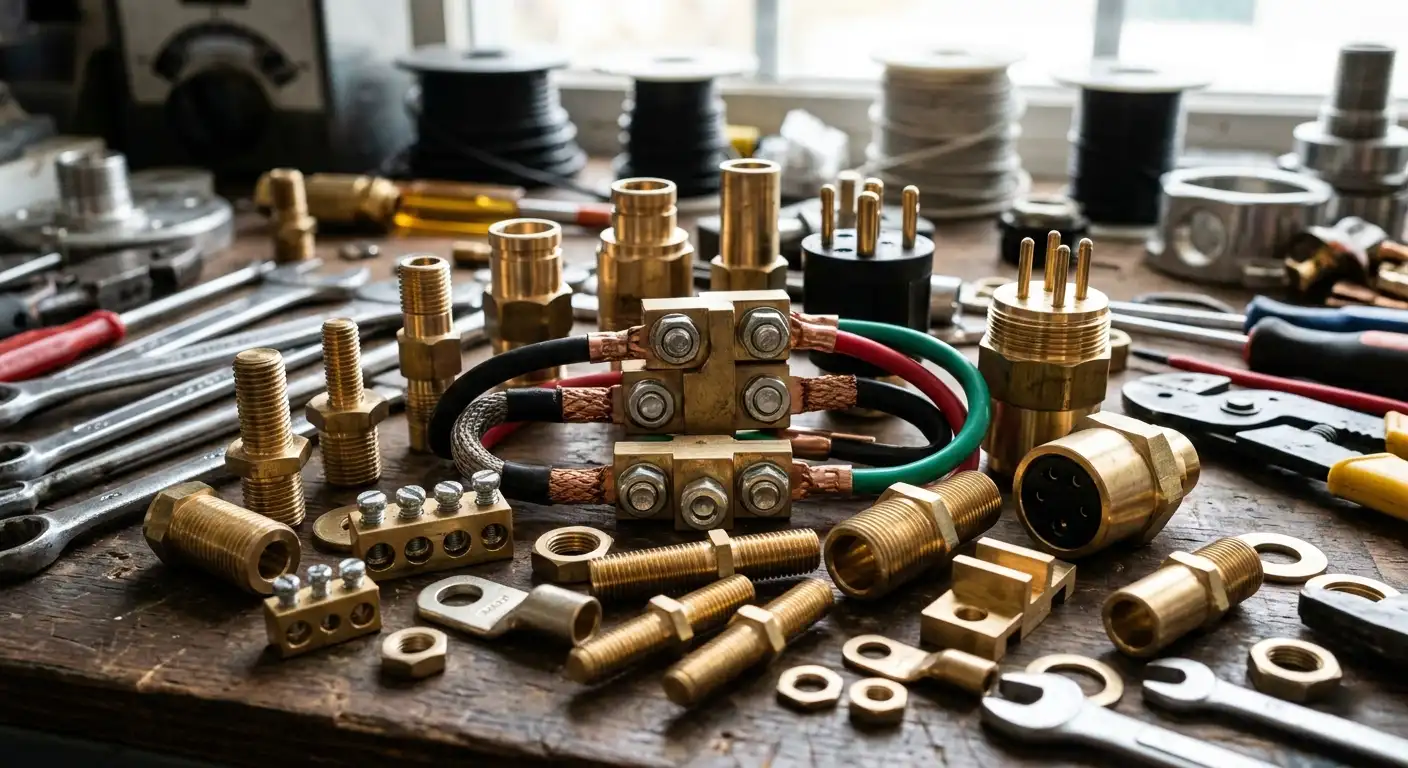
Open any electrical panel, switchboard, plug socket, or distribution box, and you'll find brass components inside. From the plug pins in a power cord to the neutral link in a distribution panel, brass is the material that makes electrical connections work reliably — often for decades without failure.
This isn't accidental. Brass occupies a unique position in the electrical engineering material space: it conducts electricity well enough for contact hardware, while offering mechanical properties (hardness, spring temper, wear resistance) that pure copper simply cannot provide. This guide explains exactly why brass dominates, what types of electrical components are made from it, and how to specify them correctly.
1. Why Brass Dominates Electrical Hardware
The electrical components market is enormous — and brass holds a commanding share of the contact hardware segment. The reason is straightforward: electrical connections require both electrical and mechanical performance, and brass delivers both.
A plug pin must conduct current and maintain spring contact pressure over thousands of insertion cycles. A terminal must carry current and resist loosening from vibration and thermal cycling. A switchgear contact must handle arc erosion and mechanical wear. In every case, the component needs a material that combines conductivity with mechanical durability — and that material is brass.
2. The 6 Properties That Make Brass Ideal for Electrical Parts
2.1 Electrical Conductivity
Brass has an electrical conductivity of approximately 28% IACS (International Annealed Copper Standard). While this is lower than copper's 101%, it is more than sufficient for the small contact areas in connectors, terminals, and pins. The contact resistance at a well-designed brass-to-brass or brass-to-copper interface is negligible in practice.
2.2 Spring Characteristics
This is brass's secret advantage over copper. Certain brass alloys (particularly C26000 in spring temper) can be cold-worked to develop excellent spring properties. This enables socket contacts, blade terminals, and spring clips to maintain consistent contact pressure — essential for low-resistance electrical connections over long service life.
2.3 Machinability
C36000 brass has a machinability rating of 100 — the highest among common engineering metals. This enables manufacturers to produce complex electrical components (threaded terminals, precision pins, multi-featured connectors) at high speed with excellent dimensional accuracy. Lower manufacturing cost per part is a direct result.
2.4 Corrosion Resistance
Brass resists atmospheric corrosion, moisture, and the mild chemicals encountered in electrical environments. This ensures that connection surfaces remain clean and conductive over time, preventing the high-resistance corrosion films that cause overheating failures.
2.5 Non-Sparking Behavior
Brass does not produce sparks when struck against hard surfaces. This is a critical safety property for electrical components used in explosive or flammable atmospheres — petrochemical plants, gas systems, mining operations, and paint manufacturing facilities.
2.6 Non-Magnetic Properties
Brass is non-magnetic, making it suitable for electrical components in environments where magnetic interference must be avoided — scientific instruments, MRI suites, sensitive electronic equipment, and electromagnetic compatibility (EMC) applications.
3. Types of Brass Electrical Components
| Component | Function | Typical Grade | Key Manufacturing Process |
|---|---|---|---|
| Plug Pins | Carry current from plug to socket | C36000 | CNC turning + nickel plating |
| Socket Contacts | Receive plug pins with spring grip | C26000 (spring temper) | Stamping + forming |
| Terminals | Connect wires to equipment/panels | C36000 | CNC turning or stamping |
| Neutral Links | Distribute neutral connections in panels | C36000 | CNC machining + drilling |
| Fuse Contacts | Hold fuses and conduct current | C26000 | Stamping + spring forming |
| Cable Glands | Secure cables to enclosures, provide IP rating | C36000 | CNC turning + threading |
| Ceiling Rose Parts | Connect lighting fixtures to wiring | C36000 | CNC turning |
| Earth Bars | Ground multiple circuits in panels | C36000 | Extrusion + drilling + tapping |
| Switchgear Contacts | Make/break circuits under load | C36000/C26000 | Forging or stamping + machining |
| Bus Bars (small) | Distribute power within panels | C36000 | Extrusion + machining |
| Transformer Parts | Terminal connectors, bushings | C36000 | CNC turning + threading |
4. Brass vs. Copper for Electrical Parts: When to Use Which
| Factor | Use Brass | Use Copper |
|---|---|---|
| Application type | Connectors, pins, terminals, switchgear | Wiring, busbars, motor windings |
| Key requirement | Mechanical + electrical performance | Maximum electrical conductivity |
| Contact pressure | Maintains spring force over cycles | Too soft — deforms under contact pressure |
| Wear resistance | Handles thousands of insertions | Wears and galls quickly at contact surfaces |
| Manufacturing | CNC turned and stamped efficiently | Difficult to machine (gummy, sticky chips) |
| Cost per part | Lower (faster machining, less scrap) | Higher (slow machining, high material cost) |
| Current capacity | Adequate for contact hardware | Required for high-current bulk conductors |
The practical dividing line: if the component's primary function is to carry current over distance (cables, busbars, windings), use copper. If its primary function is to make and maintain an electrical connection (pins, sockets, terminals, contacts), use brass.
5. Best Brass Grades for Electrical Applications
- C36000 (Free-Cutting Brass): The default for all CNC-machined electrical components. Pins, terminals, cable glands, neutral links, and transformer parts. Machinability 100.
- C26000 (Cartridge Brass): The default for stamped and formed parts. Socket contacts, fuse contacts, spring clips, and any component requiring spring temper. Excellent cold-working properties.
- C24000 (Low Brass, 80/20): Higher copper content provides better conductivity than C36000 while retaining reasonable machinability. Used when electrical performance is prioritized over machining speed.
- C27200 (Yellow Brass): Good balance for general-purpose electrical hardware where neither extreme machinability nor extreme formability is needed.
- Nickel Silver (C75200): A copper-nickel-zinc alloy used for specialized electrical contacts requiring high spring force and corrosion resistance. Silver-colored appearance.
6. How Brass Electrical Parts Are Made
Brass electrical components are manufactured through two primary processes, selected based on the component's geometry and function.
CNC Turning (for Rotational Parts)
Plug pins, cable glands, terminals, and neutral links are produced on CNC lathes and multi-spindle automatic machines. Operations include turning, boring, threading, knurling, cross-drilling, and parting. Modern multi-spindle machines produce complex pins with 6–8 features in a single cycle.
Progressive Stamping (for Flat/Spring Parts)
Socket contacts, fuse clips, terminal strips, and spring connectors are stamped from brass sheet or strip using progressive dies. The strip feeds through multiple die stations, each performing a cut, bend, or form — producing a finished part at the end. Stamping rates of 200–600 parts per minute are typical.
Secondary Operations
- Nickel Plating: Applied to plug pins and terminals for improved contact resistance, wear life, and appearance. Typical thickness 3–8 microns.
- Tin Plating: Applied where solderability is required — PCB terminals, wire-to-board connectors.
- Silver Plating: Applied to high-performance switchgear contacts for lowest possible contact resistance.
- Assembly: Some components (assembled terminals, complete cable glands with rubber seals) require post-machining assembly operations.
7. Standards Certifications
Brass electrical components must comply with relevant national and international standards depending on the destination market.
| Standard | Scope | Market |
|---|---|---|
| IEC 60947 | Low-voltage switchgear and controlgear | International |
| IS 1293 | Plugs and socket outlets | India |
| BS 1363 | UK 13A plugs, sockets, adaptors | UK |
| UL 486A-B | Wire connectors and soldering lugs | USA |
| IEC 62196 | EV charging connectors | International |
| IP Rating (IEC 60529) | Ingress protection for cable glands | International |
| ROHS / REACH | Hazardous substance restrictions | EU |
| ASTM B16 | Free-cutting brass rod, bar specification | International |
8. Applications by Sectory
Residential Electrical
Plug pins, socket contacts, switch components, ceiling rose parts, and MCB internal contacts. Every home contains dozens of brass electrical components in its wiring accessories.
Industrial Power Distribution
Neutral links, earth bars, bus bars, cable glands, and terminal blocks in distribution panels, control panels, and motor control centers. Industrial environments demand higher current ratings and vibration resistance.
Transformer & Switchgear
Bushing connectors, tap changer contacts, terminal studs, and current transformer components. Brass transformer parts require precise threading and high-quality surface finish for reliable high-voltage connections.
Renewable Energy
Solar panel junction box terminals, inverter connectors, battery bank terminals, and wind turbine control system hardware. The renewable sector is a growing market for corrosion-resistant brass electrical components.
EV Charging Infrastructure
Charging connector pins, terminal blocks, and cable management hardware in EV charging stations. This is an emerging high-growth segment requiring components that meet IEC 62196 specifications.
Telecommunications
Coaxial connector bodies, grounding hardware, equipment rack terminals, and fiber optic patch panel components. Brass provides the dimensional stability and shielding effectiveness telecom applications require.
9. How to Specify Brass Electrical Components
When ordering brass electrical components, provide these specifications for accurate quoting and manufacturing:
- Component drawing or sample: Dimensions, tolerances, thread specifications, and surface finish requirements.
- Brass grade: C36000 for machined parts, C26000 for stamped/formed parts, or specify if higher conductivity grades are needed.
- Current rating: Maximum amperage the component must carry continuously without excessive temperature rise.
- Plating: Nickel (standard for pins/terminals), tin (for solderability), silver (for switchgear contacts), or unplated.
- Standards compliance: IEC, IS, BS, UL, or other relevant standard the component must meet.
- IP rating (for cable glands): IP54, IP66, IP68 — determines the sealing requirements.
- Quantity and delivery schedule: Enables the manufacturer to optimize production planning and pricing.
? Key Takeaways
- Brass dominates electrical contact hardware because it combines conductivity, spring properties, machinability, and corrosion resistance — a balance no other metal achieves.
- Use C36000 for machined parts (pins, terminals, cable glands) and C26000 for stamped parts (socket contacts, fuse clips, spring components).
- Brass vs. copper — copper carries current over distance; brass makes and maintains connections. Different jobs, different metals.
- Non-sparking + non-magnetic — safety properties that make brass essential in explosive environments and sensitive electronics.
- Every home and factory contains brass electrical parts — from plug pins to neutral links to cable glands, brass is the invisible backbone of electrical systems.
- The EV and renewable energy sectors are creating growing demand for precision brass electrical components.
❓ Frequently Asked Questions
Need Brass Electrical Components?
From plug pins to cable glands to transformer terminals, Anand Brass Components delivers precision electrical parts manufactured to international standards at our integrated Jamnagar facility.
Request a Quote →References
- IEC 60947 — Low-Voltage Switchgear Standards — iec.ch
- Copper Development Association — Electrical Applications of Brass — copper.org
- Bureau of Indian Standards — IS 1293 (Plugs and Sockets) — bis.gov.in
- ASTM B16 — Free-Cutting Brass Rod Specification — astm.org
