
💡 Quick Answer
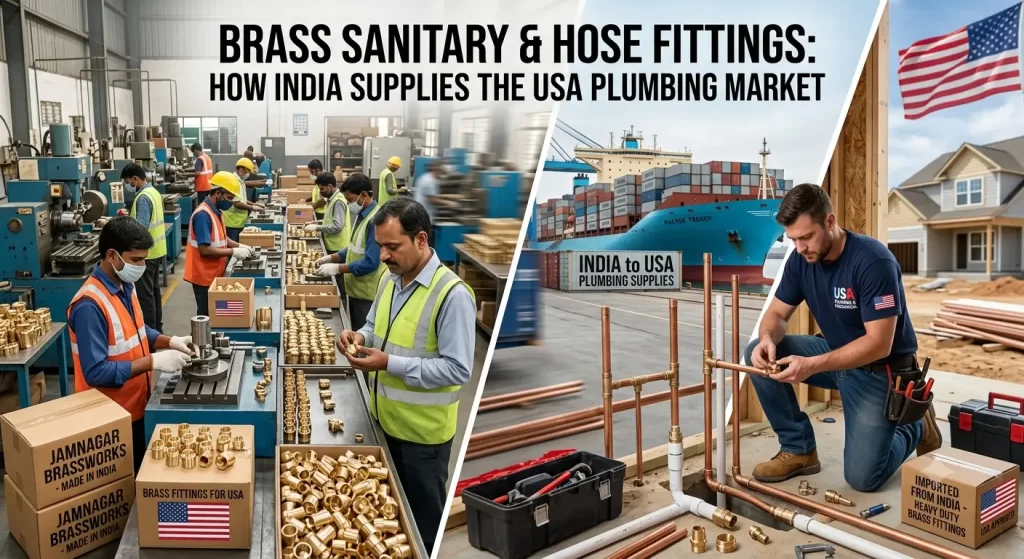
Indian manufacturers, concentrated in Jamnagar, Gujarat, supply brass sanitary and hose fittings to the United States by hot-forging and CNC-machining certified alloys such as CW617N, DZR CW602N and lead-free grades like C69300, finishing them to American thread standards (NPT per ASME B1.20.1, hose thread per ASME B1.20.7, SAE flare per J512/J513) and certifying them to NSF/ANSI/CAN 61 and 372.
For any fitting touching potable water in the US, the binding requirement is the Safe Drinking Water Act definition of “lead free” — a weighted average of no more than 0.25% lead across wetted surfaces. With an 18% reciprocal tariff set by the February 2026 India–US interim trade agreement and mature CNC capacity, India remains a leading sourcing base for US plumbing OEMs, importers and distributors. Anand Brass Components, based in Jamnagar, manufactures and exports these fittings to customer drawings and international thread standards.
Table of Contents
- Introduction
- What Are Brass Sanitary and Hose Fittings?
- Why Brass Is Still the Default Material
- Brass Alloys Used in Sanitary and Hose Fittings
- The US Lead-Free Rule Every Importer Must Verify
- Thread Standards: Where India–USA Orders Go Wrong
- How Indian Manufacturers Produce Export-Grade Fittings
- Jamnagar: India’s Brass Fittings Cluster
- India and the USA: The 2026 Sourcing Equation
- Sourcing Checklist for US Buyers
- How Anand Brass Components Supports US Buyers
- Frequently Asked Questions
Introduction
Brass sanitary and hose fittings sit at the centre of every water system ever built — the adapters, elbows, nipples, couplings and connectors that join a pipe to a valve or a hose to a tap. When one fails, the whole assembly fails with it.
India produces a very large share of the world’s machined brass fittings, and the United States is one of the largest consumers. At Anand Brass Components we manufacture and export precision brass fittings from Jamnagar, and we see this trade lane from the factory floor every day. But the India–USA route is not simply a cost decision: American lead-content regulation for potable water is among the strictest in the world, and US thread geometry differs from the BSP conventions standard across India and Asia. A supplier who can navigate both is a different proposition from one who can only quote a price per kilogram.
What Are Brass Sanitary and Hose Fittings?
“Sanitary fittings” means the brass hardware used in water supply and bathroom or kitchen installations — the category Anand Brass Components supplies as brass plumbing fittings. “Hose fittings” are the components that terminate, join or adapt flexible hose. Most Indian manufacturers produce both from the same machine shops, because alloys, tolerances and finishing operations overlap heavily.
Common Sanitary and Plumbing Fittings
- Adapters and Reducers : Join pipes of differing diameters or thread forms.
- Elbows, Tees and Crosses : Change or split the direction of flow.
- Nipples, Sockets and Unions : Extend, couple and allow servicing of pipe runs.
- Compression Fittings and Ferrules : Gasket-free seal on copper and PEX tube.
- Faucet Bodies, Spouts and Stems : The machined core of taps and mixers.
- Angle Stops and Supply Connectors : Isolate and feed individual fixtures.
Common Brass Hose Fittings
- Hose Barbs and Barbed Tails : Grip the hose wall under clamp pressure.
- Garden Hose Couplings : Male and female GHT ends for irrigation and washdown.
- Quick-Release Couplers : Fast connect and disconnect for tools and equipment.
- SAE Flare and Compression Ends : Refrigeration, gas and automotive fluid lines.
- Swivel Adapters and Y-Splitters : Prevent hose twisting and divide a supply.
- Hose Menders and Clamps : Repair and secure damaged hose runs.
Why Brass Is Still the Default Material
Plastic and stainless steel have taken share in niches, yet brass still dominates threaded water fittings for metallurgical reasons rather than habit. Free-cutting brass machines faster and cleaner than almost any other engineering metal — which matters when a fitting carries a tapered thread that must seal on metal-to-metal contact, since sharp, burr-free crests are what stop a joint weeping.
Brass also resists the corrosion typical of chlorinated municipal water and outdoor exposure, and does not embrittle with UV or temperature cycling the way many polymers do. It tolerates the pressure spikes and abuse of real installations — over-tightening, hose whip, freeze cycles — and can be disassembled and re-seated rather than replaced. Copper alloys carry inherent antimicrobial surface activity too, useful where biofilm is a concern.
Brass Alloys Used in Sanitary and Hose Fittings
Alloy selection is the most consequential decision in a fitting programme: it determines both machinability and legal saleability in the destination market.
- CW614N (CuZn39Pb3) : Classic free-machining rod to EN 12164, for high-volume turned parts outside potable-water limits.
- CW617N (CuZn40Pb2) : The workhorse hot-stamping grade to EN 12165, for forged fitting bodies, valve bodies and faucet components.
- CW602N / CZ132 (CuZn36Pb2As) : Dezincification-resistant “DZR” brass with a small arsenic addition, for aggressive or soft water.
- C69300 (silicon “eco” brass) : Lead-free grade at roughly 73–77% copper with 2.7–3.4% silicon, widely used for US potable-water fittings, faucet stems and water meter bodies.
- C87850 and C46500 : Lead-free silicon brass and naval brass for castings and marine-exposed hardware.
- Bismuth-Bearing Lead-Free Brasses : Low-lead families where bismuth replaces lead as the chip-breaking element.
Dezincification deserves a note: it is selective corrosion in which zinc leaches out and leaves a porous, weak copper skeleton behind. It is the most common cause of premature failure in brass water fittings, and exactly what DZR grades prevent.
The US Lead-Free Rule Every Importer Must Verify
This is where India–USA sanitary fitting programmes most often go wrong. Under the US Safe Drinking Water Act, as amended by the Reduction of Lead in Drinking Water Act and codified in the EPA’s 2020 final rule, “lead free” means a weighted average of no more than 0.25% lead across the wetted surfaces of pipes, fittings and fixtures; solder and flux are held to 0.2%. The rule covers pipes, fittings, fixtures, water coolers, fountains, water heaters, ice makers and plumbed-in treatment devices. Toilets, bidets, fire suppression equipment and products clearly labelled non-potable are exempt.
The Certifications That Prove It
- NSF/ANSI/CAN 372 : Verifies lead content against the 0.25% weighted-average rule.
- NSF/ANSI/CAN 61 : Broader drinking-water contact standard; requires 372 compliance unless exempted.
- ASME A112.18.1 / CSA B125.1 : North American standard for faucets and plumbing supply fittings.
- cUPC / UPC Listing : IAPMO listing widely required by inspectors under the Uniform Plumbing Code.
Third-party certification by an accredited body is mandatory — a supplier’s own declaration is not sufficient, which is why Anand Brass Components works to documented quality and approval procedures on every export order. California’s AB 1953 set the template federal law later adopted nationally, so a product built to the 0.25% federal rule generally satisfies state requirements too. The practical implication: a lead-free order cannot run on the same bar stock as a standard CW617N order. It needs segregated raw material and documented traceability from heat number to finished carton.
Thread Standards: Where India–USA Orders Go Wrong
India, like most of the Commonwealth and Europe, works natively in BSP threads. The United States works in NPT and its relatives. The two are not interchangeable — mixing them produces joints that appear to assemble but leak under pressure.
- NPT — ASME B1.20.1 : Taper pipe thread sealing on flank interference; the US default.
- NPSM / NPSH : Straight pipe threads sealed by gasket rather than taper.
- GHT / NH — ASME B1.20.7 : Hose coupling threads from 1/2 in to 4 in, including 3/4 in garden hose thread.
- SAE J512 and J513 : Inverted and 45-degree flare tube fittings for automotive, refrigeration and gas lines.
- JIC 37-degree flare : Common in hydraulic and fluid power assemblies.
- BSPP / BSPT — ISO 228 and ISO 7 : Parallel and taper British threads used across India and Asia.
A competent Indian exporter holds dedicated NPT and GHT ring and plug gauges, calibrated and traceable — not simply “cut to the drawing.” Asking to see the gauge calibration certificates is one of the fastest ways to separate a real export manufacturer from a trading house.
How Indian Manufacturers Produce Export-Grade Fittings
Step 1: Raw Material Selection and Traceability
Production begins with extruded or drawn brass rod in the specified grade. Each lot arrives with a mill test certificate stating chemical composition, and export-grade suppliers retain it against the batch for the life of the order.
Step 2: Hot Forging or Stamping
Bodies with complex geometry — elbows, tees, valve bodies, faucet cores — are heated and press-forged to near-net shape. Forging refines grain structure and eliminates the porosity that plagues castings, which is why forged bodies hold pressure better.
Step 3: Precision CNC Machining
Multi-spindle automats and CNC turning centres — the core of the Anand Brass Components machine shop — produce the bores, seats, hex flats and threads. This is where tolerance, surface finish and thread class are determined — and where interchangeability across a 100,000-piece batch is won or lost.
Step 4: Surface Treatment and Plating
Fittings receive nickel, chrome or tin plating, or a natural polished brass finish. Visible bathroom sanitary fittings typically get a nickel-chrome stack; industrial hose fittings often ship in natural brass.
Step 5: Inspection, Testing and Packing
Inspection covers dimensional verification, go/no-go thread gauging, pressure and leak testing, plating thickness, salt spray where specified, and spectrometer material verification. Lead-free lines add documented segregation checks.
Jamnagar: India’s Brass Fittings Cluster
Jamnagar in Gujarat is the reason India can quote competitively on brass fittings at all. It is not one large factory but a dense ecosystem where every process step has specialist suppliers within a few kilometres. Cluster surveys have counted roughly 3,500 brass units in and around the city — about 900 foundries, 150 extrusion units, 2,100 machining units and 350 electroplating units.
That density lets a manufacturer move a job from rod to forging to machining to plating to packing without one long-distance freight leg. For a US buyer the benefit is flexibility: prototype runs, drawing revisions, alternative finishes and mixed-SKU containers are far easier to arrange here than in a vertically integrated plant with fixed process lines.
India and the USA: The 2026 Sourcing Equation
The Tariff Reset
After a turbulent 2025 in which reciprocal tariffs on Indian goods climbed from 26% to roughly 50%, the interim India–US trade agreement announced on 6 February 2026 reset the rate to 18%, with engineering goods named among the sectors positioned for immediate gains. Buyers should still confirm landed duty for their specific HTS classification, since brass fittings fall under several headings depending on form and function.
Demand Fundamentals
India’s own faucet market was valued at roughly USD 1.89 billion in 2026 and is forecast to grow about 7.1% annually to 2031, driven by urban housing programmes and water-efficiency regulation. That domestic base gives manufacturers scale and tooling amortisation that benefits export pricing. India is no longer competing purely on unit price — the differentiators that matter to a US distributor now are certification documentation, thread accuracy, consistent plating and the ability to hold a delivery date.
Sourcing Checklist for US Buyers
- Confirm the alloy in writing : Grade designation, not just “brass,” with mill test certificates per lot.
- Demand third-party lead-free certification : NSF/ANSI/CAN 372 or 61 marks for anything potable.
- Verify thread gauging : Calibrated NPT and GHT go/no-go gauges with current certificates.
- Specify the plating stack : Base layer, thickness in microns, expected salt spray hours.
- Agree the AQL and test plan : Sampling level, leak test pressure and duration, documented up front.
- Approve a first article sample : Test-fit against your US mating parts before bulk production — Anand Brass Components supplies these ahead of every bulk run.
- Confirm HTS classification and landed duty : Before the purchase order, not after the container sails.
How Anand Brass Components Supports US Buyers
Anand Brass Components manufactures and exports precision brass sanitary, hose and pipe fittings from Jamnagar, Gujarat, working directly from customer drawings, samples and technical specifications.
- Custom CNC Machining : Precision-turned fittings to your tolerances and thread class.
- Hot Forged Fitting Bodies : Near-net-shape forging for better pressure integrity.
- Lead-Free Alloy Capability : Segregated production for US potable-water requirements.
- Multiple Plating Options : Nickel, chrome and tin finishes, or natural polished brass.
- OEM & Private Label : Custom branding, packing and carton marking for distributors.
- Global Export Support : Documentation, inspection reports and reliable logistics.
To discuss a specific part, drawing or sample, contact Anand Brass Components or request a custom quotation.
📌 Key Takeaways
- Brass sanitary and hose fittings share alloys, tooling and finishing lines in most Indian factories.
- CW614N, CW617N and DZR CW602N cover general fittings; C69300 and similar lead-free grades cover US potable water.
- US law defines lead free as a 0.25% weighted average across wetted surfaces, verified by NSF/ANSI/CAN 372.
- Third-party certification is mandatory; a supplier’s self-declaration has no legal standing.
- NPT, GHT and SAE threads are not interchangeable with the BSP threads standard in India.
- Hot forging plus CNC machining gives better pressure integrity than casting for fitting bodies.
- Jamnagar’s cluster of around 3,500 brass units delivers flexibility on mixed SKUs and short runs.
- The February 2026 interim trade agreement reset the US reciprocal tariff on Indian goods to 18%.
Industry Standards & Resources
Buyers and specifiers can refer to the following primary sources for the standards referenced in this guide:
- NSF — Safe Drinking Water Act Requirements
Official summary of the 0.25% lead-free rule and NSF/ANSI/CAN 61 and 372. - ASME B1.20.7 — Hose Coupling Screw Threads
Thread standard for hose couplings, valves and nozzles from 1/2 in to 4 in. - ASME A112.18.1 / CSA B125.1 — Plumbing Supply Fittings
North American standard for faucets and supply fittings.
Frequently Asked Questions
Looking for a Reliable Brass Sanitary & Hose Fittings Manufacturer?
Anand Brass Components manufactures and exports precision brass sanitary fittings, hose fittings and pipe fittings for plumbing, irrigation and industrial applications. We offer custom CNC machining, hot forging, multiple plating options, lead-free alloy capability and export-quality components built to US and international thread standards.
Contact Anand Brass Components → Explore Brass Hose Fittings
Related Articles
- Lead-Free Brass Components: Complete Guide to NSF 61, NSF 372 & Drinking Water Standards
- Precision and Durability: Why Our Brass Hose Fittings Are the Best in the USA
- Brass Manufacturers in Jamnagar: Why India’s Brass Capital Leads Global Manufacturing
- Jamnagar Brass Parts: Quality, Innovation and Global Supply Chain Excellence
- Top 10 Brass Industries in Jamnagar – Complete List of Leading Manufacturers 2026
- Anand Brass Components — Brass Parts Manufacturer & Exporter, Jamnagar