
⚡ Quick Answer
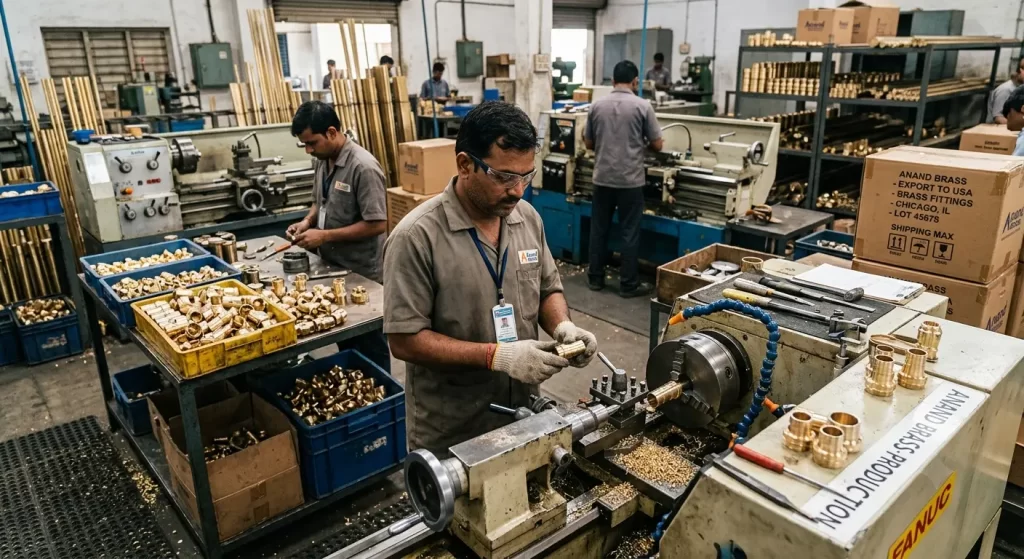
Indian manufacturers, concentrated in Jamnagar, Gujarat, supply brass sanitary and hose fittings to the United States by hot-forging and CNC-machining certified alloys such as CW617N, DZR CW602N and lead-free grades like C69300, finishing them to American thread standards (NPT per ASME B1.20.1, hose thread per ASME B1.20.7, SAE flare per J512/J513) and certifying them to NSF/ANSI/CAN 61 and 372.
For any fitting touching potable water in the US, the binding requirement is the Safe Drinking Water Act definition of “lead free” — a weighted average of no more than 0.25% lead across wetted surfaces. With an 18% reciprocal tariff set by the February 2026 India–US interim trade agreement and mature CNC capacity, India remains a leading sourcing base for US plumbing OEMs, importers and distributors. Anand Brass Components, based in Jamnagar, manufactures and exports these fittings to customer drawings and international thread standards.
Introduction
Brass sanitary and hose fittings are the backbone of global plumbing infrastructure. From the tap on your kitchen sink to the faucet in your bathroom, from irrigation systems in agricultural regions to complex heating loops in commercial buildings, these small precision components carry water safely and reliably under pressure and temperature variation.
India, particularly the cluster of manufacturers in Jamnagar, Gujarat, has emerged as one of the world’s largest exporters of these fittings. Yet for US importers, distributors, OEMs and specifiers, sourcing from India involves navigating a maze of American thread standards, lead-free certification rules, tariff classifications and quality expectations that are radically different from domestic Indian plumbing standards.
This guide walks you through what brass sanitary and hose fittings are, why Indian manufacturers dominate their production, which alloys and thread standards apply to US-bound orders, how to verify lead-free compliance, and what the 2026 tariff environment means for your sourcing strategy.
What Are Brass Sanitary and Hose Fittings?
Brass sanitary fittings are the brass components used to join and terminate fixed water supply lines in residential, commercial and industrial plumbing. They include:
- Adapters: Reduce, enlarge or change thread direction in a pipe run.
- Elbows: 90° or 45° turns in a pipe.
- Tees: Three-way junctions for splitting or joining supply lines.
- Unions: Reversible connectors for easy assembly and disassembly.
- Couplings: Straight connectors between two sections of pipe.
- Angle Stops: Small shut-off valves placed under sinks and toilets.
- Faucet Bodies: The brass castings and forgings that form the core of faucets.
Brass hose fittings are the components used to terminate or join flexible hose. They include:
- Barbs: Ribbed connectors that push into hose and are held by a crimp band.
- Garden Hose Couplings: Male and female screw couplings for attaching a hose to a faucet or reel.
- Quick-Release Couplers: Push-button disconnect couplings for washing and irrigation systems.
- Flare Adapters: SAE 45° flare connectors used in automotive and hydraulic hose systems.
- Swivel Nuts: Mobile connectors that spin around a thread to prevent hose twist.
Both categories are typically manufactured on the same CNC machines and from the same families of brass alloys. The main difference is that sanitary fittings carry fixed plumbing lines under continuous static or varying pressure, while hose fittings flex dynamically with the hose and are exposed to the outdoor environment or to vibration.
Why Brass Is Still the Default Material
Brass has dominated plumbing components for over 150 years. Despite advances in plastics, stainless steel and composite materials, brass remains the first choice for sanitary and hose fittings because:
Corrosion Resistance
Brass (a copper-zinc alloy) resists rust and dezincification far better than carbon steel, even in aggressive or soft-water environments. A properly selected brass alloy can last 50+ years in residential plumbing without significant degradation.
Machinability
Brass is one of the easiest metals to machine. It produces a clean chip, allows high spindle speeds, reduces tool wear and makes tight tolerances achievable at low cost. This is why India’s CNC facilities can produce fittings at competitive prices.
Pressure Integrity
Hot-forged brass bodies deliver better pressure fatigue resistance than cast bodies. Brass fittings rated for 200+ psi are commonplace; plastic fittings are typically limited to 80–125 psi.
Thermal Stability
Brass has a melting point above 900°C and can handle hot-water plumbing (up to 80°C continuous, brief excursions to 100°C) without softening or stress-cracking, unlike many thermoplastics.
Potable Water Safety
Brass is chemically inert to potable water and does not leach harmful compounds. When manufactured from low-lead alloys and third-party certified, brass fittings comply with the US Safe Drinking Water Act and are approved for all water-contact applications in North America, Europe and most other developed markets.
Aesthetic Value
Polished or plated brass is visually attractive. Many consumers and architects specify brass faucets and visible fittings for their appearance as much as their performance.
Brass Alloys Used in Sanitary and Hose Fittings
Indian manufacturers produce brass fittings in three broad categories of alloy:
1. Standard Brass for Non-Potable Applications
CW617N (also called CZ100 or 60/40 brass) is the workhorse alloy: 60% copper, 40% zinc plus small amounts of lead (up to 1%), tin and iron. It machines beautifully, withstands pressure well and costs less than lead-free alternatives. However, because it contains lead, CW617N cannot touch potable (drinking) water in the US and must be confined to industrial, irrigation and non-potable plumbing applications.
2. Lead-Free Brass for Potable Water
C69300, C70600 and similar grades are specifically formulated to meet the US Safe Drinking Water Act’s 0.25% lead-free threshold. These alloys replace the lead with tin, arsenic or other additions to preserve machinability. They are more expensive than CW617N but are mandatory for any fitting that will touch drinking water in the US market.
3. DZR Brass for Aggressive Water
DZR (Dezincification Resistant) CW602N or CZ132 is a specialty brass that contains a small amount of arsenic (up to 0.1%) to prevent selective leaching of zinc under soft, acidic or aggressive water conditions. DZR is often specified by code in concealed or buried fittings where replacement is difficult and long-term reliability is paramount. DZR grades also come in lead-free variants (e.g., DZR-LF) for potable applications in soft-water regions.
Selection of the correct alloy is the first critical gate in any India-to-USA fittings order. A supplier who does not ask about your end-use (potable vs. non-potable, aggressive water, concealed installation) is a red flag.
The US Lead-Free Rule Every Importer Must Verify
The Safe Drinking Water Act (SDWA) is the binding US federal law that governs brass fittings touching potable water. Section 1417 prohibits the use of lead-bearing materials in drinking water systems.
The 0.25% Weighted Average Rule
The US EPA and NSF define “lead free” not as zero lead, but as a weighted average of no more than 0.25% lead across the wetted surfaces of the component. Wetted surfaces are those parts in contact with water. Non-wetted surfaces (e.g., the outside of a fitting body or a threaded coupling nut that touches only air and sealant) are excluded from the calculation.
Example: A brass fitting body made from C69300 (which is naturally <0.15% lead) paired with a stainless-steel spring or plastic insert may still be "lead free" even if the solder or plating used on non-wetted internal features contains more lead, because the overall weighted average of wetted surfaces is ≤ 0.25%.
Third-Party Certification Is Mandatory
A supplier’s self-declaration is not sufficient. The fitting must carry a valid third-party NSF/ANSI/CAN 61 or NSF/ANSI/CAN 372 certification from an accredited body such as:
- NSF International
- Water Quality Association (WQA)
- Canadian Standards Association (CSA)
- IAPMO (International Association of Plumbing and Mechanical Officials)
Anand Brass Components and other reputable Indian manufacturers maintain current NSF 372 certifications for their lead-free lines. Before placing an order, always request a copy of the certifier’s lab report.
Solder and Flux Caps
Even on lead-free fittings, any solder or flux used in assembly is separately capped at ≤ 0.2% lead by the SDWA. This is why lead-free solder (SAC 305 or tin-silver-copper blends) is standard in US-bound production.
Thread Standards: Where India–USA Orders Go Wrong
This is the single largest source of miscommunication between Indian suppliers and US buyers. India’s domestic plumbing standard specifies BSP (British Standard Pipe) threads. The United States specifies NPT (National Pipe Thread) and GHT (Garden Hose Thread). They are not interchangeable.
NPT vs. BSP: The Critical Difference
NPT (National Pipe Thread) per ASME B1.20.1:
- Thread angle: 60°
- Pitch: Tapered 1/16″ per inch along the thread axis
- Seal: Relies on the taper and thread friction to create a seal; sealant (PTFE tape or thread paste) is required for reliable joints.
- Used in: All US sanitary fittings for water supply, gas, and industrial plumbing.
BSP (British Standard Pipe) per ISO 228-1:
- Thread angle: 55°
- Pitch: Straight (parallel) or tapered, with different conventions than NPT
- Seal: Straight BSP relies on a separate O-ring; tapered BSP has a different taper angle than NPT.
- Used in: India, UK, Australia, much of Europe and Commonwealth countries.
A BSP-threaded fitting screwed onto an NPT port may start to thread, but it will not seal under pressure and may jam partway in. This error is costly and embarrassing in the field.
GHT: Garden Hose Thread
GHT (Garden Hose Thread) per ASME B1.20.7 is a specialty thread used exclusively for garden hose couplings and quick-release couplers:
- Thread angle: 60° (same as NPT)
- Pitch: Coarser than NPT (11.5 threads per inch vs. 14 for 3/4″ NPT)
- Seal: GHT relies on a rubber washer inside the coupling to create a water-tight seal.
GHT-threaded fittings are not compatible with NPT ports, and vice versa.
SAE Flare: J512/J513
SAE J512 and J513 are used for automotive and hydraulic hose adapters. These employ a 45° flare cone (not a screw thread) to seal two tapered surfaces under torque. SAE flare is common in the US but rare in India, and many Indian suppliers are unfamiliar with the precise cone angle and tooling required.
What to Do
When placing an order with an Indian supplier, always:
- State the thread standard explicitly: “NPT per ASME B1.20.1” or “GHT per ASME B1.20.7”.
- Provide a drawing or sample of the mating component so the supplier can verify fit.
- Request a thread gauge calibration certificate as part of the first article inspection.
- Specify the gauging method (go/no-go ring gauges are standard for NPT and GHT).
How Indian Manufacturers Produce Export-Grade Fittings
Jamnagar brass manufacturers use a two-stage production process for most sanitary and hose fittings:
Stage 1: Hot Forging
A blank (called a “preform”) cut from a brass rod is heated to 650–750°C and die-forged under a hydraulic or mechanical press. This aligns the grain structure, densifies the material and produces a stronger body with better pressure-fatigue characteristics than a casting. The forged blank is then cooled and rough-machined to near-net shape.
Stage 2: CNC Finishing
The forged blank is loaded into a multi-axis CNC lathe or milling center, where:
- Threads are cut to gauge using carbide tools and coolant.
- Bore (internal diameter) and port passages are drilled and reamed to tolerance.
- Sealing surfaces (e.g., the cone on a flare adapter) are finished to a fine surface roughness (Ra 0.8–1.6 µm).
- Chamfers and radii are added to prevent sharp edges and reduce stress concentration.
Quality Inspection
Before shipment, fittings are checked for:
- Thread pitch and major/minor diameter (go/no-go ring gauge or thread micrometer).
- Overall dimensions (calipers, depth gauges, height gauges).
- Bore and port diameters (air gauges, plug gauges).
- Surface finish (visual inspection or profilometer).
- Pressure burst test (sample testing on a subset of each production batch).
Optional Finishing
For US orders, fittings are often:
- Chrome or nickel plated for corrosion resistance and appearance.
- Polished to remove machining marks.
- Passivated (if stainless-steel inserts are used) to remove surface iron and prevent rust.
Jamnagar: India’s Brass Fittings Cluster
Jamnagar, a city of roughly 600,000 people on the coast of Gujarat, is the epicenter of India’s brass manufacturing. The cluster includes approximately 3,500 brass units, ranging from one-man job shops to mid-sized companies with 200+ employees and modern CNC infrastructure.
Why Jamnagar?
Historical Proximity to Raw Materials: Brass scrap, copper ingots and zinc are imported through the ports of Kandla and Mundra, a short distance away, making raw material logistics cheap.
Labor and Real Estate: Real estate and labor costs in Gujarat are lower than in India’s metros, allowing competitive pricing while maintaining quality standards.
Supply Chain Density: With thousands of brass units in a single city, specialized service providers (plating shops, gauge manufacturers, logistics firms, quality labs) have clustered around the industry, reducing overhead.
Export Infrastructure: Jamnagar has deep experience in shipping to the USA, UK, Europe, Middle East and other developed markets. Many units hold ISO 9001 certification and are familiar with NSF, ASME and other US standards.
Advantages for Buyers
- Flexibility: A buyer can source a custom SKU (say, 1,000 units of a non-standard 5/8″ NPT adapter) and get it in 4–6 weeks at a competitive price without a large minimum order.
- Mixed Lots: A distributor can order 100 units each of 20 different sizes/styles from a single supplier, rather than having to coordinate with 10 different factories.
- Rapid Prototyping: A US OEM can send a drawing, receive a sample in 2–3 weeks and iterate on design before committing to production.
- Quality Leverage: Reputation is paramount in a tight-knit cluster; suppliers have strong incentive to maintain quality and on-time delivery.
Challenges
- Language and Distance: Time zone, language and cultural differences require clear written communication and strong supplier relationships.
- Quality Variance: Not all 3,500 units are equal. Some are sophisticated exporters with robust QA; others are opportunistic traders with minimal process control.
- Thread Standard Confusion: Many smaller units default to BSP because it is the Indian domestic standard. Without explicit instruction, you may receive BSP threads on an NPT order.
Anand Brass Components is a mid-tier Jamnagar manufacturer focused on US and European export. The company invests in modern CNC capacity, maintains NSF 372 certification for lead-free products and works directly from customer drawings.
India and the USA: The 2026 Sourcing Equation
Three factors shape the India-to-USA brass fittings trade in 2026:
1. The February 2026 India–US Interim Trade Agreement
In February 2026, the US and India reached a limited interim trade agreement that reset reciprocal tariffs. Engineering goods (including brass fittings under HTS 7307.19) were explicitly named as beneficiary sectors, and the reciprocal duty on Indian goods was reduced to 18%, down from the 25–50% range in force during 2025.
At an 18% tariff, an Indian supplier quoting $2.00 per fitting landed in the US faces a duty of $0.36 per unit, bringing the total cost to $2.36. A comparable US domestic fitting might cost $3.50–$4.00, so India retains a price advantage, but the margin is thinner than before. The tariff is expected to remain in force through at least Q4 2026, but buyers should confirm with their customs broker before placing large orders.
2. Lead-Free Compliance as a Minimum Gate
Any supplier wishing to sell fittings to the US market for potable water must maintain NSF 372 certification. Compliance is no longer an option; it is a regulatory baseline. This has pushed many smaller Indian suppliers out of the market and concentrated production among certified manufacturers.
3. Quality and Delivery Reliability
US importers and OEMs increasingly demand:
- AQL (Acceptable Quality Level) sampling plans and defect rate targets (typically AQL 1.5 or better).
- On-time delivery trackers and penalty clauses for late shipments.
- Supply chain visibility (e.g., the ability to confirm that raw materials came from reputable mills and that plating contractors meet substrate and thickness specs).
- Responsive communication: email support in English, ability to respond to technical questions and change requests within 24 hours.
Suppliers who invest in these capabilities command price premiums and win multi-year contracts. Those who do not are relegated to spot-market, price-driven tenders.
Key Takeaways
- Jamnagar’s 3,500+ brass units export sanitary and hose fittings to the USA by hot-forging and CNC-machining brass blanks and finishing them to US thread standards.
- CW614N, CW617N and DZR CW602N cover general fittings; C69300 and similar lead-free grades cover US potable water.
- US law defines lead free as a 0.25% weighted average across wetted surfaces, verified by NSF/ANSI/CAN 372.
- Third-party certification is mandatory; a supplier’s self-declaration has no legal standing.
- NPT, GHT and SAE threads are not interchangeable with the BSP threads standard in India.
- Hot forging plus CNC machining gives better pressure integrity than casting for fitting bodies.
- Jamnagar’s cluster of around 3,500 brass units delivers flexibility on mixed SKUs and short runs.
- The February 2026 interim trade agreement reset the US reciprocal tariff on Indian goods to 18%.
Industry Standards & Resources
Buyers and specifiers can refer to the following primary sources for the standards referenced in this guide:
- NSF — Safe Drinking Water Act Requirements
Official summary of the 0.25% lead-free rule and NSF/ANSI/CAN 61 and 372. - ASME B1.20.7 — Hose Coupling Screw Threads
Thread standard for hose couplings, valves and nozzles from 1/2 in to 4 in. - ASME A112.18.1 / CSA B125.1 — Plumbing Supply Fittings
North American standard for faucets and supply fittings.
Frequently Asked Questions
Looking for a Reliable Brass Sanitary & Hose Fittings Manufacturer?
Anand Brass Components manufactures and exports precision brass sanitary fittings, hose fittings and pipe fittings for plumbing, irrigation and industrial applications. We offer custom CNC machining, hot forging, multiple plating options, lead-free alloy capability and export-quality components built to US and international thread standards.
Related Articles
- Lead-Free Brass Components: Complete Guide to NSF 61, NSF 372 & Drinking Water Standards
- Precision and Durability: Why Our Brass Hose Fittings Are the Best in the USA
- Brass Manufacturers in Jamnagar: Why India’s Brass Capital Leads Global Manufacturing
- Jamnagar Brass Parts: Quality, Innovation and Global Supply Chain Excellence
- Top 10 Brass Industries in Jamnagar – Complete List of Leading Manufacturers 2026
- Anand Brass Components — Brass Parts Manufacturer & Exporter, Jamnagar