
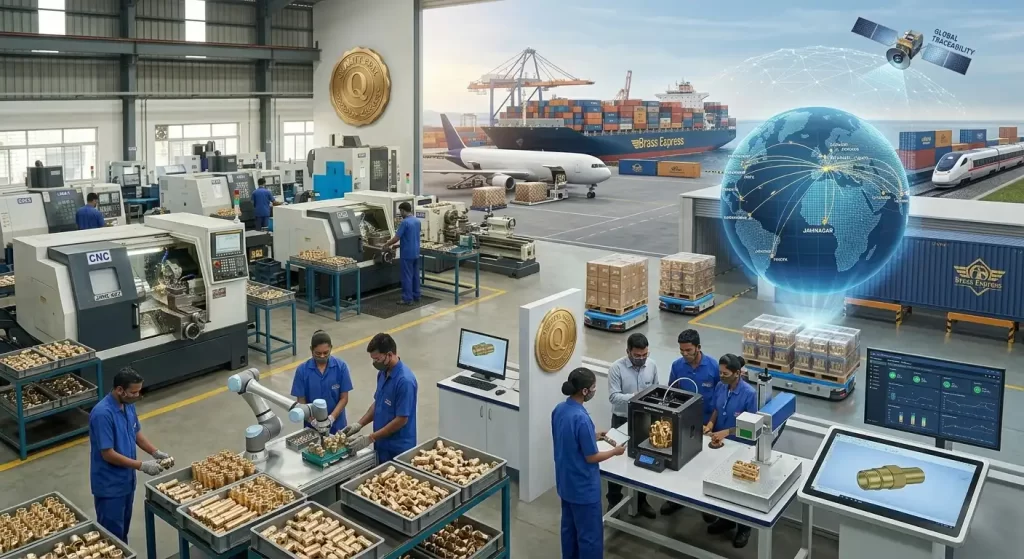
The story of Jamnagar brass parts is one of continuous evolution — from humble workshop origins to a sophisticated global manufacturing hub that serves Fortune 500 companies and specialized niche buyers alike. Today, when engineers at a US HVAC manufacturer specify brass compression fittings, or when a German automotive supplier needs precision-turned sensor housings, Jamnagar manufacturers are increasingly their first call.
This article explores how Jamnagar’s brass parts industry maintains its competitive edge through quality investment, technological innovation, and supply chain optimization.
What Defines a World-Class Brass Manufacturer?
Two decades ago, inconsistent quality was Jamnagar’s primary challenge. Today, leading manufacturers operate quality systems that rival the best in Europe and North America. This transformation was driven by demanding export customers who required ISO certification, documented inspection processes, and material traceability as prerequisites for doing business.
Modern Jamnagar facilities maintain spectrometer testing for alloy verification, CNC-controlled machining for dimensional consistency, automated vision inspection for high-volume parts, and statistical process control for production monitoring. These capabilities ensure that parts shipped from Jamnagar meet the same specifications whether they are destined for a plumbing distributor in Texas or an electronics assembler in Stuttgart.
Technological Innovation
Advanced CNC Technology
Leading manufacturers have invested in multi-axis CNC turning centers from Mazak, DMG Mori, and Citizen that combine turning, milling, drilling, and threading in single setups. This technology reduces cycle times, improves accuracy, and enables complex geometries previously impossible to produce economically.
In-House Extrusion Development
Modern CNC turning centers with sub-spindle, live tooling, and bar feeding systems produce complex multi-feature parts in single setups. Leading facilities operate 20 or more CNC machines running three shifts to meet high-volume demand.
Digital Manufacturing
ERP systems, machine monitoring dashboards, and digital quality records are becoming standard among export-oriented Jamnagar manufacturers. These tools improve production planning, reduce waste, and provide customers with real-time order status visibility.
Supply Chain Strengths
- Raw Material Proximity : Scrap dealers, foundries, and extrusion plants within the same industrial zone minimize material lead times.
- Multi-Source Capacity : Multiple competing manufacturers ensure supply continuity and competitive pricing.
- Flexible Volume : From 500-piece prototypes to million-piece production runs within the same cluster.
- Port Access : : Two major ports within 90-180 km enable competitive ocean freight rates.
- Export Documentation Expertise : Established processes for invoicing, certificates of origin, and material test reports.
Industry Applications Served
Jamnagar brass parts serve electrical distribution, plumbing infrastructure, HVAC systems, automotive manufacturing, telecommunications, oil and gas, renewable energy, aerospace, defense, medical devices, and consumer electronics. This breadth means that specialized expertise exists for virtually any application requirement within the cluster.
Future Outlook
Growth drivers for Jamnagar brass parts include global infrastructure expansion, EV charging station deployment, 5G network rollout, smart building technologies, and increased automation in water management systems. The industry’s ongoing investment in CNC technology, quality systems, and workforce development positions it well to capture this growth.