
⚡ Quick Answer
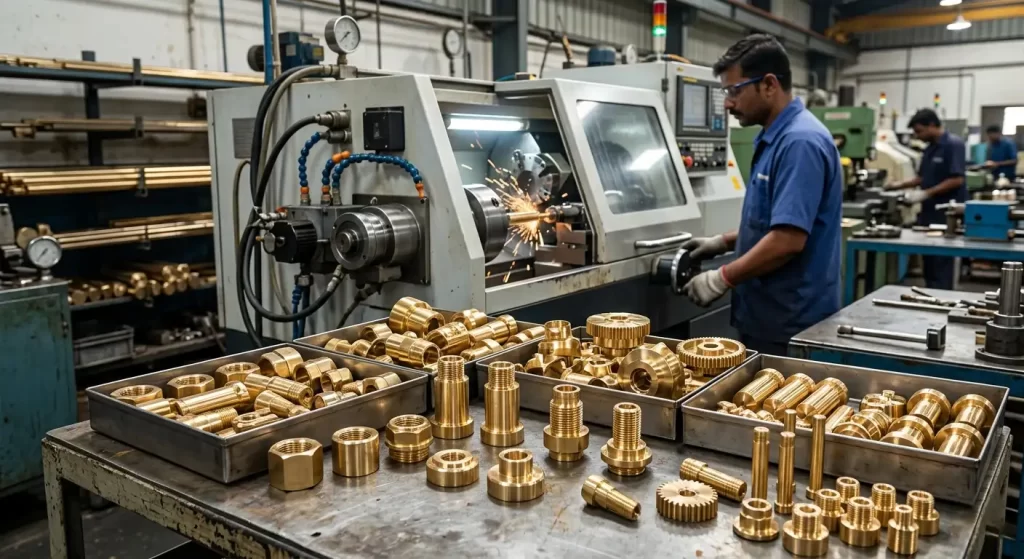
Brass turned parts are precision components machined on CNC lathes from free-cutting brass rod (C36000). They include pins, bushes, connectors, fittings, studs, and custom shapes — achieving tolerances to ±0.01mm. Jamnagar, India is the world’s largest sourcing hub for brass turned parts, with 5,000+ manufacturers, globally competitive pricing, and complete supply chain from casting through CNC finishing.
Brass turned parts are the backbone of precision manufacturing. From the tiny pin inside an electrical plug to the threaded fitting in an industrial valve, turned components are found in virtually every mechanical and electrical assembly. The global brass turned parts market runs into billions of dollars — and the majority of these parts originate from one place: Jamnagar, India.
This guide covers everything about brass turned parts: what they are, how they’re made, achievable tolerances, the machines used, industrial applications, and why Jamnagar is the go-to sourcing destination for buyers worldwide.
1. What Are Brass Turned Parts?
Brass turned parts are components manufactured by a subtractive process called turning — where brass rod stock is rotated at high speed while a cutting tool removes material to create the desired shape. The term “turned parts” covers any component produced primarily on a lathe, whether CNC or conventional.
The process can produce cylindrical shapes with features including external diameters, internal bores, threads (internal and external), knurling, grooves, chamfers, shoulders, cross-drilled holes, and tapers — all in a single setup on modern CNC machines.
2. Why Brass Dominates CNC Turning
C36000 free-cutting brass holds a machinability rating of 100 — the global benchmark against which all other metals are measured. This isn’t arbitrary; it reflects measurable manufacturing advantages:
- Cutting speeds of 90–180 m/min — 2–3x faster than stainless steel, 3–5x faster than copper.
- Short, clean chip formation — lead particles break chips into small pieces that clear easily, preventing machine jams.
- Excellent surface finish off the tool — Ra 0.4–0.8µm achievable without secondary polishing.
- 3–5x longer tool life compared to steel or copper — reducing tooling cost per part significantly.
- High dimensional stability — brass maintains tight tolerances across production runs without thermal drift issues.
The net result: brass turned parts cost 30–50% less to manufacture than equivalent parts in stainless steel, with better surface finish and tighter tolerances. This economic advantage is why brass dominates the global precision turned components market.
3. Common Types of Brass Turned Parts
| Component | Description | Industry |
|---|---|---|
| Pins | Plug pins, dowel pins, contact pins, guide pins | Electrical, electronics |
| Bushes & Sleeves | Cylindrical spacers, bearing bushes, adapter sleeves | Mechanical, automotive |
| Studs & Standoffs | Threaded studs, PCB standoffs, mounting posts | Electronics, telecom |
| Connectors | Pipe connectors, hose barbs, adapter fittings | Plumbing, hydraulics |
| Nipples & Adapters | Threaded pipe nipples, reducing adapters | Plumbing, gas |
| Nuts & Bolts | Hex nuts, cap nuts, special bolts | Construction, marine |
| Valve Stems | Control valve stems, spindles | Industrial, plumbing |
| Inserts | Threaded inserts for plastic (knurled OD) | Pipe fittings, molding |
| Cable Gland Bodies | Threaded gland bodies with IP-rated features | Electrical |
| Custom Parts | Any geometry per customer drawing/sample | All industries |
4. Machines Used for Brass Turning
Single-Spindle CNC Lathes
The workhorse of brass turning. Suitable for low-to-medium volumes and parts requiring multiple operations. Modern CNC lathes with live tooling can perform turning, drilling, tapping, and milling in a single setup.
Multi-Spindle Automatic Lathes
Designed for high-volume production. 4, 6, or 8 spindles work simultaneously — each performing a different operation on a different part. One complete cycle produces multiple finished parts. Ideal for simple-to-medium complexity Jamnagar brass parts produced in quantities of 50,000+.
Swiss-Type CNC Lathes
Specialized for small-diameter (typically under 25mm), long, or complex parts. The sliding headstock design provides exceptional rigidity and precision for slender parts that would deflect on conventional lathes. Tolerances to ±0.005mm are achievable. Common for medical, electronic, and telecom components.
Conventional Traub-Type Automats
Cam-operated automatic lathes widely used in Jamnagar for high-volume production of simpler parts (pins, studs, spacers). While less flexible than CNC, they offer very low per-part cost for standardized components.
| Machine Type | Best For | Typical Tolerance | Volume Sweet Spot |
|---|---|---|---|
| CNC Lathe (single) | Complex parts, prototypes | ±0.01–0.025mm | 100–50,000 pcs |
| Multi-Spindle | High-volume simple/medium parts | ±0.025–0.05mm | 50,000+ pcs |
| Swiss-Type CNC | Small, long, precision parts | ±0.005–0.01mm | 1,000–100,000 pcs |
| Traub Automat | Simple high-volume parts | ±0.05mm | 100,000+ pcs |
5. The CNC Turning Process: Step by Step
- Material Selection : Brass rod in the required diameter and alloy grade (typically C36000) is loaded into the bar feeder.
- Program Setup : The CNC program (G-code) is loaded, defining all tool paths, speeds, feeds, and sequences.
- Rough Turning : The first pass removes bulk material, bringing the part close to final dimensions (within 0.1–0.3mm).
- Finish Turning : Lighter cuts bring dimensions to final tolerance with the required surface finish.
- Secondary Operations : Threading, knurling, grooving, drilling, boring, and cross-hole drilling are performed — often in the same setup on modern CNC machines.
- Part-Off : The finished part is cut free from the bar stock.
- Deburring : Tumbling or manual deburring removes any sharp edges.
- Inspection : Dimensional verification using digital calipers, micrometers, and go/no-go gauges.
A well-optimized CNC turning operation on brass produces 200–1,000+ parts per hour depending on part complexity. Multi-spindle machines multiply this further — a 6-spindle automat producing 6 parts per cycle at 15 seconds/cycle achieves 1,440 parts per hour.
6. Tolerances & Surface Finish
| Parameter | Standard | Precision | Ultra-Precision |
|---|---|---|---|
| Dimensional Tolerance | ±0.025mm (±0.001″) | ±0.01mm (±0.0004″) | ±0.005mm (±0.0002″) |
| Roundness | 0.02mm | 0.01mm | 0.005mm |
| Surface Finish (Ra) | 1.6µm | 0.8µm | 0.4µm |
| Thread Class | 6g/6H (ISO) | 4g/4H (ISO) | Per specification |
| Typical Machine | Multi-spindle, automat | CNC lathe | Swiss-type CNC |
Brass’s excellent dimensional stability means tight tolerances are maintained consistently across long production runs — unlike some materials that shift with heat buildup during machining.
7. Industrial Applications of Brass Turned Parts
- Electrical & Electronics : Plug pins, socket contacts, terminal studs, PCB standoffs, connector bodies, switch parts.
- Plumbing & HVAC : Pipe fittings, nipples, adapters, valve components, compression fittings, hose connectors.
- Automotive : Fuel fittings, sensor housings, battery terminals, brake connectors, radiator components.
- Gas Systems (LPG/CNG) : Regulator parts, flare fittings, connector bodies, safety valve components.
- Telecommunications : Coaxial connector bodies, shielding components, grounding hardware, antenna parts.
- Construction : Anchors, fasteners, door hardware components, lock cylinders, hinge pins.
- Medical : Instrument components, equipment fasteners, sterilization-compatible fittings.
- Renewable Energy : Solar panel terminals, inverter connectors, battery bank hardware.
8. Why Source Brass Turned Parts from Jamnagar?
Jamnagar is the world capital of brass turned parts production. The city’s 5,000+ brass manufacturers collectively operate thousands of CNC machines, multi-spindle automats, and Swiss-type lathes — creating an unparalleled concentration of brass turning capability.
Cost Advantage
Jamnagar brass parts are typically 15–30% cheaper than equivalent parts from China, and 40–60% cheaper than European or US-manufactured components. This is driven by the ecosystem’s efficiency — abundant skilled labor, concentrated supply chain, and competitive raw material access.
Integrated Supply Chain
The best Jamnagar manufacturers control the entire chain: casting the alloy, extruding the rod, and CNC machining the final part. Anand Brass Components exemplifies this — their facility handles casting, extrusion (2 tons/day, 2–50mm diameter), forging, and CNC machining, all within a 15,000 sq ft integrated plant.
Customization
Jamnagar manufacturers excel at producing custom brass turned parts to client drawings. Whether it’s a non-standard thread, unusual profile, or custom alloy composition, the city’s manufacturers have seen it all and can deliver. Explore Anand Brass’s range of brass turned parts and CNC & auto parts for examples.
Export Readiness
Leading Jamnagar brass parts manufacturers have decades of export experience — handling documentation, international packaging standards, quality certifications, and shipping logistics to 100+ countries. Proximity to Mundra and Kandla ports ensures efficient freight routing.
Anand Brass Components produces brass turned parts from 2mm to 50mm diameter across 16 product categories — from standard fasteners and hose fittings to complex custom CNC components. With in-house extrusion providing consistent rod stock and 25+ machines, they serve 550+ clients worldwide with precision brass parts from Jamnagar.
9. How to Specify Brass Turned Parts
When requesting quotes for brass turned parts, include these specifications for accurate pricing and production:
- Technical Drawing (PDF/DWG/STEP) : All dimensions, tolerances, thread specifications, and surface finish requirements.
- Material Grade : C36000 (standard), C26000 (for spring properties), C69300 (lead-free), or custom composition.
- Quantity & Schedule : Annual volume, batch sizes, and delivery frequency..
- Surface Finish : As-machined, polished, nickel plated, chrome plated, or passivated.
- Thread Standard : BSP, NPT, metric ISO, UNC/UNF — including class/tolerance.
- Quality Requirements : Material test certificate, dimensional report, PPAP level (if applicable).
- Packaging : Bulk, counted bags, individual wrapping, or custom packaging.
🎯 Key Takeaways
- Brass (C36000) is the #1 material for turned parts — machinability 100, fastest production speeds, lowest per-part cost.
- CNC, multi-spindle, and Swiss-type machines each serve different volume and precision needs — match the machine to your requirements.
- Tolerances to ±0.005mm are achievable on Swiss-type CNC — more than adequate for virtually any precision application.
- Jamnagar is the global sourcing hub — 5,000+ manufacturers, 15–30% cost advantage, integrated supply chains, and proven export capability.
- Integrated manufacturers offer the best value — alloy control from casting through CNC ensures consistent quality that rod-buyers cannot match.
- Specify completely — drawing, material grade, finish, threading, quality docs, and packaging for accurate quotes.
Frequently Asked Questions
Need Precision Brass Turned Parts?
Anand Brass Components — CNC turning from 2mm to 50mm, in-house extrusion for consistent rod stock, 30+ years in Jamnagar.
References
- Copper Development Association — Machining Brass Guide — copper.org
- ASTM B16 — Free-Cutting Brass Rod, Bar, and Shapes — astm.org
- ISO 286 — Geometrical Product Specifications — Tolerances — iso.org